


 Expert Logo PNG
The Expert logo shows that the company specializes in customer service and assistance. The emblem unifies disparate stores. Each presents goods under different brands but is equally useful to customers.
The company “Expert” began in postwar Europe, when TVs, radios, and home appliances were moving into everyday retail. Independent electronics dealers faced the same problem across the region: on their own, they had little buying power against larger chains.
On October 16, 1967, Intercop GmbH was registered in Zurich, Switzerland. Swedish entrepreneur Gunnar Nygren, representing Samex, the Swedish association of radio and TV retailers, led the initiative. Five other national retail groups joined him. The model was based on joint purchasing, while stores kept their own names and local control.
On March 30, 1971, the company became Expert International GmbH, and the Expert trademark was internationally registered. The network expanded across Europe, and its headquarters later moved from Zurich to Zug. In Germany, Expert SE in Langenhagen became a major national player and grew into the country’s second-largest electronics retailer after MediaMarkt Saturn.
In 1999, Expert tried to expand through Expert Global with Associated Volume Buyers Inc. in the U.S. and Cantrex in Canada, though the alliance later ended. In 2001, Betta Stores from Australia and New Zealand joined. In 2007, Expert strengthened its Nordic business by acquiring Finland’s Konepiste, while Expert AB operated 222 stores in Sweden. That Swedish unit went bankrupt on September 18, 2012. By 2019, Expert International still united retail groups across Europe and South Africa, facing pressure from MediaMarkt and Euronics, and had a purchasing turnover of over €15 billion.
Meaning and History
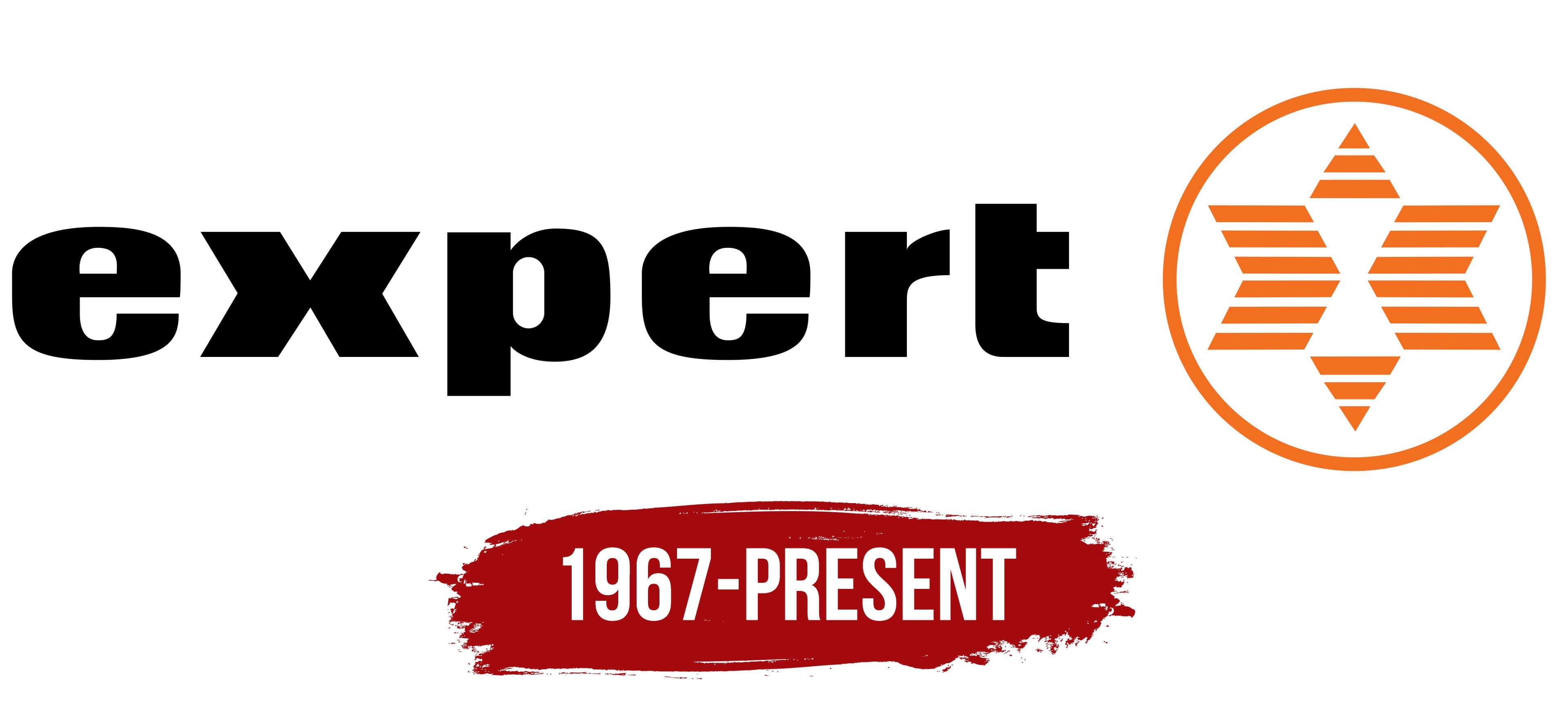
The Expert brand emerged from Intercop GmbH in 1967. Entrepreneur Gunnar Nygren founded it on behalf of the Samex association, which included television and radio service providers. Later, other organizations joined the group. In 1971, it was renamed, which prompted a change to its logo.
As a result of the rebranding, a new Expert symbol appeared, featuring the brand name and an icon of a striped six-pointed star with a white hourglass in negative space. The black wordmark seems as simple as possible: at first glance, it consists of unremarkable bold sans-serif letters. But on closer inspection, you notice that some glyphs have an unusual shape. First, the lowercase “,” looks like two angle brackets pointing in different directions. They look like a modified fast-forward icon, usually used for video or audio playback.
What is Expert?
The Expert retail chain sells electronic equipment for everyday use. It is headquartered in Switzerland and has stores worldwide. It received its current name in 1971. Before that, the company was known as Intercop GmbH.

To the right of the inscription is a white-orange emblem: a striped six-pointed star in a white circle with an orange outline. This is not just an abstract symbol but a stylized “x.” Parts of the letter appear in two angle-bracket shapes. They are distant but connected by two small triangles (one at the top and one at the bottom). The empty white space formed by the geometric shapes resembles an hourglass.
Together, the fragments form a six-pointed star, which is no coincidence. The hexagram has many meanings in cultural, religious, and historical contexts. It is considered a sign of harmony between the spiritual and the material, of the connection between the two principles. It is also an ancient symbol to which mystical properties have been attributed throughout all eras.
Font and Colors

The brand name is written in bold sans-serif type. The lines are uneven in thickness: the main strokes are much wider than the secondary ones. Moreover, the word is written entirely in lowercase. This subtle psychological trick builds consumer confidence.
Most likely, the designers developed a set of individual glyphs for the Expert International logo to achieve the necessary shape. This is evident in the unusual appearance of the letter “x,” which was adapted to the brand concept. However, similar typefaces include Balboa Extra Black by Parkinson Type Design and Ultimate Serial Heavy by SoftMaker. Almost 100% of the lowercase “e” is in Quilon Bold from the Indian Type Foundry.
The black inscription is contrasted with an orange icon. To keep it from being too bright and drawing too much attention, the designers diluted the orange with white accents.