


 GameStop Logo PNG
The GameStop logo contrasts real life with the gaming world. The emblem represents the transition from fantasy to reality, reflecting the company’s belief that games are meant to be experienced and enjoyed as part of life.
GameStop’s origins trace back to the mid-1970s, when James McCurry and Gary Kusin met at Harvard Business School. After graduation, McCurry joined Bain & Company, while Kusin worked in retail at Sanger-Harris. In 1982, they reunited to build a chain focused on software and video games.
With early funding from Ross Perot, the first store opened on Memorial Day 1983 at Dallas NorthPark Center as Babbage’s, after Charles Babbage. Initial operations were small, and the founders managed the store themselves. By late 1983, the network reached five locations.
The assortment shifted with market demand. Atari 2600 drove early sales, but in 1987, Babbage’s added Nintendo products, which accelerated growth. The company went public in 1988 at $13 per share. By 1991, video games generated two-thirds of revenue, reaching $168.3 million.
In 1994, Babbage’s merged with Software Etc., a chain linked to B. Dalton, forming NeoStar Retail Group. Financial pressure led to bankruptcy in 1995. In 1996, Leonard Riggio acquired assets from Barnes & Noble.
In 1999, a new retail format launched under the GameStop name alongside an online store. Barnes & Noble acquired the business for $215 million and added “Funco” and Game Informer. By 2000, the company adopted the GameStop name, went public in 2002, and acquired Electronics Boutique for $1.44 billion in 2005.
In January 2021, GameStop shares surged after retail investors on Reddit coordinated a buying effort. The price jumped from $17.25 to above $500. The company issued new shares, eliminated long-term debt, and raised capital. Ryan Cohen later took a leading role in governance.
Meaning and History
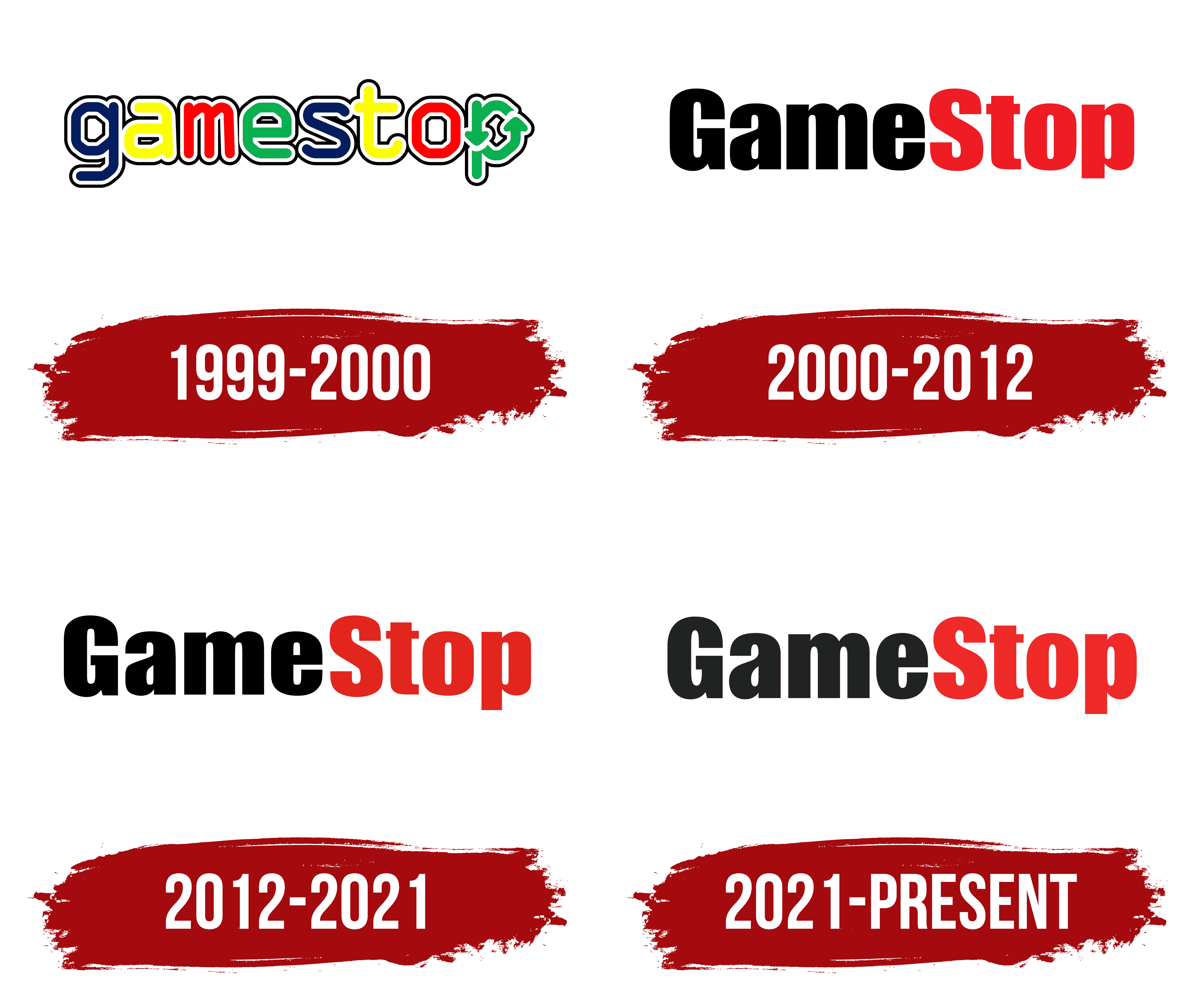
Babbage, a Dallas software company, started GameStop. Its founders were two Harvard Business School graduates: classmates Gary Kusin and James McCurry. They named their company after the scientist who developed the idea of a programmable digital computer, Charles Babbage. It received its current name in 1999.
The new name carries a shock factor that initially attracted many buyers. It seems to say, “Stop playing, start playing for real!” The rebranding gradually became a redesign because management wanted to use a modernized logo and name. Because the name conveys the brand’s main meaning, they decided not to add graphics. The text plays its role. The developers combined two words to emphasize the concept and colored them differently. Today, there are four emblems.
What is GameStop?
GameStop is the largest video game retailer. It was founded in 1984 as Babbage’s and only received its current name in 2000. The company is headquartered in the United States and operates more than 4,400 stores across Australia and Canada. Customers can buy games for Nintendo, PlayStation, or Xbox consoles, as well as the consoles themselves. Barnes & Noble owned the brand until 2004.
1999 – 2000

The logo uses playful, attractive, bright colors. These include green, red, yellow, and blue. They are used in succession. To make the glyphs stand out more against a light background, the designers encircled them with a black line, leaving a small indent between the edge and the center. The result is another white frame. All characters are lowercase, and “p” is formed from two circular arrows. This style fits well with the game’s theme.
2000 – 2012

The transition to the 21st century was a turning point for the company and required a transformation. The cardinal decision led to a completely different logo concept that emphasizes “Game” and “Stop.” By combining the two foundations, leadership takes on the opposite meaning: it confuses, pushes to buy, and checks whether that is so. As a result, “Stop” (prohibition, stopping) sparked increased interest. At the same time, the emblem is simple: a horizontal inscription in black and red, two “fatal” colors.
2012 – 2021

In this version, the developers kept the previous logo design as much as possible, making only a few color tweaks. They removed the excessive color saturation and made the inscriptions black (“Game”) and dusty red (“Stop”).
2021 – today

The modern logo has changed not only the color but also the typography. Now, black was replaced with dark gray and red with muted burgundy. In addition, the designers changed the font in the second part of the name: the “S” and “o” now have smooth transitions and rounding, while the “t” has a shorter lower segment.
Font and Colors
This logo has no graphic element; the informational inscription is paramount. Both variants include text that highlights the main product range. Before, the word was “classic”; now it looks “original”. Two factors made this possible. First, the uppercase “G” and “S” at the beginning and end of the name. The second is a two-tone palette. It very well conveys a person’s emotional intensity and reflects the extremes, all-or-nothing, as is customary in the world of games.
For the word “GameStop,” the developers chose the Impact typeface. Massive and wide letters look indestructible. The “P” has a shortened leg, while the “m” and “t,” by contrast, are elongated. Although the two stems are fused, their borders are highlighted in capital letters and color. The left side of the name is colored black, and the right side is red. They symbolize the peak of emotional stress. The inscription was set in a thin font with white characters in the debut version, so it almost went unnoticed.