 Good Morning America Logo PNG
The Good Morning America logo is bright and attractive, helping it attract viewers and maintain their attention. The emblem signifies the show’s popularity and morning format.
Good Morning America debuted on ABC on November 3, 1975, as the network’s attempt to enter the profitable U.S. morning television market dominated by NBC’s Today show. Airing from 7 to 9 a.m. across American time zones, the program mixed news, weather, interviews, celebrity segments, lifestyle reports, and live features from different locations.
Nancy Dussault and David Hartman were the first hosts. Hartman, a former actor, gave the broadcast an accessible tone, while Dussault brought journalistic experience. The format closely followed NBC’s model but with a lighter presentation. Growth was slow, yet by the late 1970s GMA had become a real competitor. In 1980, Joan Lunden replaced Dussault, and her partnership with Hartman helped ABC pass NBC in the ratings in 1986.
After Hartman left in 1987, Charles Gibson joined Lunden and kept the show strong into the early 1990s. The mid-1990s were weaker, as NBC regained momentum and ABC tested new hosts and formats. Lisa McRee replaced Lunden in 1997, but the program recovered in the early 2000s when Gibson returned and worked with Diane Sawyer during major events, including the 2000 U.S. election and the September 11, 2001, attacks.
Robin Roberts became co-host in 2005, adding new momentum to the broadcast. Diane Sawyer left in 2009 for ABC Evening News, and George Stephanopoulos joined Roberts. In April 2012, GMA led the weekly ratings for the first time in 16 years. ABC later expanded the brand through GMA Day, Strahan, Sara, and Keke, and GMA3: What You Need to Know, launched in 2018. By 2022, the program marked its 47th year on air.
Meaning and History
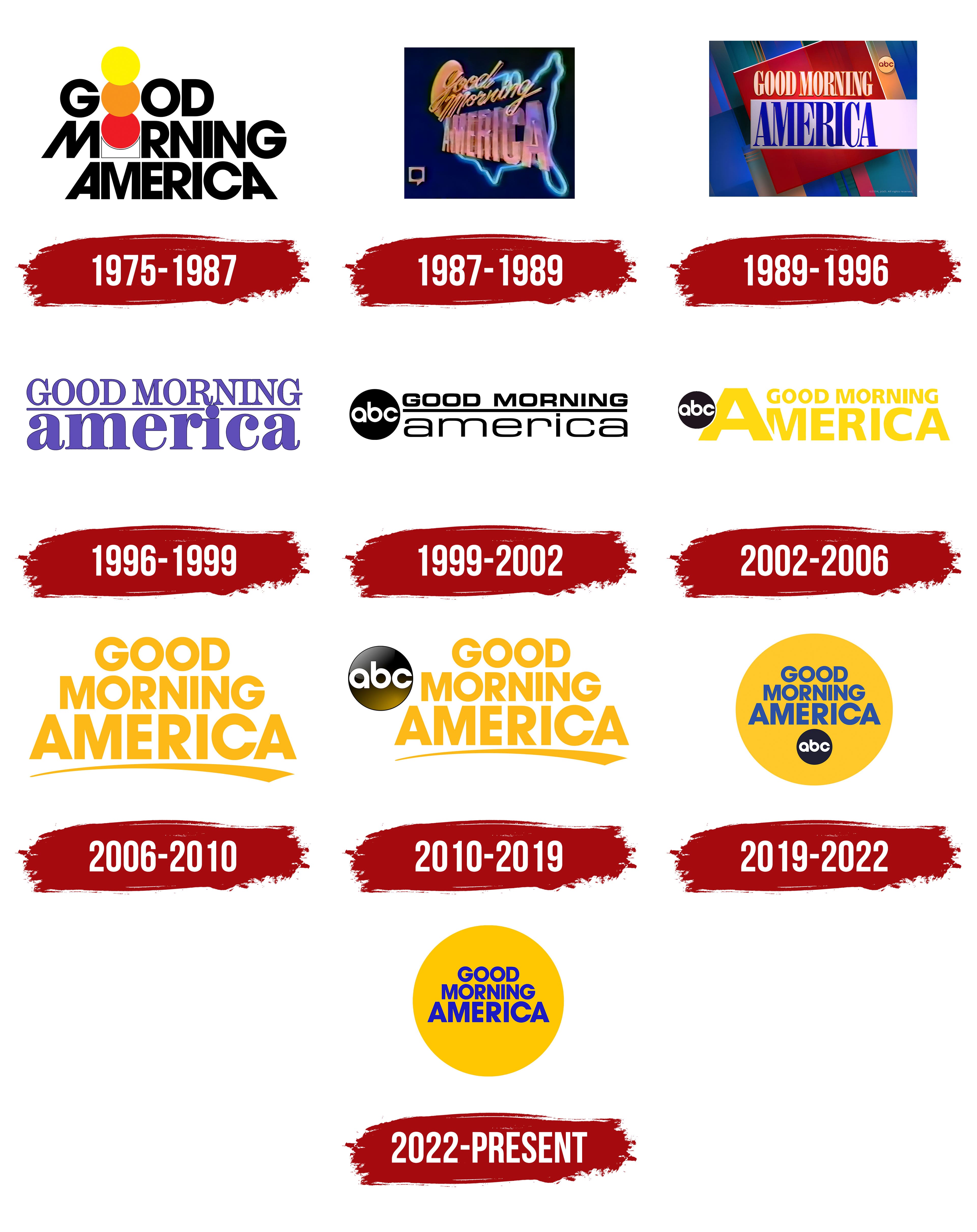
The logo of America’s most energetic and joyful show is based on the rising-sun theme. This theme is expressed through color or shape in all its logos, but most prominently in the first and last emblems.
What is Good Morning America?
A daily morning program of ABC, owned by Disney Entertainment, airing since 1975 from 7 to 9 AM on weekdays and from 7 to 8 AM on weekends across the U.S. It mainly covers political and cultural news, sensational stories, weather forecasts, and special sections. Since 2012, it has been considered the most-watched show.
1975 – 1987
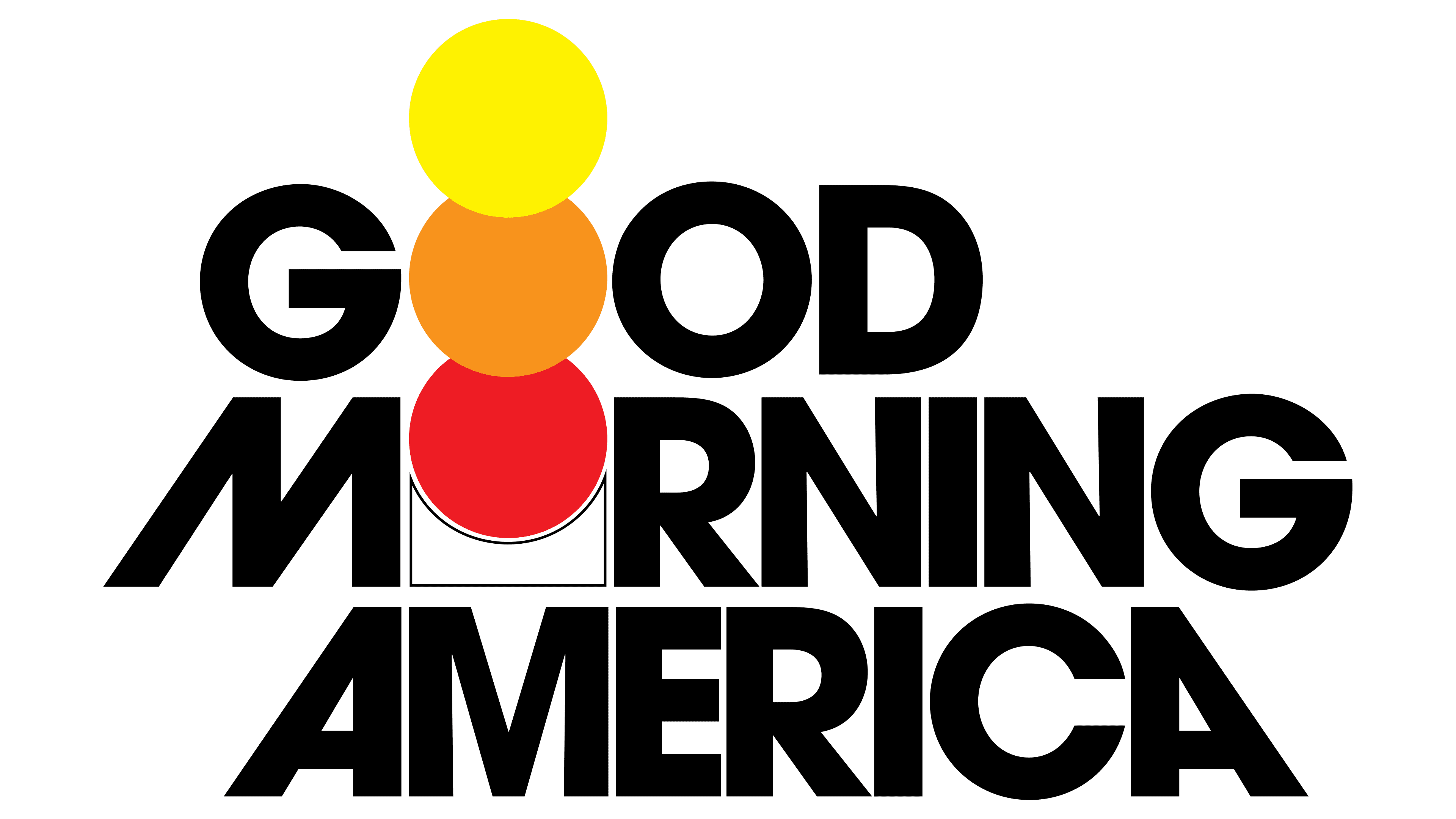
The first symbol of the TV program consists of a three-level inscription. Each word of the name forms a separate line. The arrangement creates a mountain-like structure.
Interestingly, the name was plagiarized. Originally, ABC launched the show AM America, but it was unpopular. Looking for another format, they considered the Boston company’s option. Good Morning! Eventually, the revamped show was named Good Morning America, leading to legal proceedings that Boston’s WCVB-TV lost.
The two O’s in Good and Morning are stylized as a gradually rising sun, depicted as a third circle above. The smooth change in color and position, like in frame-by-frame shooting, shows the sun rising from the horizon from 7 to 9 a.m.
The symbol looks compact and brilliantly plays on the theme of awakening.
1987 – 1989

In 1987, the main host, Hartman, retired, and a new successful duo of anchors was formed. The emblem was updated to match the new style.
The symbol took the shape of America’s contours, which seemed to slowly unfold for the viewer, as if rotating with the globe. The map’s half-turn placement conveyed the theme of morning and the rising sun. The sun itself was partially visible in the upper left corner.
The program name was executed in two fonts. “Good Morning” appeared in small uppercase letters, echoing the sun’s color and starting right from its image. The word “America” appeared massive and voluminous in the middle of the country’s contour.
The emblem seemed disharmonious because of the many techniques and colors used, which likely helped it be quickly replaced.
1989 – 1996
From 1989, the program’s logo consisted of a simple two-level inscription with elongated letters, as if reaching for the sun. Meanwhile, the word “America” continued to stand out in size, indicating its broad reach across the country.
1996 – 1999
In 1995, the program lost its leading position to its competitor, Today. Efforts to change the situation led to several innovations, including the departure of host Joan Lunden, who had held the position for 17 years, and a branding update.
The new symbol also consisted of the name. However, its letters became rounder, and a horizontal line separated the words “Good Morning” and “America”. Lowercase letters in America made the inscription less formal but still stood out in size. This choice showed the program was now more focused on the interests of the country’s residents and entertainment topics than on political and state issues.
1999 – 2002
In 1998, Lunden’s partner, Charles Gibson, left the program, and its rating dropped further, bringing it to third place nationally. Therefore, the channel invited a new producer, who brought back Gibson and paired him with Diane Sawyer, creating one of Good Morning America’s successful and long-lasting duos.
The refreshed program identity also changed. The modern and dynamic black inscription looked like a running line. Its clarity and structure conveyed professionalism and order.
For the first time, the emblem’s general layout included the ABC channel logo, a black sphere with a white inscription. Adding weight to the logo made it part of a larger family, helping attract more viewers to the morning show.
2002 – 2006
The Good Morning America logo, updated in 2002, carries special significance and looks bright and energetic, perfectly capturing the spirit of a morning show. The dominant yellow color symbolizes morning, sunshine, and energy. This sunny hue practically shouts “Good Morning!” and radiates positivity, making it ideal for a program that starts the viewer’s day on a positive note.
The key element in this logo is the massive, capital letter “A” in the word “AMERICA.” It emphasizes the show’s importance and status in morning television. The “A” serves as a visual anchor, representing the program’s leadership and significance over the years. In this sense, the logo reflects the show’s return to high ratings when the redesigned look was introduced.
The font is bold, large, and straightforward. This typeface choice underscores the confidence and stability of a brand that has been on the air for years and has earned the trust of a large audience. There are no unnecessary details; everything is simple and direct, showing that the program isn’t about theatrics but delivers what’s important and interesting.
Another detail is the ABC logo, placed next to the show’s name. This element enhances brand recognition, as Good Morning America is part of a larger television family. The black circle with white “abc” letters creates a striking contrast with the yellow text, and this contrast works effectively, making the overall design cohesive without overwhelming it.
At this time, the show was changing, aiming to regain its former popularity and leadership among morning shows. The return to the bright yellow color and the emphasis on the capital “A” symbolized the morning spirit and the show’s resurgence in the ratings. The logo became a statement: the show was back on top.
2006 – 2010

As it approached its thirtieth anniversary, the show expanded. It added a third host and even planned an additional third hour on weekdays, which debuted in 2007. The new logo underscored the project’s grandeur and scope.
The three-level yellow inscription, without the ABC logo, showcased the program’s growth and expansion. The number three symbolically refers to the three hosts. The lower arc-shaped underline created a sensation that the inscription was rising above the horizon, like the morning sun.
2010 – 2019

In 2009, the program returned to its roots, bringing back the old studio look and two hosts: a man and a woman. This choice had little impact on the logo. The broadcasting company’s emblem was added to the previous inscription, with a black satellite leading it.
2019 – 2022
In 2019, the show completely changed its visual style, returning to the Sun theme in the logo. The round background speaks of harmony and perfection. The producers selected an excellent team of hosts, and important news and entertainment materials were seamlessly integrated into the broadcast.
2022 – today
The modern Good Morning America logo radiates positivity. Simple and bright, it immediately evokes associations with a sunny morning and a good mood. The central element is a yellow circle that symbolizes the sun and sets the right tone. As the first symbol of a new day, the sun brings warmth and light, and the logo clearly conveys that the show greets viewers in the morning.
The text is in rich blue and centered in the circle. The color combination is intentional: the bright yellow and deep blue create a striking contrast that grabs attention. Yellow is associated with energy and joy, while blue represents confidence and calm. This balance captures the atmosphere of the morning show: lively, yet without unnecessary rush.
The font of “GOOD MORNING AMERICA” is bold and large, adding a sense of confidence and clarity to the logo. No embellishments or extra details emphasize simplicity and accessibility. Viewers perceive the show as something familiar and easy to connect with. The centered text appears embedded in the sun, reinforcing the idea that the show “shines” with the first light of a new day.
Notably, the modernized version of the logo removed the black ABC logo, making it lighter and more “airy.” This was a smart decision, as it made the logo look even brighter and fresher, perfectly matching the dynamic of a morning show.
When the show first aired, its goal was simple: to become part of viewers’ morning routine, offering news and interesting topics and starting the day with a smile. The logo fully reflects this concept. Its simple yet vibrant style has helped the show remain recognizable and beloved for decades.
Font and Colors
Yellow and blue naturally combine with the morning theme. Like an inseparable pair, the blue sky and yellow sun appear at sunrise.
- Yellow is welcoming and friendly. It creates a light, homely atmosphere in the studio.
- Blue represents the intertwining of important news and current topics within the entertainment canvas.
The inscription uses the confident, straightforward ITC Avant Garde Gothic Paneuropean Bold font.