


 Google Hangouts Logo PNG
Communication is the key to a messaging service’s visual identity. It is attractive because the Google Hangouts logo partly represents the identity of the main virtual giant’s digital family. The emblem contains classic messenger elements.
Google Hangouts grew out of Google’s long search for a unified messaging product. In 2005, the company launched Google Talk, an XMPP-based chat client for the browser and desktop. In 2011, Google+ added group video chats called Hangouts, allowing users to join or leave an open video call. At the same time, Google+ Messenger, first called Huddle, handled text conversations.
By 2012-2013, Google had too many overlapping communication tools: Google Talk, Google+ Messenger, Google+ Hangouts, and several Android SMS services. Using Meebo technology, Google built a unified product under the internal name Babel. On May 15, 2013, Google presented Hangouts at Google I/O as a standalone service for the web, Android, and iOS.
Hangouts replaced Google Talk, Google+ Messenger, and Google+ video chat. It supported text messages, voice calls, video calls with up to 25 people, and group chats with up to 150 contacts. At launch, it competed with Skype in video calling and WhatsApp in mobile messaging. Its browser-based HD video calls gave it a practical advantage for users who did not want a separate desktop client.
In 2014, Hangouts added SMS integration and deeper Google Voice support, combining internet chats and regular texts into a single interface. By 2015, it had passed 1 billion installs on Google Play. The decline began in 2016, when Google promoted Messenger, Allo, and Duo. In 2017, Hangouts split into Hangouts Chat and Hangouts Meet for G Suite, with the latter aimed partly at Slack. From 2020, users moved to Google Chat and Meet. Classic Hangouts fully shut down on November 1, 2022.
Meaning and History
To compete with platforms such as WhatsApp, Facebook Messenger, and iMessage, Google has created a product with similar capabilities called Hangouts. Google introduced it in 2013 at the Google I/O conference, and it initially combined several functions. It included chat, voice messaging, and real-time remote video meetings.
The impetus for the new product was a too-disparate set of applications for exchanging information: Google Talk (based on XMPP) and Google+ Messenger. Their merger produced Google Hangouts. Then the copyright holder experimented extensively, closing some projects and launching others, but still could not keep pace with the popularity of large competitors offering similar functions. Therefore, in 2017, Google split Hangouts into two parallel services: Meet (for video conferencing) and Chat (for instant text messaging). Their main user group was business customers.
In 2018, Google announced it would phase out classic Hangouts and permanently disable it throughout 2019. However, outraged users pushed back, delaying the service’s shutdown to 2020. But then the unpredictable coronavirus pandemic intervened, and the digital giant announced that the app would remain a consumer-grade product for users on standard accounts. In parallel, it shifted the audience to Meet and Chat, making it free for everyone.
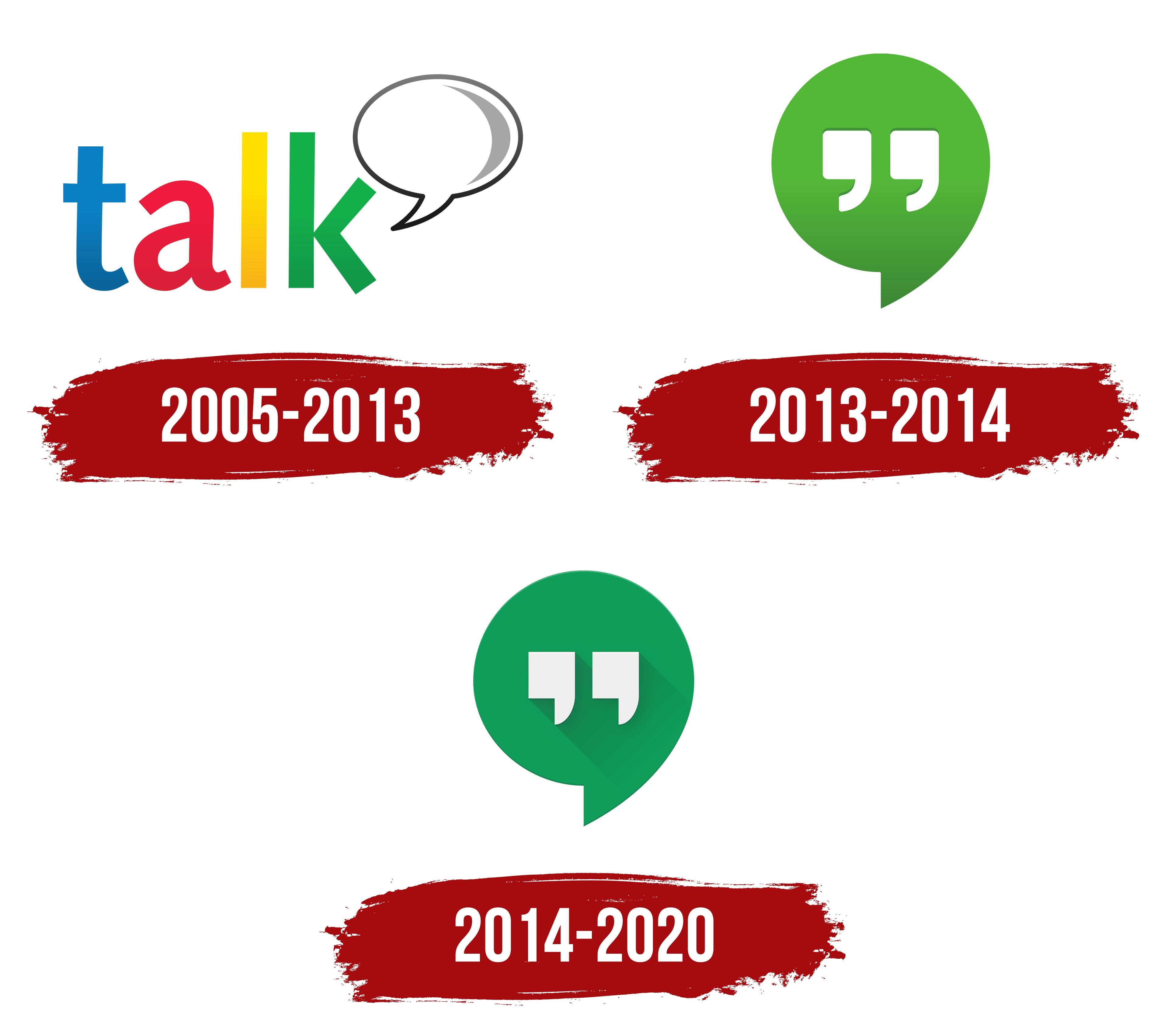
So this service will apparently be shut down soon as Google moves most users to its new services. Therefore, the issue of eliminating the program remains relevant. It can be closed at any moment, so the parent company cares little about the Hangouts identity and instead promotes Chat. In total, the service has five logos.
What is Google Hangouts?
Google Hangouts is a communication service for online text messaging and video meetings. It appeared in the Internet giant’s proprietary software package in 2013, based on Talk, and in 2017 it split into two independent projects: Meet and Chat. The first is for direct video conferencing; the second is instant text messaging. In 2020, Google initiated its liquidation, which is expected to be completed shortly.
2005 – 2013
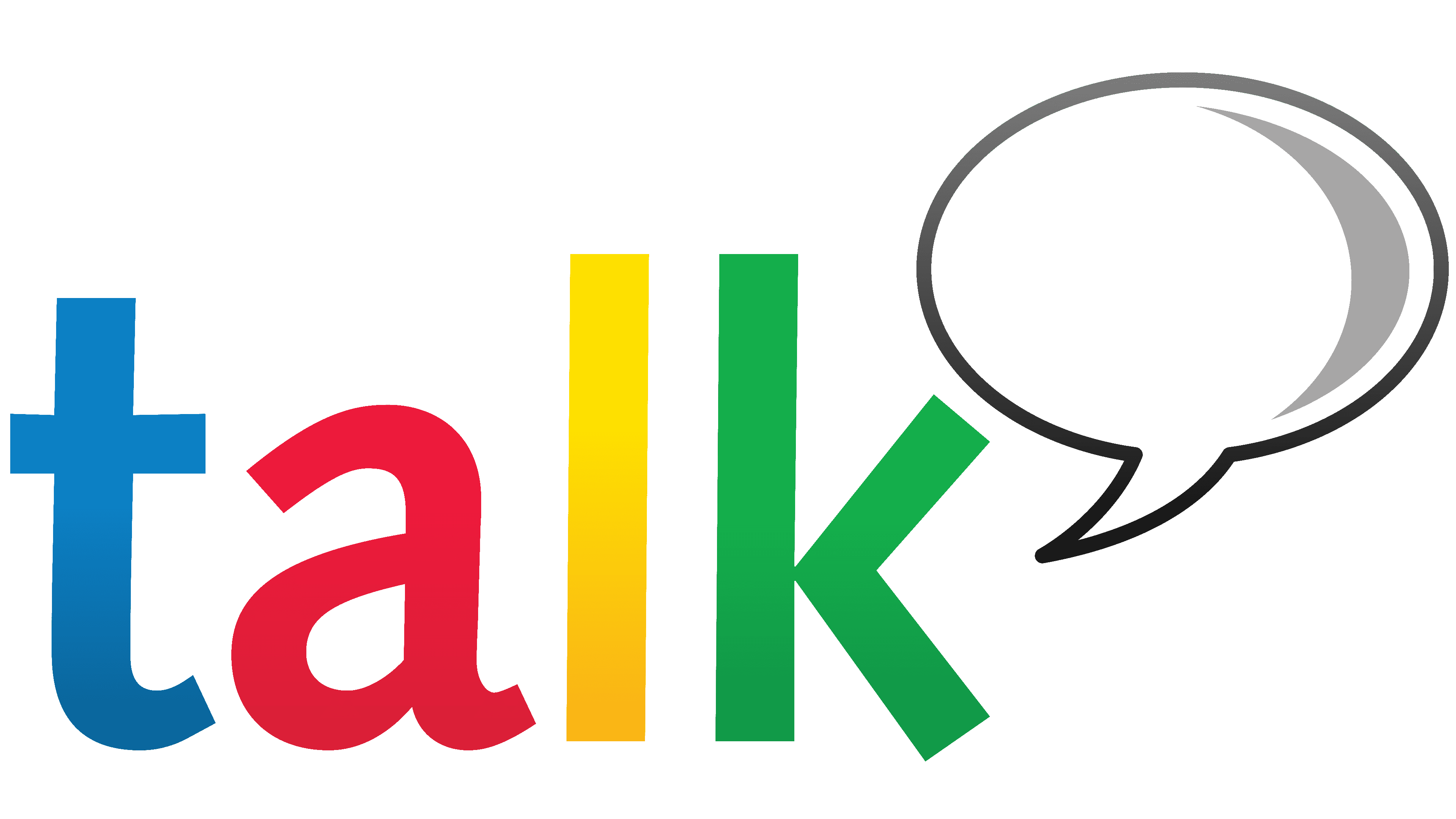
Since Talk became the foundation of Hangouts, it has used the same visual identity. It consists of a lowercase inscription composed of multi-colored letters: “t” is blue, “a” is red, “l” is yellow, and “k” is green. These are Google’s corporate colors, indicating that the application is part of an Internet company’s personal portfolio. The font was even and angular, without serifs. At the end of the word was a classic white, round dialog bubble with a bottom stroke. Inside, a gray crescent-shaped stripe set it off.
2013 – 2014
After merging several programs into Hangouts, Google completely overhauled its identity. The rebranding resulted in a new logo without text. A hint of its presence was the large quotation marks, two white commas. They were housed in a green gradient speech bubble.
2014 – 2020
The Hangouts platform logo was redesigned with the release of Android Lollipop. The developers left it as it was, focusing on color. They made the green more intense and added shadows to the quotation marks to give them a three-dimensional appearance. There were no other changes. After all, it was assumed that Google would stop developing this service in 2020 and finally eliminate it, having previously split it into two parallel streams: Meet and Chat.
Font and Colors
In the short time Google Hangouts has existed, its visual identity has constantly varied. This is because the parent company has opened, merged, or closed the project. All versions share one thing in common: simplicity. The emblem’s design is minimalist; it focuses only on thematic elements that hint at the web platform’s main direction.
The text is present only in the original version of the Talk service logo, the Hangouts prototype. The lettering uses the Struktur Pro Bold typeface from FontSite Inc. The base palette includes green, though the early logo also includes yellow, blue, and red. They are complemented by neutral white.