 Green Arrow Logo PNG
The Green Arrow logo directly points to the instrument of justice – the arrow. It is the superhero’s legendary attribute, aimed at establishing order in the world and punishing those who disturb it. The emblem’s palette connects it with the mysterious archer.
Green Arrow debuted on September 19, 1941, in More Fun Comics No. 73, the same issue that introduced Aquaman. The character was created by writer and editor Mort Weisinger with artist George Papp. Early ideas drew from Robin Hood, The Green Archer by Edgar Wallace, and visible parallels with Batman, including a wealthy hero, a young partner named Speedy, a cave base, special transport, and a clown-like villain called Bull’s Eye.
Green Arrow and Speedy soon became regular DC Comics figures. In 1941, they joined the Seven Soldiers of Victory, DC’s second superhero team after the Justice Society of America. When More Fun Comics ended in 1946, the character moved to Adventure Comics, where he appeared as backup material with Superboy until 1960.
A major change came in 1969 and 1970. Neal Adams redesigned Oliver Queen in The Brave and the Bold No. 85, adding the beard and a new costume. Dennis O’Neil then stripped him of his fortune in Justice League of America No. 75, turning him into a left-wing defender of the oppressed. Green Lantern/Green Arrow tackled racism, poverty, corruption, and drug addiction, including Speedy’s addiction story in issues No. 85 and 86.
In 1987, Mike Grell launched Green Arrow: The Longbow Hunters. This monthly series moved Oliver to Seattle and gave the stories a harsher urban tone. Oliver died in 1995, was replaced by Connor Hawke, and returned in Kevin Smith’s Quiver in 2001. In October 2012, The CW launched Arrow, starring Stephen Amell. The series ran for eight seasons until 2020 and led to the Arrowverse, including The Flash and Legends of Tomorrow.
Meaning and History
Mort Weisinger and George Papp developed Green Arrow to expand the DC Comics universe. He has several features not typically associated with superheroes:
- high social status (he is a wealthy businessman and owner of a company, in essence, an oppressor of people dependent on him);
- ancient weapon (a bow and arrows used in ancient times, not something fantastically modern and cool);
- the ability to appear in different images (he only occasionally dresses up as Robin Hood, a parallel initially traced).
The hero didn’t enjoy popularity for the first 25 years, so he was sometimes paired with another character. Despite the low fame, he still has his attributes – starting with motivation and ending with an emblem. It reflects his weapon of revenge – special arrows with various functions.
What is Green Arrow?
Green Arrow is the alias of a DC Comics superhero who is an archer and fights crime. According to the author’s idea, this is Oliver Jonas Queen, a wealthy businessman who stands up against injustice. His main weapon is a bow with several arrow types for use in special situations. They have the functions of a flashbang grenade, tear gas, a grappling hook, an explosive mechanism, and an adhesive tip. Mort Weisinger and George Papp created the character. His debut appearance took place in November 1941.
1941 – today
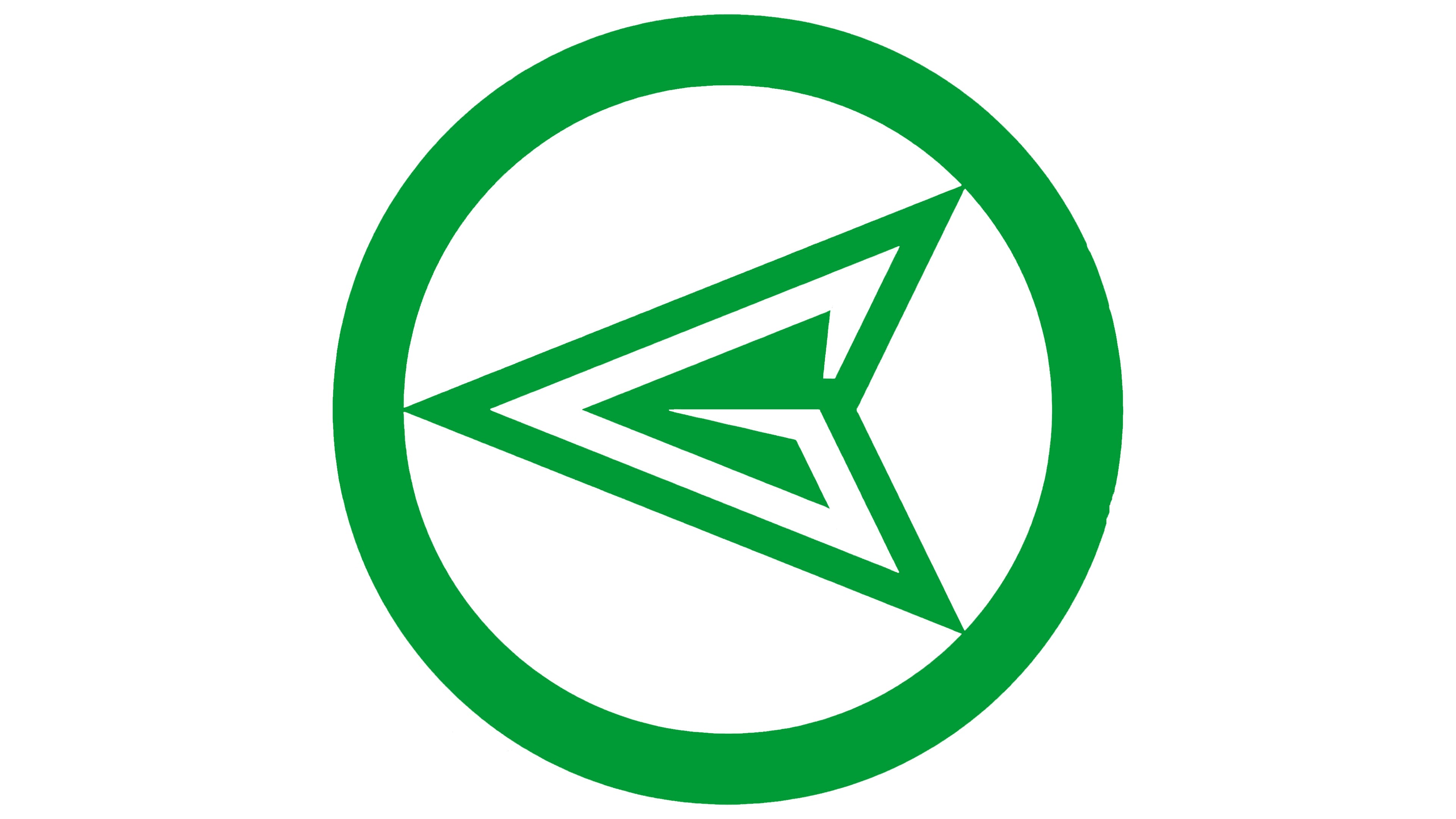
Despite its outward simplicity, the Green Arrow logo is multi-structured and conceptual. Using common graphic elements, it encapsulates the complex idea of opposition and struggle. Designers expressed this through straight lines, geometric shapes, and precise angles. They also utilized negative space by placing the superhero’s sign in it.
A wide ring serves as the framing. Outside the frame, three arrow tips are overlaid. However, if you look closely, you can see a green arrow with the white letter “G” in the middle. Such a visual technique solves several tasks at once:
- represents the name of the fantasy character;
- indicates the type of weapon he uses;
- emphasizes the idea he fights for;
- demonstrates his determination.
Font and Colors

The Green Arrow logo has a single lettermark. It’s “G,” stylized as an arrowhead. It is in uppercase and set in a unique font with no analogs, matching the triangle’s size.
The emblem’s palette consists of green. It’s the main color, as required by the superhero’s concept, since his name contains the word “Green.” A neutral shade is chosen for the emblem – not dark but not light, i.e., neutral, as the boundary between two sides of human nature. For contrast, it’s supplemented with white.