


 Greys Anatomy Logo PNG
Looking at the emblem, it’s unclear who matters more: Grace, with her life story, or anatomy, which is woven into each series. Like a bone-engraved inscription, the Grey’s Anatomy logo is the perfect invitation to the world of medical cinema.
Grey’s Anatomy began in 2005 when creator Shonda Rhimes pitched a medical drama about young surgical interns to ABC. Inspired in part by her own hospital experiences during college, Rhimes focused the story on doctors balancing medical pressure with their personal relationships. The series premiered on March 27, 2005, with Ellen Pompeo narrating the story as Meredith Grey.
Although the first season contained only nine episodes, strong ratings quickly secured a full second season. By 2005 and 2006, the show had become a global hit, expanding its storylines beyond hospital cases into its characters’ private lives. The third season earned major awards, including a Golden Globe for Best Drama Series. It launched the spin-off Private Practice centered on Addison Montgomery, played by Kate Walsh.
Between 2007 and 2012, the series went through major cast and story changes. Isaiah Washington left during the early seasons, while the season six finale in 2010 featured a hospital shooting that became one of the show’s most discussed episodes. Later seasons explored the aftermath while introducing new characters and long-running arcs. Patrick Dempsey eventually exited the series in season 11, forcing another major shift in the narrative.
From 2015 onward, Grey’s Anatomy continued adapting to cast turnover and changing television trends. The series experimented with character-focused episodes and incorporated contemporary medical and social topics. By 2021, the drama had been renewed for an 18th season, securing its place as one of the longest-running medical series on American television.
Meaning and History
Grey’s Anatomy has had high ratings since its premiere. Despite its genre, it does not focus on medical ethics. It reveals completely different aspects of relationships in a team, professional growth, and everyday situations.
The creators of the television series took a very responsible approach to the naming issue. They borrowed the name from the famous medical drama Grey’s Anatomy, linking it to the hospital theme and the main character’s name, Meredith Grey. So the authoritative anatomy textbook, written by the young surgeon Henry Gray in the mid-nineteenth century, became famous beyond the student audience. True, many viewers are unaware of the name’s true origin.

The episode intros use a thinner and more accurate version of the logo. The designers chose a serif font for the phrase “GRAY’S ANATOMY” and enlarged the first “G” and “A,” although all the letters are capitalized. Both words are on the same line, sandwiched between two long horizontal lines.
Sometimes, the series logo depicts Seattle’s tallest buildings because, according to the plot, the hospital is located there. The artists based their work on the famous Kerry Park Hill skyline. The composition centers on the famous Space Needle observation tower. The 55-story Washington Mutual Tower and the 76-story Columbia Center are easily recognizable by their outlines. Not all buildings are detailed; only their outlines appear as a common black line.
What is Grey’s Anatomy?
It is an American TV series centered around the stories of medical professionals at the fictional Seattle Grace Hospital. The plot focuses on their personal lives and professional activities. It is one of ABC’s longest-running TV shows. As of 2023, it includes 19 seasons, with the first one debuting in 2005. The show has become very popular and has received numerous awards.
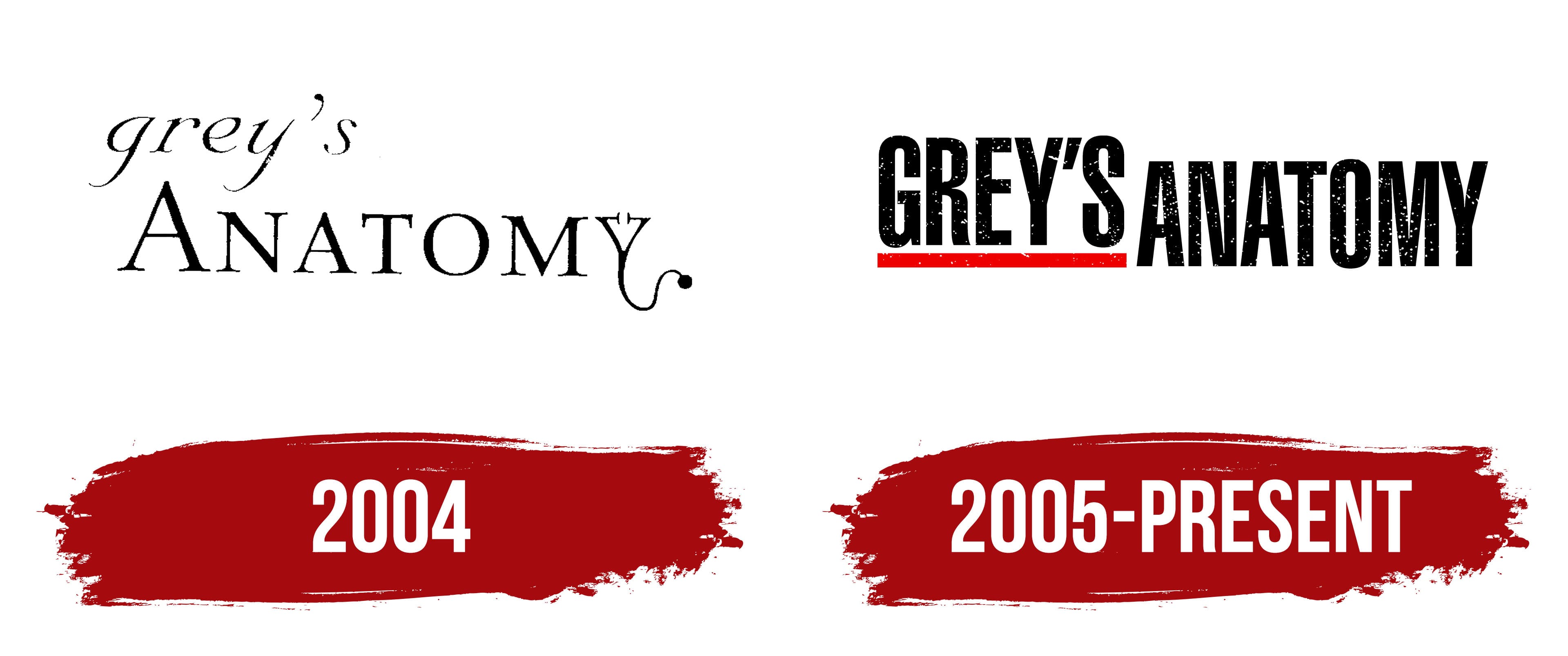
2004

This minimalist and austere logo reflects the drama and seriousness of the show’s medical themes. The logo’s central element is the series title, set in a large, clear, sans-serif font to emphasize clarity and directness.
The color scheme is black and white, symbolizing the contrast between life and death, determination, and doubt, key themes often explored in the show’s storyline. Black suggests seriousness, formality, and professionalism, while white represents purity and hope, both crucial in medical drama.
The logo’s style is strict and concise, highlighting the series title and conveying the show’s serious, tense atmosphere. This design aligns well with the series’ overall tone, where every detail matters and every decision can be a matter of life and death.
The emblem captures the characters’ moods and challenges, strongly associating them with the emotions viewers experience while watching the show.
2005 – today

The phrase “GRAY’S ANATOMY” appears on the series’ main logo. The designers have made the lettering black and large for advertising posters. The font is bold, grotesque, and elongated vertically. The first word is slightly raised because a bold red line is under it. The underline is the same width as most of the letter strokes. The lettering looks aged, with white spots and scuffs. Sometimes, the text is supplemented with an emblem depicting a distant city on the horizon.
Font and Colors

The logo on the advertising posters is bold sans-serif type with roughly the same stroke weight. It resembles Helvetica Ultra Compressed. The letters are disproportionately shaped, compressed at the edges, and elongated upward. The screensaver wordmark uses a different style. The designers chose a thin antique typeface, Cheltenham, created at the end of the nineteenth century.
The Grey’s Anatomy identity is dominated by black. One logo is aged, with white spots, and complemented by a bright red tint (#EF0000). This contrast looks good on a white or light background, especially on advertising posters, and draws attention to the series title.