


 Grand Theft Auto Logo PNG
The GTA logo represents the road network players drive through. The many plot twists reflected in the emblem make the series attractive for regular use. The sign shows that it will not be boring inside.
Grand Theft Auto began in Edinburgh at DMA Design, founded in 1987 by David Jones. After Lemmings in 1991, the studio shifted focus. By the mid-1990s, Race’n’Chase introduced a concept centered on crime in an open city.
In 1997, BMG Interactive released Grand Theft Auto for PC and PlayStation. The top-down format and violent mechanics triggered criticism from the media and retail chains. Some stores refused distribution, which increased visibility and supported sales.
In 1998, Take-Two Interactive acquired BMG Interactive. DMA Design became Rockstar North, while Sam Houser and Dan Houser formed Rockstar Games and shaped the series’ direction.
In 2001, Grand Theft Auto III moved the franchise into 3D. Liberty City introduced traffic systems, routine-driven pedestrians, radio stations, and nonlinear missions. Competing titles like Driver offered more limited interaction models.
Vice City followed in 2002, set in a world inspired by 1980s Miami. In 2004, San Andreas expanded the scale to three cities. In 2005, hidden content known as “Hot Coffee” led to lawsuits and a temporary Adults Only rating from the ESRB, forcing a re-release.
In 2008, Grand Theft Auto IV launched with a budget of nearly $100 million. Day-one revenue reached $310 million and exceeded $500 million in a week. Rockstar used RAGE and Euphoria to improve physics and character animation.
On 17 September 2013, Grand Theft Auto V generated about $1 billion in three days. The game introduced three playable protagonists and a detailed version of Los Angeles. By 2024, sales exceeded 200 million copies, making it the third-best-selling game behind Minecraft and Tetris. GTA Online, launched in October 2013, evolved into a separate platform with регуляр updates and a large active audience.
Meaning and History
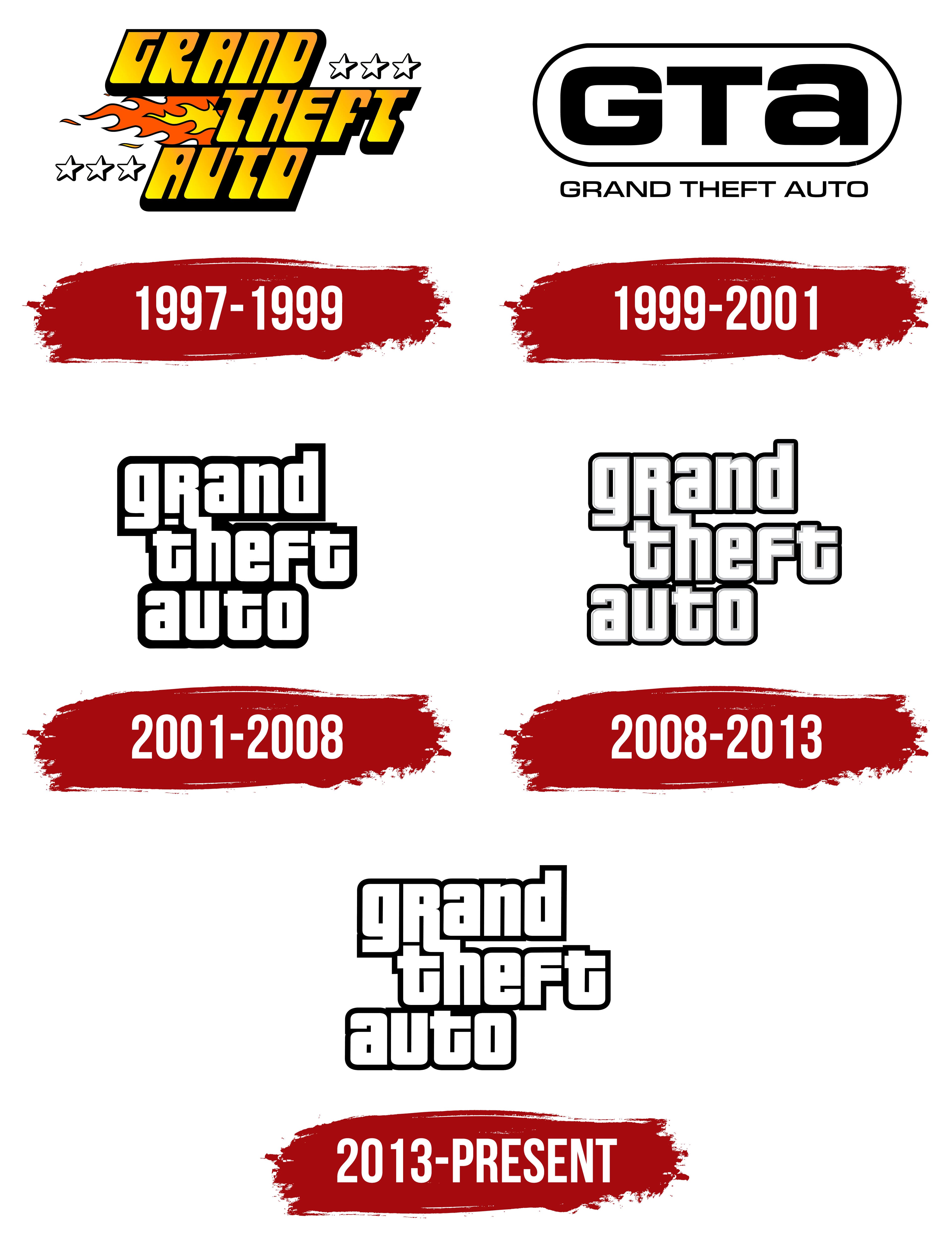
A common element of all GTA emblems is the “Grand Theft Auto” lettering. Since 2001, its style has remained unchanged: the designers made minor edits, adjusting the outline’s thickness.
What is GTA?
GTA is an abbreviation for the video game series Grand Theft Auto, an action-adventure series with seven main parts and four expansions. David Jones, Mike Dailly, Aaron Garbut, Leslie Benzies, Sam Houser, and Dan Houser were involved in their development. Rockstar Games published the series, with the first installment released in 1997.
1997 – 1999

The game series title is written in stylized italics on the debut logo. Above and below are the words “GRAND” and “AUTO.” Three five-pointed stars complement each other. “THEFT” sits in the middle, left of a bright two-tone flame. The palette is also fiery: the letters have a slight yellow-orange gradient. The lettering looks impressive, thanks to its wide black bezel.
1999 – 2001

In 1999, the logo designers used the abbreviated name GTA. The abbreviation is placed inside a rounded rectangle. The uppercase “G” and “T” are combined with a lowercase “a” that is no smaller than them. Below is the inscription “GRAND THEFT AUTO.”
2001 – 2008

A new trademark was registered for the release of Grand Theft Auto III. The designers removed the abbreviation and returned to the classic structure, placing the words from the series name one under the other. At the same time, they mixed letter cases but kept them the same size.
2008 – 2013

In 2008, the inscription acquired an inner light gray outline. The outer black lines are thinner than in the previous version.
2013 – today
The gray outline has disappeared in the latest version of the logo, making it look flat. Everything else is unchanged.
Font and Colors

The GTA branding is a stylized “Grand Theft Auto” lettering. It looks powerful and impressive thanks to the special lettering. The words are arranged in three lines, although there is a horizontal version.

The logo designers used a variation of Pricedown Black. The color scheme is monochrome, with white letters outlined in black and separated by black lines from the same white background. This starkly contrasts with the vibrant yellow-orange palette of the logo adopted in 1997.