 Guitar Hero Logo PNG
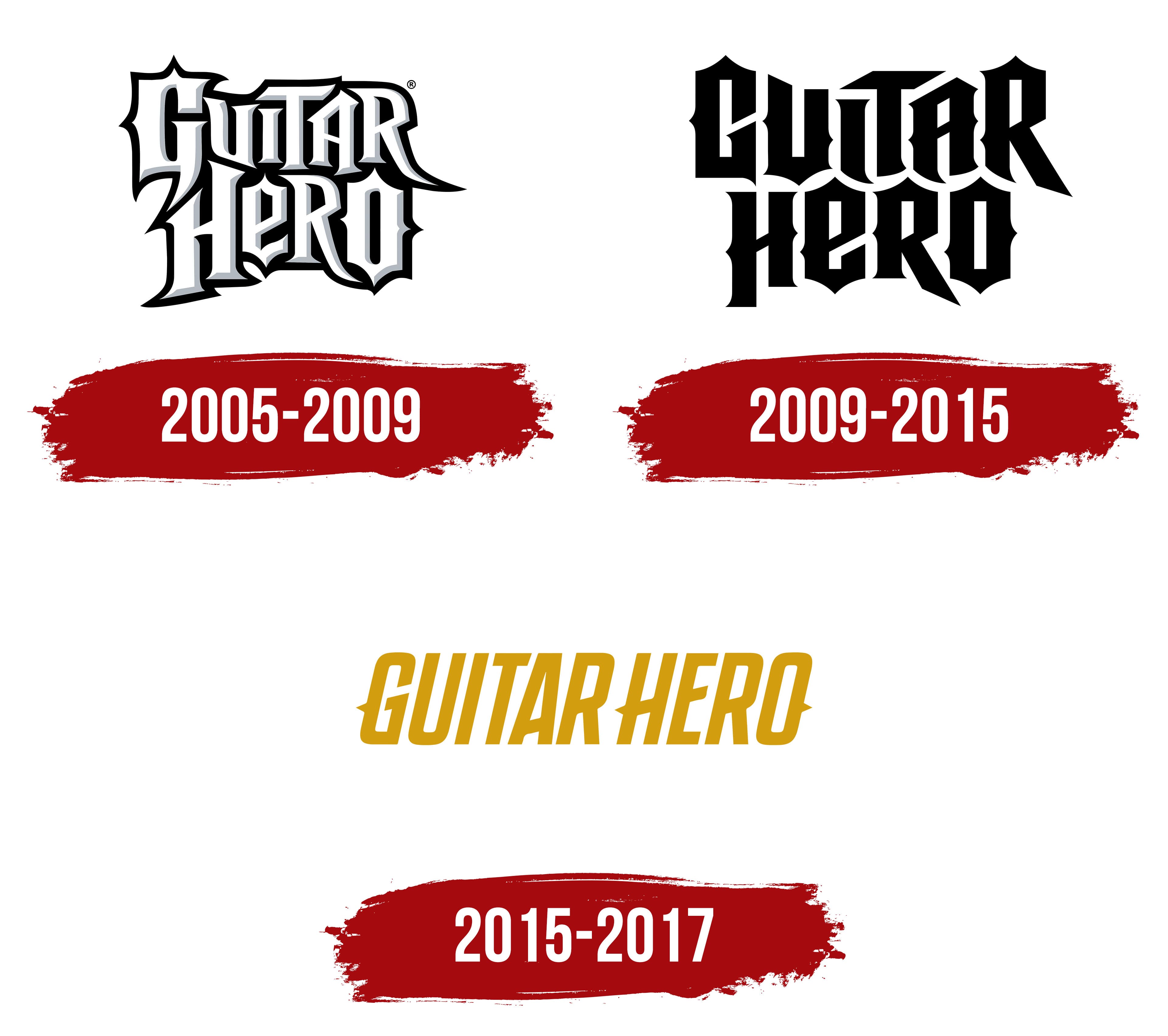
Initially, the Guitar Hero logo reflected the video game’s affiliation with heavy metal; hence, it was spiky and prickly. But as the song database expanded, the spikes pointing in all directions were increasingly smoothed out until the emblem became a legible attribute of the brand identity, with smooth elements. It became universal and suitable for all music genres.
The history of Guitar Hero began at RedOctane in California, a company producing gaming peripherals inspired by Konami’s arcade rhythm title Guitar Freaks. The idea of a Western version with a plastic guitar controller was developed in collaboration with the Boston studio Harmonix, already known for Frequency and Amplitude. The development budget was about 1 million dollars, with marketing around 30 thousand.
On 8 November 2005, Guitar Hero was released on PlayStation 2 with 30 rock tracks in cover versions. Initial sales grew primarily through word of mouth, reaching $ 45 million within two months. In 2006, Guitar Hero II expanded the format with 64 songs and cooperative play, exceeding $ 200 million in revenue in a similar timeframe. Later in 2006, Activision acquired RedOctane for about $ 100 million, while MTV Games acquired Harmonix, splitting future development between the two corporate structures.
In 2007, Guitar Hero III: Legends of Rock, developed by Neversoft, became the first single-game to surpass $ 1 billion in sales. Rock Band by Harmonix and MTV Games reached about $ 600 million in sales, intensifying direct competition in the rhythm game segment. By 2008, the market reached saturation, and 2009 saw multiple releases that increased consumer fatigue and hardware costs.
In 2010, Activision closed RedOctane and paused the franchise with Guitar Hero: Warriors of Rock. In 2015, Guitar Hero Live was developed by FreeStyleGames, introducing a redesigned controller and Guitar Hero TV streaming system. Despite the shift to a service model, sales underperformed. In 2017, FreeStyleGames was sold to Ubisoft. In 2018, Activision shut down Guitar Hero TV, ending access to most of the digital catalog.
Meaning and History
The music rhythm video game, similar to Guitar Freaks, unexpectedly gained users’ attention and critics’ trust. Released at the end of 2005, it became a real hit and received several continuations. Its gameplay is very original. It’s based on musical hearing and on a guitar controller. Players must press the corresponding buttons on it to hit the notes displayed on the screen. For the first years, the playlist included heavy metal and hard rock repertoire, so the developers chose a logo that harmonized with them, which featured:
- Monochrome colors;
- Spikes sticking out in different directions;
- Massive letters in a block style;
- Extended sharp legs.
As the game’s platforms and its musical directions expanded, the emblem gradually evolved, becoming softer and less aggressive. To this end, designers shortened the spikes, rounded the corners, and minimized sharp projections.
What is Guitar Hero?
Guitar Hero is a music-themed video game played with a guitar controller. The gamer presses buttons on it in time with the notes appearing on the display. The first version was released in 2005, and the latest in 2015. They cover 30 iconic rock songs from the 1960s to 2005. The game’s first developer was Harmonix, along with its publisher, RedOctane. Initially launched in North America for the PlayStation 2, it later expanded to additional territories and digital platforms.
2005 – 2009
The Guitar Hero logo is text-based, but each letter in it is an example of gothic-style graphics. They have elongated stripes, sharp angles, and many spikes that point in different directions. There are also black shadows that turn the outer line into a bold frame. The emblem uses gray to effectively highlight the signs and give them a three-dimensional appearance. Such a combination conveys the stability and authority of the game developers, as well as their close association with hard rock and heavy metal. The two-level inscription is arranged as if the upper word is integrated into the lower one. Both are figurative and done in a font resembling the Nightmare Hero typeface.
2009 – 2015

After expanding the repertoire of musical tracks, the creators decided to move away from a limited association with heavy metal. They used songs from other genres, so they made the logo less aggressive and less spiky. The sharpness of the lines became less expressive; the prickly projections were shortened, and the shadows disappeared. Moreover, the designers separated the upper and lower lines, so they are now visually unconnected, with a small but free space between them. The letters were painted in black.
2015 – 2017
In this version of the Guitar Hero emblem, there is a very distant similarity to the Gothic style. The font is more Old English, with small spike-like projections on the legs. In particular, they are present in the “G,” “H,” and “O.” The letters are smooth, italic, uppercase, and semi-bold, with smooth transitions on rounded parts. The video game name is regrouped into a single row with narrow spacing between words, so it looks like a single line of text. The dark palette has given way to a mustard one, calmer and more life-affirming.
Fonts and Colors
In the text logos of Guitar Hero, the inscriptions are set in fonts resembling Nightmare Hero and Tungsten SemiBold, with minor modifications. Depending on the style, the letters are either gothically prickly or modernized under smooth italics. But for the most part, the design is custom, Hero Bold.
The color palette also lacks rich diversity. Bright splashes are absent because they convey the character of heavy metal and hard rock. And with them, black-and-white monochrome perfectly matches. Later, the colors were enriched with mustard yellow, symbolizing life force.