


 Hampton Pirates Logo PNG
The Hampton Pirates logo is the best way to visualize your name. Therefore, it features a formidable sea pirate, ready to attack any passing ship at any moment. It symbolizes the pursuit of victory, and the long, sharp blade in his hand warns future opponents.
Hampton Pirates represent Hampton University, founded on April 1, 1868, by Samuel Chapman Armstrong on the site of the “Little Scotland” plantation to educate freed slaves. The American Missionary Association supported the project, and among early students was Booker T. Washington, later founder of Tuskegee Institute.
The nickname “Pirates” appeared in the early 20th century, reflecting the coastal location near the Chesapeake Bay. Geography shaped the program, including a sailing team and, since 2016, a lacrosse squad competing at the NCAA Division I level, whose first game was broadcast on ESPN.
For decades, Hampton competed in lower NCAA divisions before moving to NCAA Division I in 1995 and joining the Mid-Eastern Athletic Conference. The transition produced quick results across several sports.
In March 2001, the basketball team upset Iowa State 58–57 in the NCAA Tournament as a 15th seed, with Tarvis Williams scoring the final basket. The moment became one of the most recognized plays of the tournament era, and it repeated in 2002.
Under Joe Taylor, football dominated the Mid-Eastern Athletic Conference, winning three titles from 2004 to 2006 and earning national recognition for HBCUs. In 2007, five players were invited to the NFL Combine.
In November 2017, Hampton left the Mid-Eastern Athletic Conference and joined the Big South Conference in 2018. In 2022, the program moved to the Coastal Athletic Association alongside North Carolina A&T.
Meaning and History
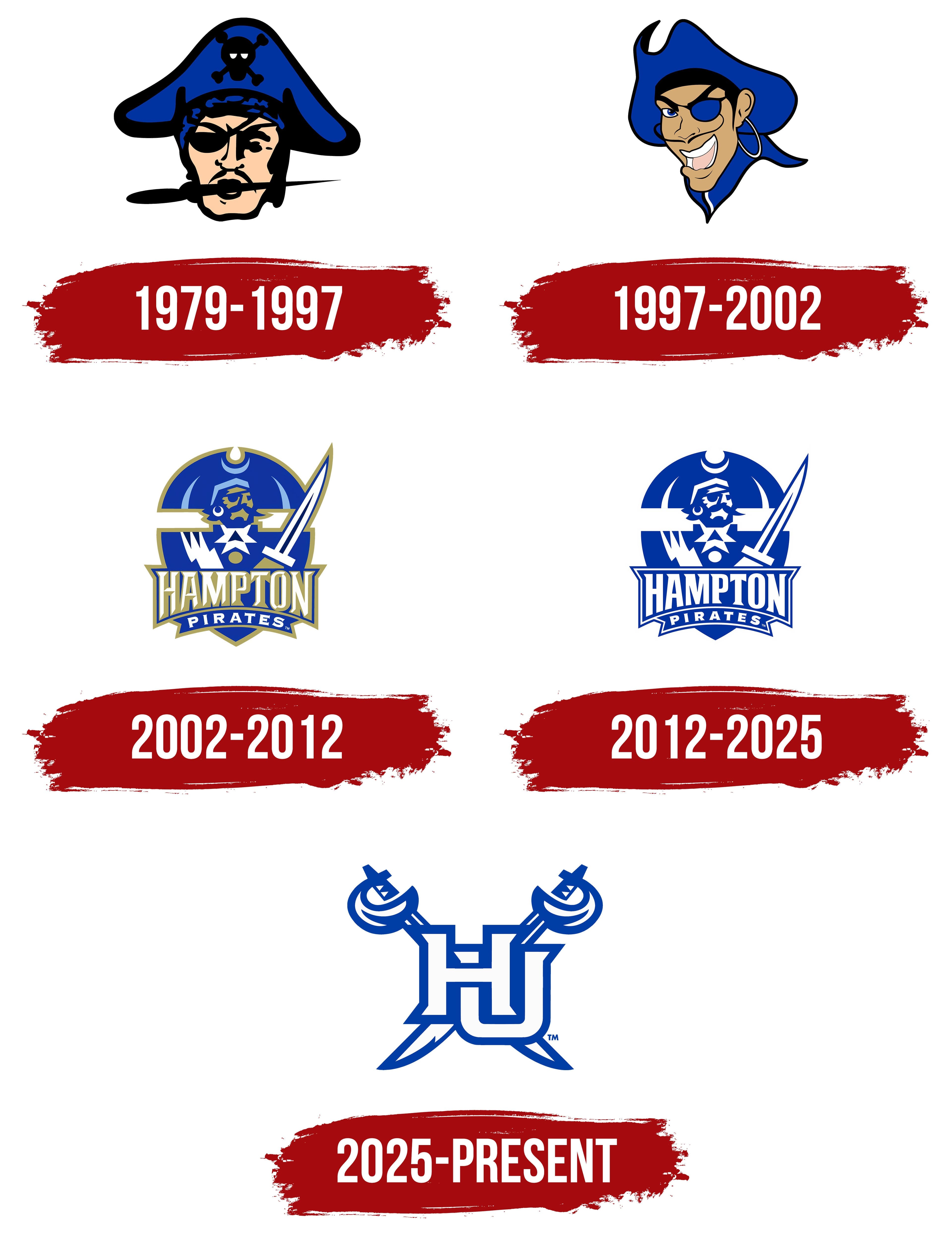
What is Hampton Pirates?
Hampton Pirates participate in the NCAA Division I (FCS) intercollegiate program, representing Hampton University. The sports department comprises 19 student teams in Hampton, Virginia, and is part of the Colonial Athletic Association.
1979 – 1997
The pirate in the Hampton Pirates emblem used from 1979 to 1997 represented an athletic nickname students had adopted decades earlier. Hampton University’s teams in Virginia became the Pirates following a 1933 vote. Before then, publications used Ironmen, Seasiders, Wildcats, and Pirates interchangeably, creating confusion over the teams’ name.
Hampton graduate Thomas Young, a staff member at Norfolk’s Journal and Guide, initiated the poll. After using Pirates in a football story, he proposed a vote to establish a common name. After discussions with athletic director Charles H. Williams, the student newspaper The Script, edited by Enoch Walker, took charge. In May 1933, 577 of the institution’s 989 students voted. Pirates received 307 votes, Seasiders 184, Ironmen 74, Buccaneers seven, and Wildcats five. The Pirates’ victory established the nautical theme in the athletic identity.
Hampton refers to the institution’s home city. Its history began on April 1, 1868, when Samuel Chapman Armstrong opened Hampton Normal and Agricultural Institute to educate African Americans following emancipation. As its academic programs and organizational structure expanded, the institution became Hampton University in 1984. By then, the Pirates nickname had existed for half a century.
In the 1979–1997 logo, the pirate’s appearance conveyed the team name. His head faced forward, with a blue tricorn hat occupying nearly the entire upper half of the emblem. A black skull and crossbones appeared on the front. Black hair, a mustache, and a small beard framed a light beige face, with a black patch covering one eye.
The pirate held a knife between his teeth. It lay almost horizontally, with the handle pointing left and the blade’s tip pointing right. A thick, irregular outline united the face and hat. The tricorn, eye patch, weapon, and skull and crossbones communicated Pirates without lettering.
1997 – 2002

The Hampton Pirates emblem used from 1997 to 2002 gave the pirate a cartoon appearance. His head turned left, and a smile with white teeth and a pink mouth replaced the knife. The skull and crossbones disappeared from the hat. As before, a standalone pirate image represented the teams.
Blue united the hat, eye patch, and new neckerchief beneath the chin. The hat became asymmetrical, with an upturned edge, and a large light-colored hoop earring appeared in his ear. The face and ear retained their beige fill. An open eye and raised brow complemented the smile, while black lines separated the colored areas.
2002 – 2012
Hampton’s growing national athletic profile coincided with the introduction of a third emblem in August 2002. A waist-up pirate portrait with a weapon and the full athletic name replaced the standalone head. The figure and text shared a shield-like background with a rounded top and pointed bottom.
Large HAMPTON lettering beneath the portrait used tall, narrow uppercase letters with pointed serifs. White faces and gold side facets gave the letters depth. A ribbon below carried small, widely spaced PIRATES lettering. Above both lines, the pirate faced almost directly forward. A large tricorn, eye patch, earring, mustache, and beard defined his appearance. A saber ran diagonally along the right side of the image.
Blue and light blue combined with white and muted gold. Light blue areas defined folds and highlights on the tricorn. A gold line traced the emblem’s outer edge. It highlighted the face, portions of the clothing, and letter facets, connecting the portrait to the text.
Alongside the portrait, the athletic identity used Hampton Pirates lettering over crossed blades and HU monograms for Hampton University. The 2002–2007 monogram consisted of white interlocking initials with pointed serifs and thick blue outlines. It appeared on football helmets. Another HU version entered use in 2006, with blue letters staggered vertically, outlined in white, and accented by a blue shadow.
2012 – 2025
The 2012 Hampton Pirates update changed the colors while retaining the primary emblem’s structure. The pirate portrait, large hat, diagonal saber, and two-line name became blue and white. The gold outline disappeared, and the face and lighter clothing details became white. Flat white lettering on a blue base replaced the gold side facets in HAMPTON. The colors changed throughout the illustration, but its contours remained intact. This version served as the primary athletic logo until 2025.
Secondary marks continued to explore pirate imagery. Hampton Pirates lettering appeared with crossed sabers, while a sailing ship bearing an “H” on its sail was used from 2012 to 2018. In 2018, a standalone “H” appeared over two blades. An HU monogram followed the same arrangement in 2023. The university initials and pirate weapons connected the earlier lettermarks to the later primary emblem.
2025 – today
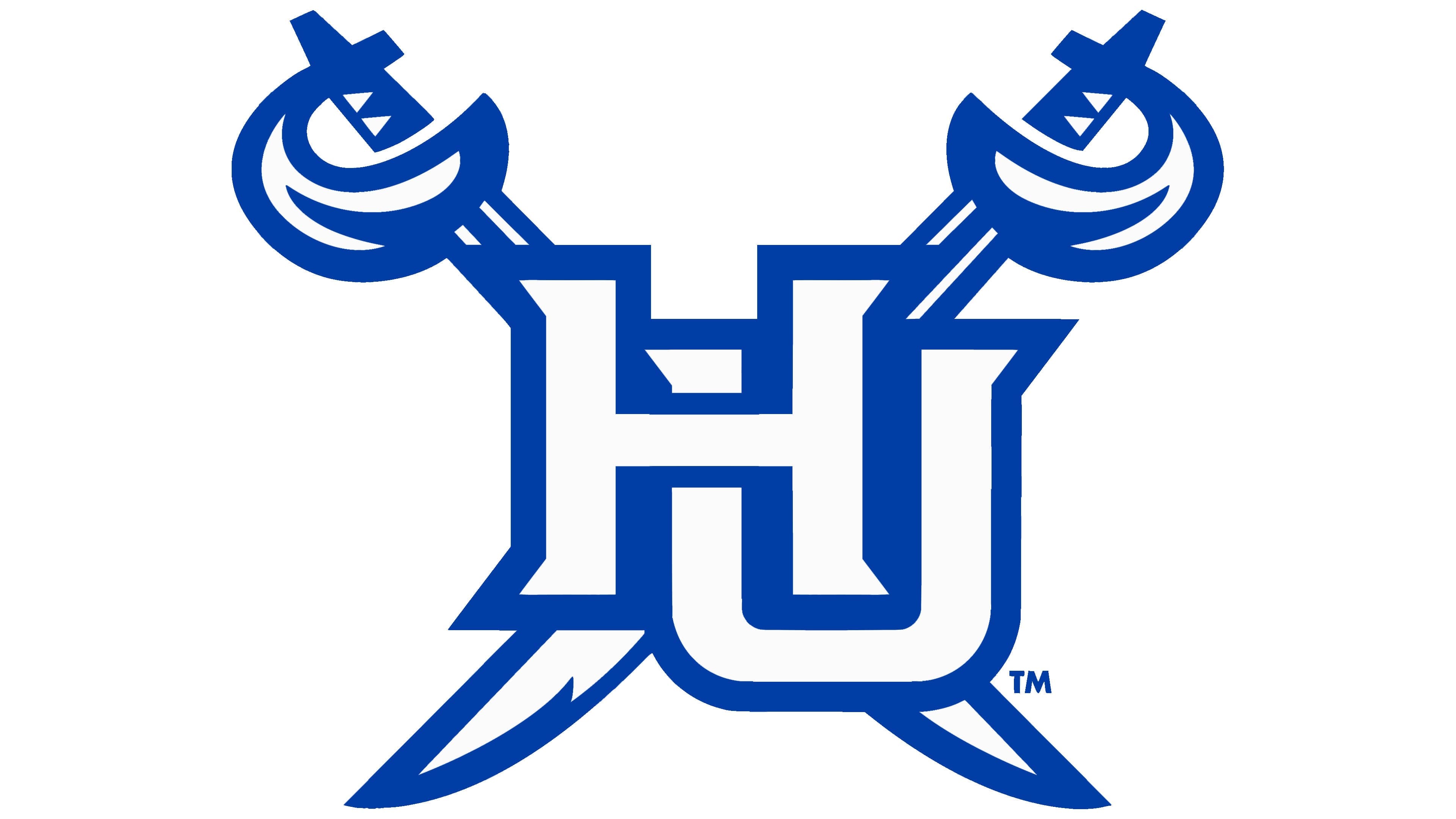
In 2025, an HU monogram with crossed sabers became the Hampton Pirates’ primary athletic emblem. The university abbreviation and nautical imagery replaced the pirate portrait. Earlier portrait versions were retired from official use. The initials connect the teams to the university. At the same time, the logo’s official interpretation includes leadership, courage, and a pursuit of excellence.
White letters with blue outlines cover the point where the sabers cross. The “H” sits above and to the left of the “U,” with pointed terminals referencing a pirate ship’s sails. Behind the monogram, the handles rise diagonally while the blades spread downward. Rounded guards surround the grips, and light interior areas define the blades’ surfaces.
The change in primary emblem accompanied the introduction of a vivid Hampton Blue, specified as Pantone 293 C and hex code #004AAD. It is paired with Sail White. Black, Hampton Grey, and the darker Anchor Grey provide supporting accents.
A secondary emblem retains Hampton Pirates lettering over crossed sabers. The wordmarks have distinct roles. Standalone HAMPTON may serve as a primary identifier, while PIRATES is reserved for secondary use. Team and department names can accompany the secondary emblem, creating a consistent identity across basketball, football, track and field, sailing, and other university programs.