


 Hawaii Warriors Logo PNG
Since 1909, the University of Mānoa has been developing sports venues. The latest Hawaii Warriors logo features minimalism and reflects a commitment to national roots. The graphic motifs of indigenous people ensure brand recognition and highlight key features.
Hawaii Warriors athletics began in 1909 on Oahu, initially competing as an independent program. Distance from the mainland shaped scheduling and costs from the start. In 1923, the team adopted the name Rainbows, later changing it to Warriors in 1974.
From 1979 to 2012, Hawaii competed in the Western Athletic Conference. In 2012, football and several major sports moved to the Mountain West Conference, while other teams remained or shifted to the Big West Conference, creating a split structure across sports.
A defining era came under coach June Jones, hired in 1997. Using the run-and-shoot system, he built a high-output offense. In 2005, quarterback Colt Brennan arrived after leaving Colorado and led the NCAA in touchdown passes and total offense in his first season.
In 2006, Brennan set records with 5,549 passing yards and 58 touchdowns, surpassing Houston’s David Klingler. He ranked sixth in Heisman voting as Hawaii finished 11:3. In 2007, the team went 12:0 in the regular season, with Brennan finishing third in Heisman voting.
The run ended in the 2008 Sugar Bowl with a 10:41 loss to Georgia. Brennan closed his career with 14,193 yards and 131 touchdowns, later surpassed by Case Keenum. Jones recorded 76 wins, the highest total by a head coach in program history.
Meaning and History
What are the Hawaii Warriors?
The Hawaii Warriors (also known as the Hawaii Rainbow Warriors and Rainbow Wāhine) are the University of Hawaiʻi sports teams at Mānoa. Based in Honolulu, Hawaii, the program has 19 student teams. Athletes compete in NCAA Division I and represent the Big West Conference.
1980 – 2000
The rainbow in the Hawaiʻi Rainbow Warriors emblem used from 1982 to 2000 references the football game that gave the university’s teams their name. Rainbow Warriors identifies the men’s athletic program at the University of Hawaiʻi at Mānoa in Honolulu. Hawaiʻi connects the teams to the islands, while the two parts of the nickname originated at different times. The rainbow recalls a victory on the field, and the warrior reflects Hawaiian history and local support for athletics.
Before 1923, the university’s teams were known as the Deans. The change followed the final game of that season, when Otto Klum’s football team defeated Oregon State 7–0. A rainbow appeared over the field in Mōʻiliʻili during the game. Reporters began calling the team the Rainbows, and fans came to believe that a rainbow’s appearance foretold a Hawaiʻi victory.
Warriors joined the football team’s name in 1974, expanding Rainbows to Rainbow Warriors. The university associates the warrior with the unification of the Hawaiian Islands under Kamehameha I. ʻAhahui Koa Ānuenue, a student-athlete support organization founded in 1966 and known as the Order of the Rainbow Warrior, helped popularize the name. The women’s program adopted Rainbow Wahine in 1972 at Donnis Thompson’s initiative. “Wahine” is Hawaiian for “woman.” The men’s and women’s naming histories differ, though the rainbow connects them.
Before introducing a lettermark, the university drew on Hawaiian folklore. In 1974, when the athletic program moved to NCAA Division I, an illustration featured a menehune, a small mythical being with immense strength, accompanied by a spear and rainbow. In the circular 1975 version, the character wore a green cape and headdress and carried a football. Flames appeared at his feet, with a rainbow above his head. The emblem later became oval and appeared on football helmets from 1976 to 1981.
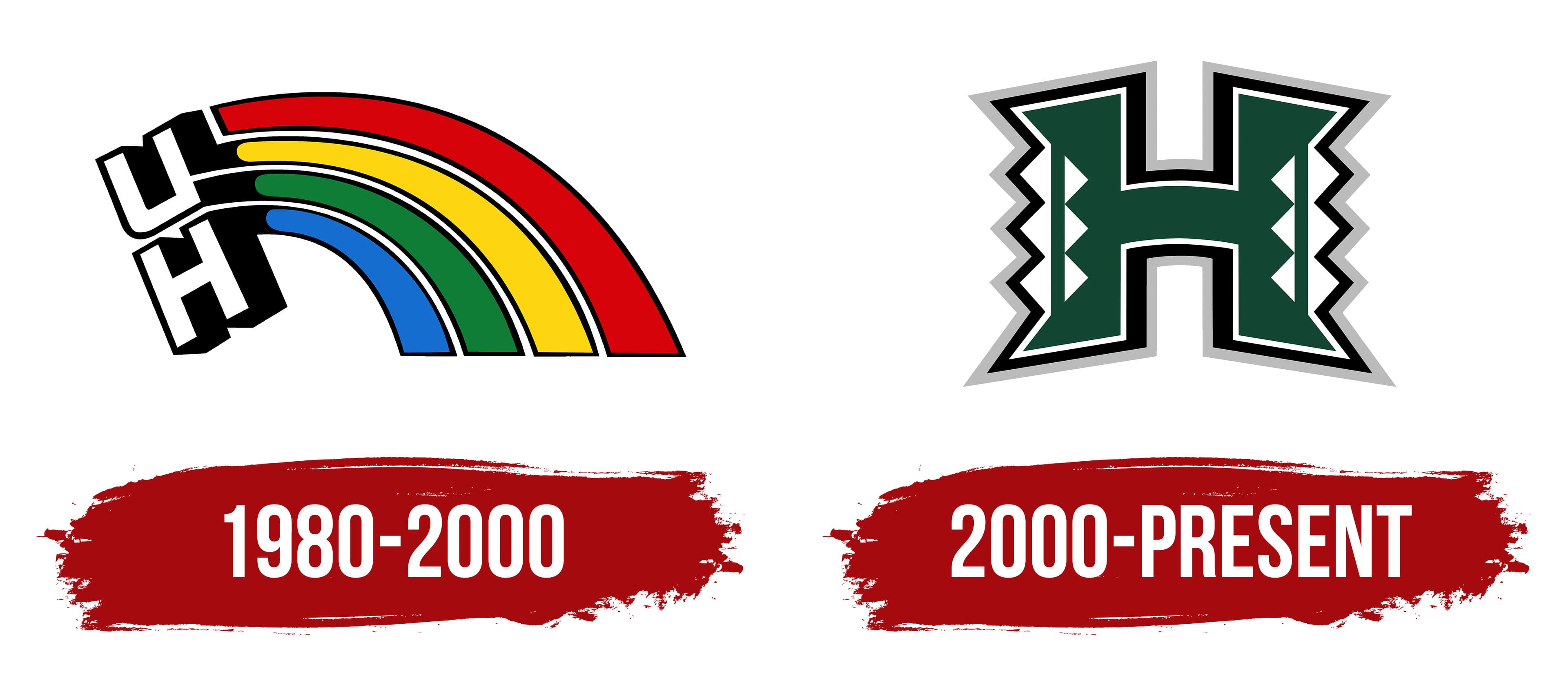
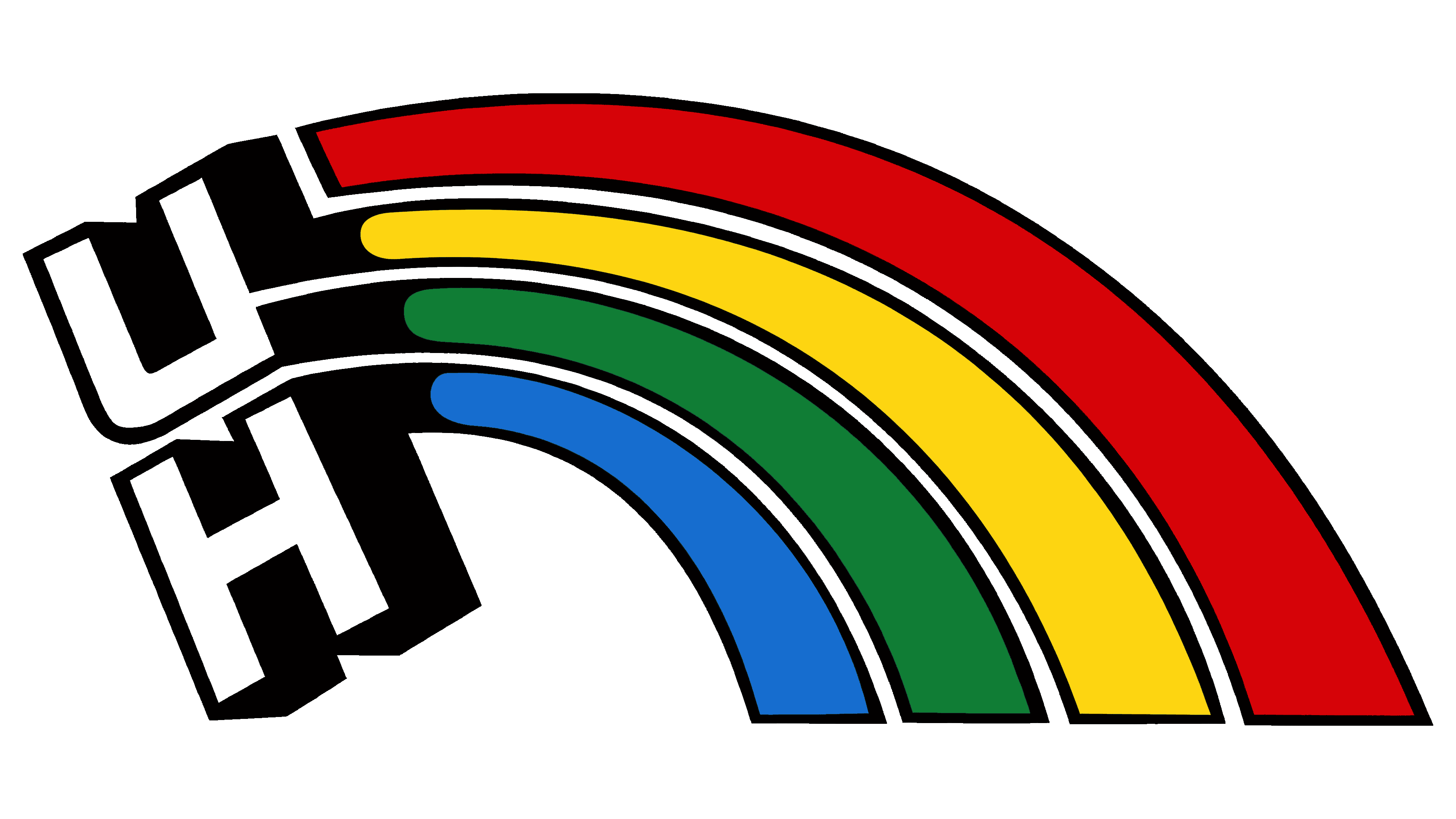
The rainbow with UH initials, short for University of Hawaiʻi, was officially adopted in 1982. It remained the athletic department’s primary emblem until 2000. The folkloric character gave way to university initials paired with the rainbow associated with the team name’s origins. Instead of spelling out Hawaiʻi and Warriors, the emblem represented the teams through the rainbow and identified the university through its initials.
The arc extends down and to the right from the letters. Rather than seven spectrum colors, the designers used four broad bands. Red follows the outer edge, then yellow, green, and blue. Black outlines and white gaps separate the colors. At the rainbow’s left end, the “U” sits above the “H.” Black outlines surround the white letter faces, and an offset black shadow adds depth. The letters’ slant follows the arc’s curve. Heavy strokes and rectangular terminals distinguish them from the ornamental “H” introduced later.
In 1999, a separate anniversary emblem appeared on black football helmets to mark 25 years of the Rainbow Warriors name. It revived the character from the 1970s identity and added “25 Years as Rainbow Warriors.” The rainbow bands were green, silver, and black, anticipating the colors of the following year’s “H.” The anniversary version was intended for football uniforms, while the UH rainbow remained the athletic department’s primary logo.
2000 – today
The transition from the rainbow to an “H” in July 2000 was part of an effort to unite University of Hawaiʻi athletics under a shared identity. Work began during Kenneth Mortimer’s presidency. The new emblem was unveiled to approximately 500 guests at the Stan Sheriff Center, with athletes and coaches participating in a uniform presentation. The football team shortened its name to Warriors. Other teams were initially allowed to retain different combinations of Rainbow, Warriors, and Wahine.
The project was commissioned by Kurt Osaki and Craig Hirasaki, both University of Hawaiʻi at Mānoa graduates. They earned Bachelor of Fine Arts degrees in 1989, remained friends after graduation, and collaborated on projects. Osaki grew up on Kauaʻi and later led Osaki Design in Berkeley, where they worked on professional sports identities. Hirasaki stayed in Honolulu, where he headed Hirasaki Nakagawa Design. The commission from their alma mater continued their collaboration.
The designers were asked to reflect Hawaiian culture and the role of university athletics in bringing the islands together. They consulted community members and cultural specialists. The project centered on “PŪPŪKĀHI I HOLOMUA,” a call to unite in pursuit of shared achievement. The agency connected it to ʻohana, or family, and mutual respect. Patterns found in kapa, a traditional cloth made from processed tree bark, inspired the ornamentation. The designers interpreted them as representing people of different backgrounds united in the pursuit of knowledge.
The “H” was associated with both Hawaiʻi and the Hawaiian word “hā,” meaning “breath.” In the university’s interpretation, hā carries life and knowledge between generations. Rows of triangles within the emblem represent balance among body, mind, and spirit. Athletic lettering uses the Hawaiʻi kapa style, coordinated with the ornamentation of the “H.” Kapa became the name for the university’s athletic typography and remained in use through later team-name changes.
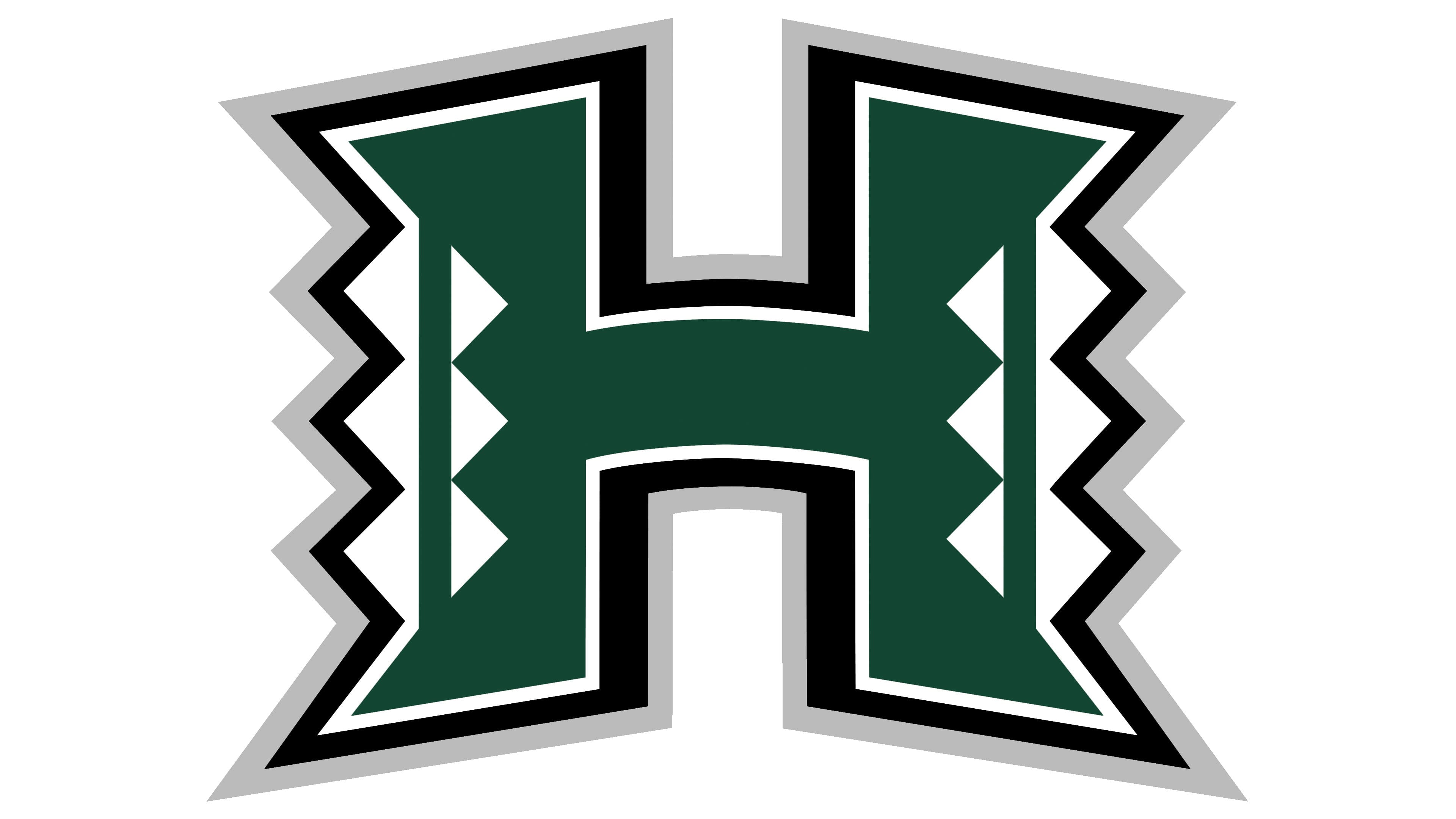
The two halves of the “H” mirror each other across a vertical axis. Dark green stems widen toward the top and bottom, with notches cut into their outer edges. Rows of white triangles run inside them. White, black, and silver outlines follow the outer silhouette, while a crossbar connects the two sides. The large ornamental “H” replaced the multicolored arc and slanted UH initials, becoming the emblem’s sole letter.
Green and white had been used long before the update. University tradition attributes their introduction to faculty wives who decorated campus events. White materials were readily available, and local plants supplied greenery. Green was later associated with Mānoa Valley, the agricultural deity Lono, and ti leaves. Football uniform specifications identify it as Pantone 3435. Black and silver, added in 2000, received separate interpretations. Black referenced the Hawaiian creation chant Kumulipo and emergence from darkness. Silver evoked rain and the luminous veil over Mānoa.
Replacing the rainbow sparked public controversy. Athletic director Hugh Yoshida cited the symbol’s association with the gay community as one reason for the change. Civil rights advocates criticized his remarks. University spokesman Jim Manke later expressed regret that people were offended and explained the comment as concern about confusion between symbols. Alumni and fans objected to losing the familiar rainbow. The debate extended beyond uniforms to the emblem’s cultural associations, team names, and the university’s treatment of different communities.
Despite sharing the “H” emblem, men’s teams continued to compete under different names. Until 2013, football, volleyball, golf, and tennis used Warriors; basketball and swimming retained Rainbow Warriors, and baseball used Rainbows. In February 2013, athletic director Ben Jay announced plans to rename all men’s programs Warriors. The plan was reconsidered after discussions with fans. On May 14, the university announced Rainbow Warriors as the shared name, effective July 1. Women’s teams retained Rainbow Wahine. The “H” remained the primary emblem after Rainbow returned to the name.
The historic rainbow continued to appear in throwback designs. It returned to football helmets for selected games in the 2014 and 2015 seasons. For the September 2015 game against Ohio State, Under Armour prepared white uniforms with rainbow stripes on the shoulders and along the sides of the pants. White helmets with green facemasks and the 1980s logo completed the set. The old emblem retained its colored arcs and university initials. It appeared on a special uniform, while the “H” remained the current emblem.