 History Logo PNG
The original History logo broadcasts a love of history to viewers, who were initially indifferent. But this is more than just events from the past. This is a whole world of life in all its manifestations, in which even an individual impulse or personal attitude toward what is happening can be considered history.
History began inside A&E Networks, a joint venture of Hearst, ABC, and NBC. In 1992, A&E aired The Real West with Kenny Rogers, and its ratings prompted executives to pursue a separate channel focused on historical programming. In 1993, A&E announced the plan, created a production unit, bought the Lou Reda Productions documentary library, and secured long-term access to the Hearst Entertainment archive.
The History Channel launched on January 1, 1995, with an expected audience of 500,000 to one million subscribers. Its early schedule included Year by Year, History Alive, Movies in Time, and Our Century. At the same time, about 30 percent of programming was original. By 1996, the channel had reached 16 million subscribers. Modern Marvels, launched on opening day, became one of its longest-running series.
International expansion began on November 1, 1995, with the creation of a UK channel in partnership with British Sky Broadcasting. Brazil followed in 1996 through TVA, while Scandinavia, the Baltic region, and Canada followed in 1997. In the late 1990s, the brand expanded into radio, VHS sales, travel content, The Biography Channel, and History International.
In the 1990s, critics nicknamed it the “Hitler Channel” because of heavy World War II programming. On March 20, 2008, the network shortened its name to History, then shifted toward reality formats such as Ice Road Truckers, Ax Men, Pawn Stars, American Pickers, and Ancient Aliens. In 2013, Vikings became its main scripted hit. In 2012, The Walt Disney Company bought a 50 percent stake in A&E Networks, leaving History under the control of Disney and Hearst Communications.
Meaning and History
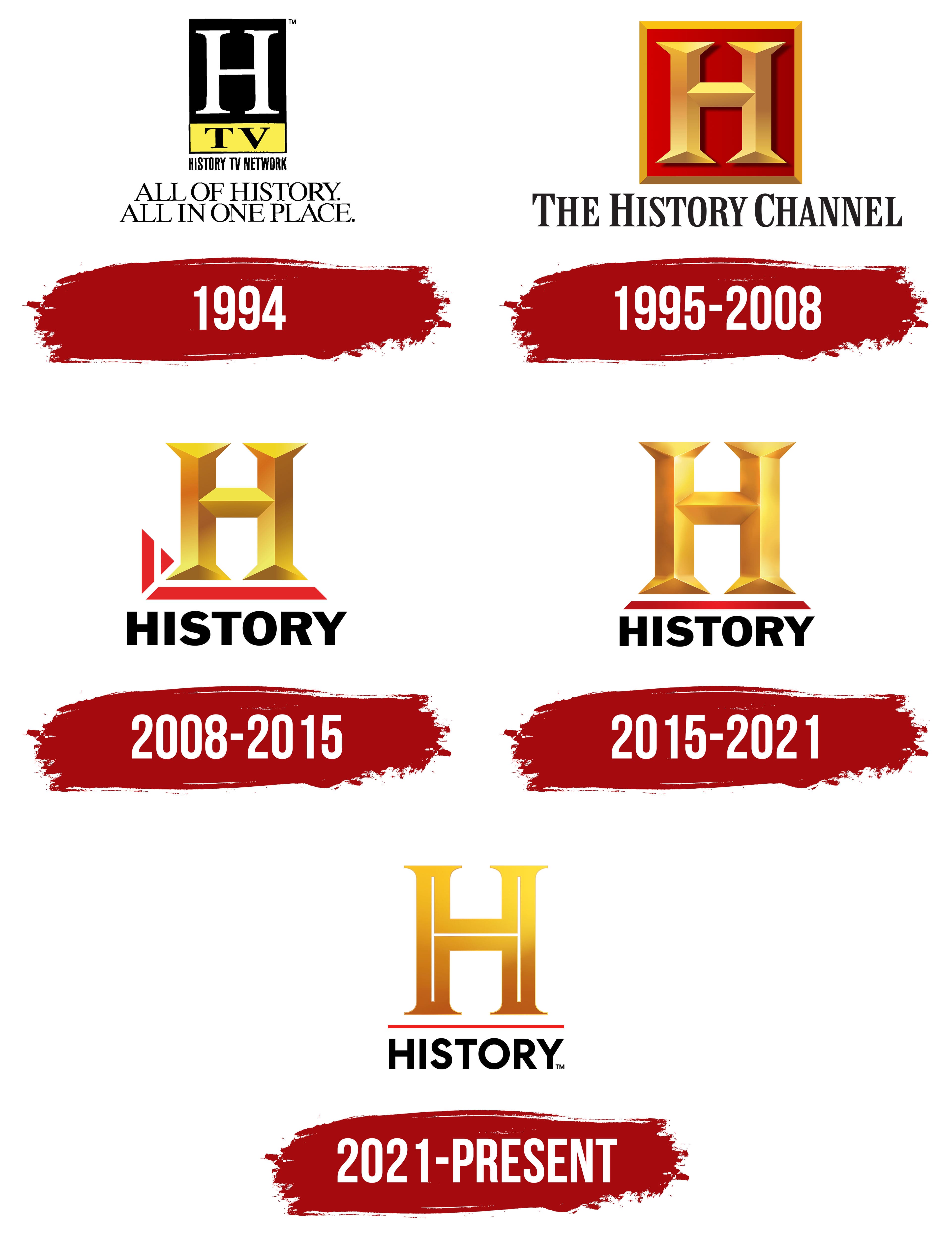
This television network was initially conceived as a historical channel, as its original name, The History Channel, suggests. However, following disapproving comments from critics about its “non-expert” content aimed at the general audience, it transitioned into reality TV. Naturally, the rebranding reflected the entire identity, including the logo.
However, the designers retained the emblem’s original style, the capital “H,” derived from the channel’s name. They just reinterpreted it, adding new shades of meaning and abandoning excessive seriousness. Therefore, starting in 2008, the logo no longer conveys a sense of businesslike strictness and practicality. Instead, it emanates colorfulness, joy, and liveliness.
What is History?
History is a subscription-based channel from the USA that gained widespread popularity and became the flagship. It was founded in 1995 and initially covered numerous historical issues, offering viewers documentaries, scientific and social films, and news. In 2008, it switched to various reality shows. Its owner is the broadcasting company A&E Networks.
1994 (pre-launch)

The History logo depicts a large “H.” The single letter is capitalized and centered within a vertical rectangle, occupying three-quarters of the rectangle’s height. At the bottom, there’s a yellow segment with the classic abbreviation for “television.” The inscription “TV” is painted black, thus clearly visible against the light background. The rectangle is set on the phrase “History TV Networks,” rendered with thin, sans-serif glyphs. Below it, the channel’s slogan is “All Of History. All In One Place”. It is divided into two lines and centered.
1995 – 2008

The emblem has a dual structure: a picture plus text. Graphically, they are separated from one another, yet remain conceptually connected. The upper part contains an even square with a large “H.” A golden frame borders it, with a solid red fill. But in reality, in the early years, the background was not always red:
- Blue was used for documentaries.
- Green for biographical materials;
- Purple indicated sitcoms.
- Yellow for reality shows;
- Orange for short content.
The iconic 3D glyph with serifs remained unchanged in the logo. It is three-dimensional, with lines running through the legs and the crossbar. They visually enlarge the letter. At the bottom is the channel’s full name, typed in black, semi-bold, uppercase font.
2008 – 2015

Following the rebranding, designers significantly simplified the logo to match the concise name, leaving only the word “History” from the phrase “The History Channel.” It is located at the bottom, set in a slab serif typeface, and centered. Above it is the volumetric “H.” The letter remained three-dimensional and gradient but lost its frame and background. Now, under it is just a plain white space without a border, except for the red geometric figure at the bottom left. It consists of a miniature triangle and a vertical trapezoid. A similar line is under the glyph.
2015 – 2021

The tendency to simplify the visual identity was retained, so the History logo became even more minimalist, adding greater cleanliness and smoothness. Designers transformed the texture of the single “H,” turning it into a very wide glyph with shadows and a golden gradient. The triangle and trapezoid disappeared, but the underline was preserved, becoming a steady pedestal for the letter. The developers also kept the name.
2021 – today

As the era of visual simplicity began, the television channel’s logo lost all volume. Now, it features a flat “H” of a goldish color with gradient transitions. Shadows, light flares, and thin white lines running in the center of the legs and the crossbar make it expressive. Visually, they repeat the glyph shape and look like a letter without serifs. Designers also changed the font of the lower inscription, narrowed the red line, and removed its diagonal cuts at the edges.
Font and Colors

Several types of typefaces have been used in the History logo. Depending on the year the emblem was introduced, the TV channel name is set in Franklin Gothic Bold or Centra No. 2 Bold. The corporate color palette is also diverse, comprising red, black, and several shades of gold. White serves as the neutral background.