


 HIT Entertainment Logo PNG
The HIT Entertainment logo is 3D. However, this was not always the case because the volume is noted only in the modern version. Older versions were conventional, flat, and two-dimensional. The designers, interestingly, played with the abbreviation of the phrase “Henson International Television”: they placed one letter on a cube turned sideways. Moreover, each of the three visible sides has an individual color.
HIT Entertainment began with Peter Charles Orton, a British media executive who worked at the Children’s Television Workshop in New York in the late 1970s, distributing Sesame Street internationally. There he met Jim Henson, creator of the Muppets. In 1981, Henson invited Orton into his company. In 1982, Orton, Henson, and Sophie Turner Laing founded Henson International Television to manage global rights for Jim Henson Productions.
During the 1980s, the company distributed Henson’s programs outside North America. In 1989, while Jim Henson Productions was discussing a possible sale to The Walt Disney Company, Orton led a management buyout of the distribution arm. It became HIT Communications PLC. The Disney deal never closed after Henson died in 1990, but HIT was already operating as an independent British company.
In the early 1990s, HIT built a catalog around children’s brands such as Postman Pat, Fireman Sam, The Wind in the Willows, and Peter Rabbit. In 1992, it became HIT Entertainment PLC. In 1993, it gained international rights to Barney & Friends from Lyrick Studios. In 1996, HIT was listed on the London Stock Exchange, and in 1997, it launched Bob the Builder, created by Keith Chapman.
In 2002, HIT bought Gullane Entertainment for about £144 million, gaining Thomas & Friends and adding it to a portfolio led by Bob the Builder. Competitors included Entertainment Rights in the preschool content market. In 2005, Apax Partners took HIT private. In 2011, Mattel acquired the company, mainly for Thomas. On 31 March 2016, HIT became part of Mattel Creations, later Mattel Television.
Meaning and History
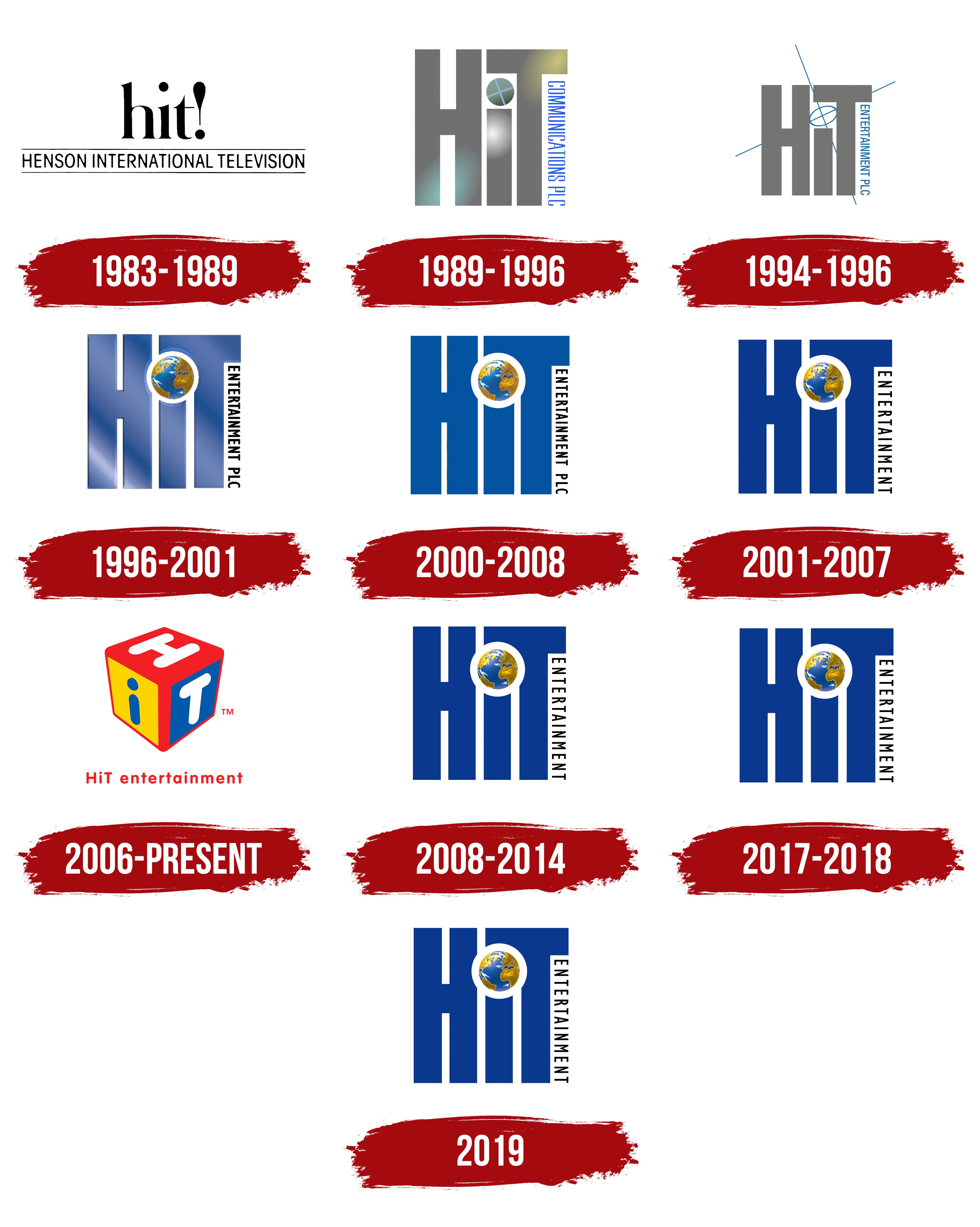
The new television studio kept the previous image in mind and maintained it properly to avoid losing its recognizability. The inscription was the basis of its identity for a long time, and now graphics prevail. This change took place in 2006.
What is HIT Entertainment?
HIT Entertainment is an American-British television company founded in 1982 and currently owned by Mattel Television. It was founded by Jim Henson, Sophie T. Laing, and Peter Orton, who later took over the leadership. The studio distributes children’s entertainment content.
1983 – 1989

At first, the TV company’s visual identity was textual. The base was an abbreviation for the full name of Henson International Television, “hit,” which was quite suitable for a company associated with entertainment content. The letters were lowercase, printed, and classic. The serifs appeared as miniature extensions at the ends, and at the end of the word, there was a bold exclamation mark. The dot above the “i” was very high. Beneath the abbreviation was the unabbreviated name, typed on a single line in thin capital grotesque and separated by two black stripes.
1989 – 1996

After the rebranding, the company had a new logo. It was made in a completely different style, although it contained text. This period marked the beginning of the era of massive block letters. The glyphs consisted of broad, dark gray lines. The “H” and “T” were uppercase and tall, and the lowercase “i” occupied a modest space between them. It was located under the head “T” and was complemented by a large dot, divided into four segments by two thin blue stripes. On the right was the phrase “HIT Communications PLC.” This inscription was vertical.
1994 – 1996

This emblem had limited circulation: it was used for only two years. The designers made the letters’ legs slightly thinner, but the character spacing remained the same, so the inscription remained dense. The new name of the television company, HIT Entertainment PLC, was used in the logo. The vertical inscription occurred on the right side of the “T” and was directly under her hat. An oval replaced the bold dot above the “i.” It was placed diagonally and was empty inside. In the center of it, two long, thin stripes crossed, extending beyond the word “HiT” and crossing it out.
1996 – 2001

Monochrome disappeared in the emblem, and color appeared. The developers used very wide blue letters. The dot over the “i” was replaced with a colorful globe, symbolizing the television company’s international status. To fit the globe comfortably under the high “T,” the designers cut off a fragment of its hat, and the adjacent “H” created a recess in the leg. In addition, they added highlights and repainted the studio’s full name in black.
2000 – 2008

In this period, two-dimensional graphics prevailed. The developers have removed light reflections from the emblem, making the image simpler, lighter, and flatter, so it blends better with displays and other media. The color of the letters has been changed to deep blue.
2001 – 2007, 2008 – 2014, 2017 – 2018, 2019

This logo appeared periodically and, occasionally, fell out of the audience’s sight. It was identical to the previous version. The word “PLC” disappeared, giving way to the inscription “HIT Entertainment.” The company was renamed in 2001 as part of a rebranding following its transition to Lyrick Studios.
2006 – today

The logo that was designed for the DVD is still used in parallel. Now, it is the official symbol of the TV company and is intended for its presentation in advertising. It first depicts a cube placed on the edge. The three visible sides are marked with the letters “H,” “i,” and “T.” The first and last glyphs are uppercase and white, and the middle ones are lowercase and blue. The background colors are red, blue, and yellow. Beneath the shadow of the 3D cube is the studio’s name, with the word “entertainment” in lowercase.
The palette of this logo varied interestingly during its evolution. So, from the standard black-and-white version, it first turned gray, then blue, and finally multi-colored. Some versions were used in parallel and featured on different broadcasts, confusing HIT Entertainment’s visual identity story. Numerous identity changes are associated with frequent name changes.
Font and Colors

For the inscriptions in all logos (except the first one), the designers chose smooth, sans-serif letters that are massive, even, and tall. However, they have no analogs because they are not written but drawn individually. The main colors of the emblem are black, blue, grey, white, red, and yellow.