 IFunny Logo PNG
The iFunny logo conveys emotion. The emblem is full of smiles and good moods. Promises drive, communication, and fun. Indicates the application’s friendly interface.
The iFunny platform grew out of FunCorp, a 2004 Limassol-registered company founded by developers from Penza. Early work focused on mobile entertainment apps, including a Russian-language meme service that shaped the core idea of user-generated humor feeds.
On April 26, 2011, iFunny launched on iOS, followed by Android on November 25. The product was structured around two streams: Featured, curated by moderators several times a day, and Collective, an open feed. This division created internal competition for visibility and defined the platform’s culture.
The app entered a space already influenced by 9GAG. iFunny focused on community dynamics rather than scale alone. On April 11, 2013, iFunny launched its website. The website launch extended access beyond mobile devices and supported desktop use.
Feature expansion followed, including GIF support, hashtags, repost tools from Instagram and Vine, and creator subscriptions. In November 2016, the platform expanded into Brazil with localized feeds, triggering conflicts between user groups from different regions.
Growth accelerated between 2015 and 2017, driven in part by US election-related content. The platform positioned itself between Reddit and 9GAG, balancing moderation with relatively open publishing. From 2018 to 2021, iFunny faced scrutiny over moderation and harmful content, including media-reported incidents. Despite this, the app surpassed 70 million downloads in the US by 2023 and maintained a stable position in entertainment rankings.
Meaning and History
The entertainment-viewing service was initially available on iOS and Android, and could be downloaded from the App Store and Google Play. Then the web version began to catch up with them and gradually gained popularity. Residents of the United States actively posted, viewed, and commented on funny pictures. Of course, they marked the memes they liked using emoticons; a similar system of likes operated in AyDaPrikol.
This explains why IFunny’s logos have always featured a large smiley face. Its appearance changed periodically, progressing from complex to simple. This trend spans all levels, from the disappearance of the gradient to background adaptation.
What is IFunny?
IFunny is an entertainment website and app where users share memes. FunCorp owns the brand; it is legally registered in Cyprus, has Russian roots, and was founded by students from Penza. Essentially, IFunny is an English-language social network for fans of humorous images, GIFs, and videos. It has faced several controversies due to extremist content involving threats toward various individuals.
2011 – 2012
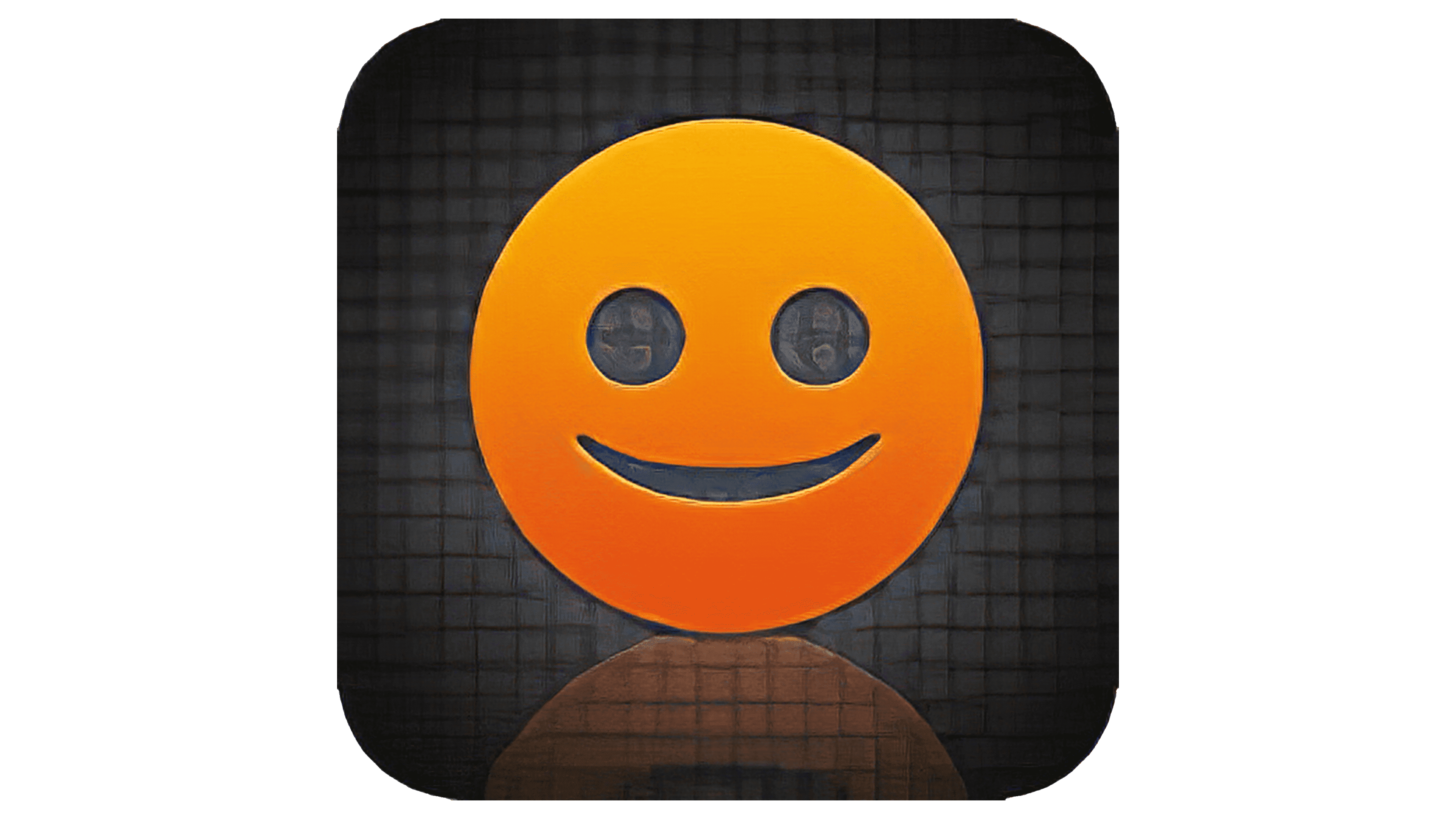
When the app first appeared, it had a visually heavy logo. The designers combined two dark elements: a yellow-orange smiley with holes instead of eyes and a mouth, and a square with rounded corners and a gray checkered pattern. The edges were black because vignetting was a very popular effect at the time. The background’s specular shine, the gradient, and the smiley’s reflection added dimension to the picture.
2012 – 2013

In 2012, FunCorp updated the IFunny logo for the first time. They made it lighter by changing the color palette. At the same time, the smile took on a friendlier look thanks to the new shapes of the eyes and mouth. The specular reflection disappeared, as did the cellular background. The square now has full-fledged right angles and colors in the form of gray semi-blurred rays. The vignetting effect was not used, but the edges were still darkened due to the characteristic stripe shape.
2013 – 2014

After another redesign, the creators of IFunny approved a new icon: a large black square with a small smiley in the center. The designers changed the smile’s shape and position again. They also used a moderate amount of orange and made the background solid, so the image doesn’t feel as heavy as it used to.
2014 – 2021

The trend towards simplification continued: in 2014, the gradient finally disappeared. But the smiley became larger, so it is easy to notice without any graphical techniques. At the same time, the colors lost their brightness and saturation, making the logo look faded.
2021 – today
After the redesign, the black square that serves as the smiley’s background lost its right angles; they were rounded to make the drawing look friendlier. For the same purpose, the developers have changed the smile’s shape, expanding it at the bottom. At the same time, the orange color became light, almost yellow. To the right of the icon was the inscription “iFunny” in the same shade. It uses a bold geometric sans-serif typeface that is proportionately balanced. Only the “F” is capitalized in the brand name; all other letters are lowercase. The shape of the “F” makes it seem like there’s more spacing between it and the “u.”
Font and Colors

IFunny’s owners have long experimented with the logo’s graphic design without changing its key elements. Now it consists of a square (background), a circle (head), two mini-ovals (eyes), and an arc (mouth). With the simplest set of geometric shapes, the designers conveyed the essence of the entertainment service. First, the smiling emoticon symbolizes the good mood users feel when viewing funny pictures. Second, it appears in the site’s and app’s system.

The IFunny logo contains no text. This is a simple two-color drawing. The artist used Golden Tainoi (#FFC449) for the smiley and the square, and Black Russian (#212124) for the square.