


 Jackass Logo PNG
The Jackass logo symbolizes the spirit of madness and risk. It is associated with extreme stunts, recklessness, and excitement, which are present in the TV show that gave rise to the franchise of the same name. The emblem is often used on posters, DVD covers, clothing, and other brand merchandise.
Jackass began in the mid-1990s outside television, through skate culture and homemade video. Johnny Knoxville, then trying to work as an actor in Los Angeles, pitched an article about testing self-defense devices on himself. Most magazines refused, but Big Brother editor Jeff Tremaine turned the idea into video in 1996, filming Knoxville with pepper spray, a stun gun, a taser, and a bulletproof vest.
A second source came from Pennsylvania, where teenage skater Bam Margera was releasing CKY, or Camp Kill Yourself, on VHS with friends and family. Tremaine saw CKY2K in 2000 and brought Margera into the project he was building with Knoxville and Spike Jonze. Saturday Night Live offered Knoxville a regular segment, but the team chose MTV for wider creative room.
Jackass premiered on MTV on October 1, 2000. After its second episode, the channel recorded 2.4 million viewers aged 12 to 34 in Sunday prime time. The cast included Knoxville, Margera, Steve-O, Chris Pontius, Dave England, Ryan Dunn, Ehren McGhehey, Jason “Wee-Man” Acuña, and Preston Lacy. The show drew attacks from medical groups, critics, and parents, and MTV ended production in 2002 after three seasons and 25 episodes.
The brand then moved to film. Jackass: The Movie earned about $64 million in the U.S. in 2002 on a $5 million budget. Jackass Number Two followed in 2006; Jackass 3D reached $171 million in 2010; and Bad Grandpa arrived in 2013, earning an Oscar nomination for makeup. Ryan Dunn died in 2011. Jackass Forever was released in February 2022, and Jackass: Best and Last was planned for June 26, 2026.
Meaning and History
An image of a skull with crossed crutches was used in the TV show as a symbol of the danger posed by the stunts. Later, the emblem migrated to movie posters associated with the franchise. Before the graphic logo appeared, one could see a simple wordmark on the Jackass show, set against the backdrop of the American flag. And the skull with bones (not crutches) appeared in the bottom-right corner of the screen, simultaneously with warning inscriptions. This was done so that the program would not be blamed for the deaths and injuries of people who wanted to replicate extreme experiments at home.
The exact date of the iconic emblem’s development is unknown. It is assumed that it happened after filming the first season of Jackass, during which Johnny Knoxville was injured and spent most of the episodes on crutches. Perhaps this fact served as inspiration, as Johnny dramatically crossed his crutches in the early episodes. The logo is more associated with movies than scandalous TV shows. It appears on introductory screens, decorates posters, and is often found on souvenirs. Sometimes designers remake it, creating parody versions with beards and hair, 3D glasses, hats, and other accessories.
Once, the Jackass emblem got involved in a real crime story. In 2003, Mexican police detained a car damaged by bullets. Inside were people suspected of murder and more than a dozen black uniforms with an image of a skull and crutches. It later turned out that the drug cartel was illegally using this symbol to mark their clothing and goods. Perhaps this interest in the emblem stems from its appealing and provocative design. The image looks so stylish that many actors have gotten tattoos like this. The TV show’s logo is immortalized on the bodies of Machine Gun Kelly, Rachel Wolfson, Zach Holmes, and Wee Man.
What is Jackass?
Jackass is a franchise based on the eponymous TV show. Its creator is considered to be Johnny Knoxville, who proposed most of the ideas. The essence of the program was to entertain viewers through extreme stunts and unexpected reactions. Due to its unpredictable and shocking nature, the content was repeatedly criticized. The original show was filmed for MTV and aired from 2000 to 2002. Then other projects associated with the brand appeared: movies and spin-offs.
2000 – 2002
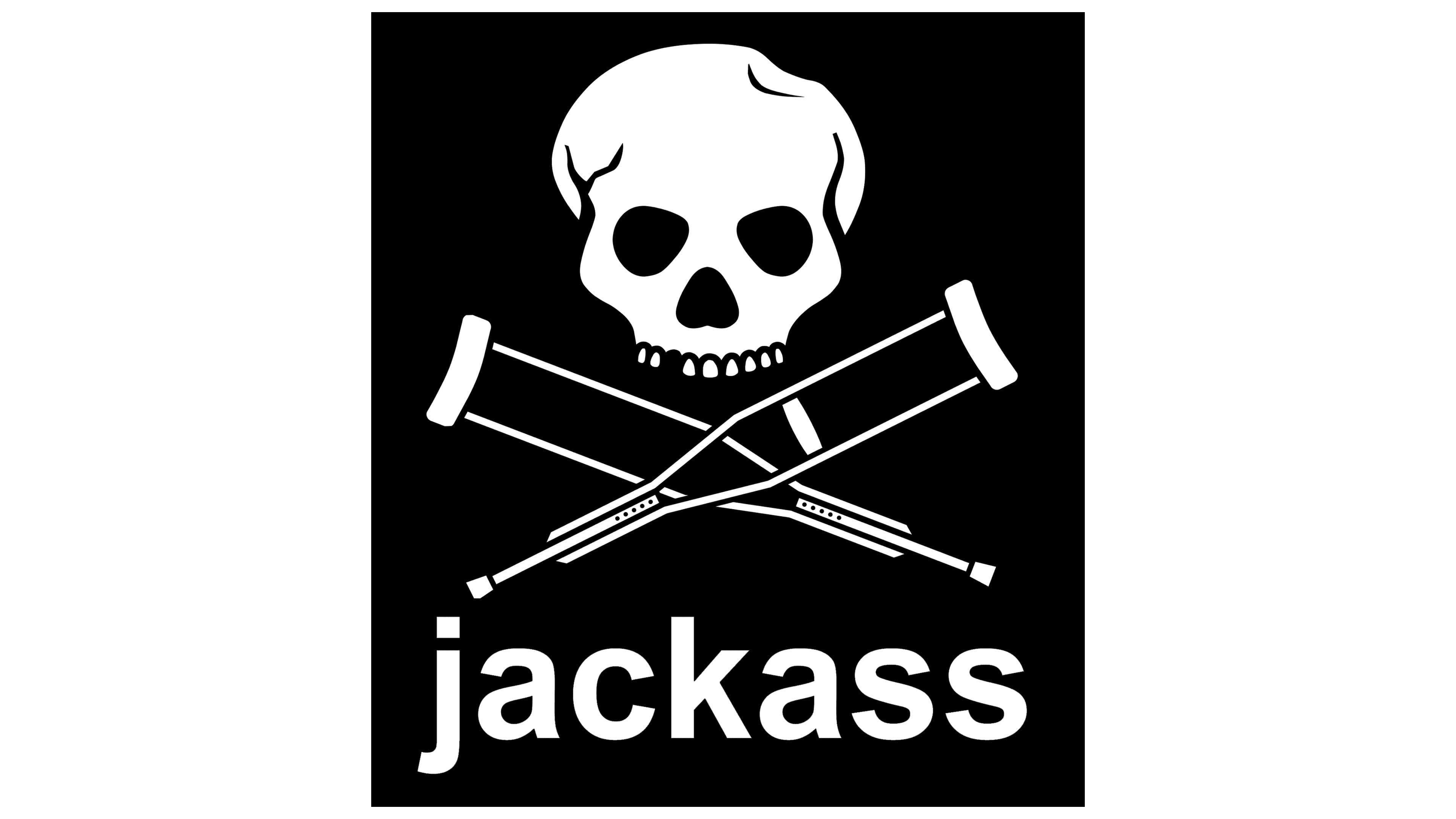
The iconic Jackass symbol was created by graphic designer Andy Jenkins, who was well acquainted with the show’s director, Jeff Tremaine. Their shared extreme past united them: they participated in bicycle motocross and skateboarding. So Jenkins knew firsthand what risk was and could present it as a drawing.
When creating the logo concept, the artist drew inspiration from the famous pirate sign, the Jolly Roger. The black flag with the image of a human skull and two crossed bones is historically linked to death. When the crews of trade ships saw it on the horizon, they knew they were doomed. Nevertheless, Jolly Roger also has a positive meaning: it expresses love for freedom. This is why the ancient symbol ended up on the emblem of a modern TV show.
- The skull is a classic sign of danger. Its presence in the logo underscores the brand’s extraordinary and reckless nature.
- Crossed crutches add a crude element of humor and are associated with unpredictable stunts performed by Jackass participants.
The skull on the logo has deep cracks, the lower jaw is missing, and one tooth is knocked out. This hints that the stunts should not be repeated due to their high risk of injury. In turn, the crutches could be a parody of Johnny Knoxville, who was forced to use them in the show’s first season. The white drawing is balanced by the same white inscription: the franchise’s name is at the bottom, typed in lowercase to balance it.
Font and Colors
The main feature of the Jackass word mark is the Helvetica Bold font. This neo-grotesque font was created by two Swiss typographers: Eduard Hoffmann and Max Miedinger. It is characterized by all strokes ending on vertical or horizontal lines. The letters have both roundings and sharp corners, making them look harmonious. The black-and-white color of the emblem is a tribute to the Jolly Roger. This sign has always been depicted on pirate flags in just such a palette.