


 Jeopardy Logo PNG
Almost all entertainment programs use frivolous logos that characterize their essence. For example, the Jeopardy logo is designed in a playful style because the TV show has a non-standard quiz show format. The emblem’s internal dynamics motivate one to be resourceful and active.
Jeopardy! grew out of a 1963 idea by Merv Griffin and his wife, Julann, after the quiz-show scandals of the late 1950s damaged trust in TV competitions such as Twenty-One. Julann suggested reversing the usual format: give contestants the answers and require them to respond with questions. Griffin pitched the concept to NBC under the working title What’s the Question?
The show premiered on NBC on March 30, 1964, with Art Fleming as host and Don Pardo as announcer. Its core format was already in place: three contestants, themed categories, clue-like answers, and responses framed as questions. The original version ran for 11 years, ending on January 3, 1975. A short revival, The All-New Jeopardy!, aired from October 1978 to March 1979.
In 1984, Griffin revived the show through syndication, giving it 13 weeks to prove itself. The new Jeopardy! premiered on September 10, 1984, with Alex Trebek as host and Johnny Gilbert as announcer. Trebek’s restrained, precise style fit the format, and the show grew alongside Griffin’s Wheel of Fortune. King World Productions distributed both programs and built a major business around them.
Production rights were later transferred to Columbia TriStar Television in 1994 and to Sony Pictures Television in 2002. In 2004, Ken Jennings won 74 consecutive games and $2.52 million, setting a record for the show. Trebek announced stage 4 pancreatic cancer on March 6, 2019, yet continued hosting until late October 2020. He died on November 8, 2020, after more than 8,200 episodes across 37 seasons.
Meaning and History
Griffin owes his wife the idea of launching a quiz show with a cash prize, which later gained immense popularity among Americans. She proposed this concept to the media mogul: creating a game program consisting of questions and answers. On the flight from Duluth to New York, she told him, “Why not give the participants ready-made answers and let them come up with their questions?” The host liked the concept and went straight to NBC with it. The management supported the idea without even looking at the trial program.
Then the search began for a specific embodiment of an unprecedented television project, as it was still raw and fraught with contradictions and dangers. As a result, instead of “What’s the Question?” (as the show was originally called), the current name was chosen. At the same time, the idea of a question-and-answer quiz was not new: something similar existed in the 1940s. A similar format was used on CBS Television Quiz’s Gil Fates.
Gradually, the TV program gained immense popularity and even the approval of professional critics. In 2013, it was ranked #45 on the list of the 60 Greatest Shows in US Television History. At the sight of its logo on the TV screen, viewers are still looking forward to an entertaining, funny action show. Over time, the Jeopardy game became a franchise: its concept was approved in other countries. In total, it has three emblems; however, they are of the same type of text, but this is where their similarity ends.
What is Jeopardy?
Jeopardy is an American television game show that has become a franchise and is now on television in many countries worldwide. The original version appeared in 1964 and has 38 seasons. The show has a non-standard format and is a quiz in which you need to ask questions about already known answers. The creator of the show is Merv Griffin. The studio releasing it is Sony Pictures Television.
1964 – 1979
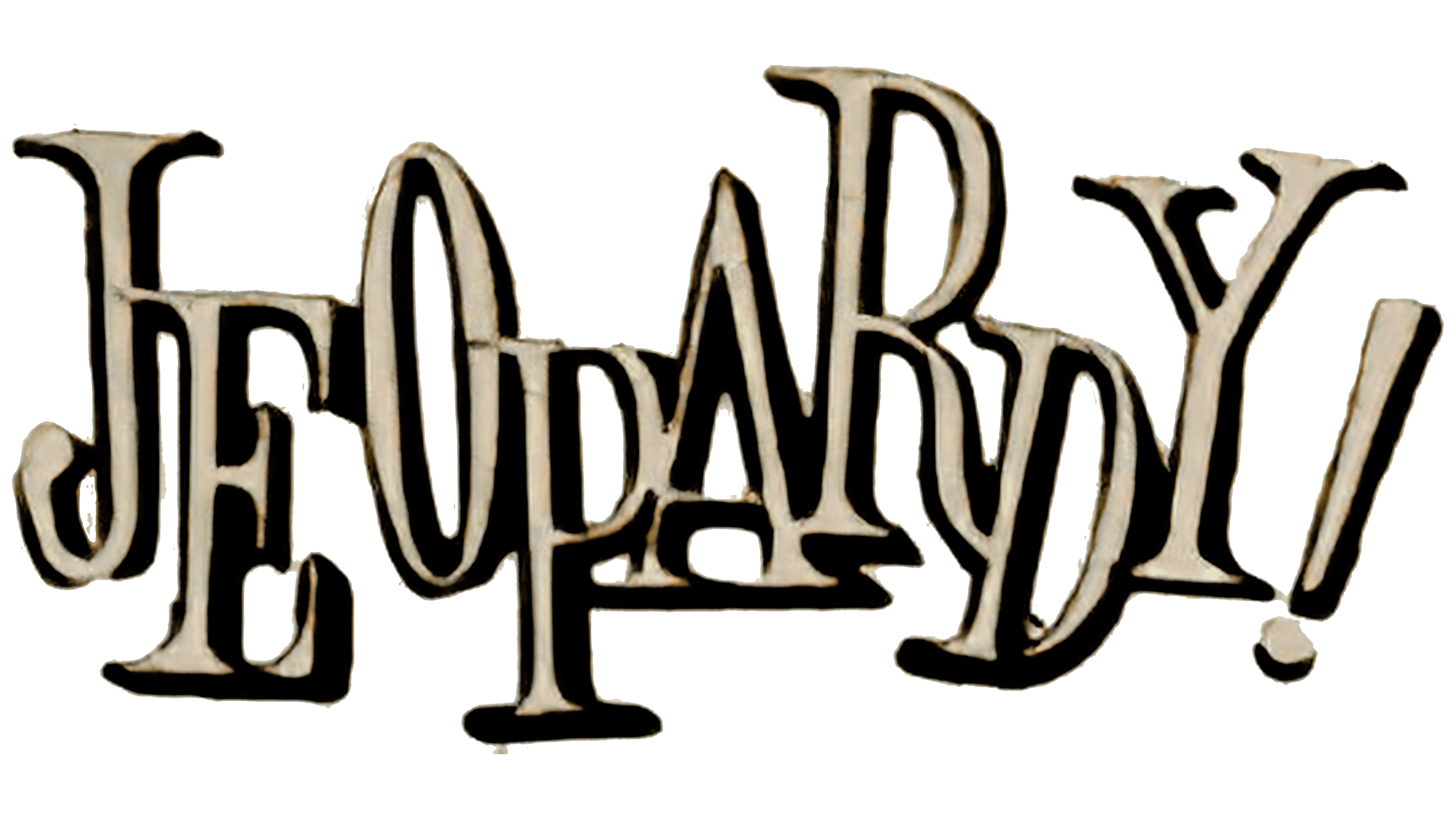
The very first Jeopardy logo features bouncing glyphs. Moreover, they are drawn individually, and the multi-level arrangement makes them jump. The symbols alternate: one is at the top, and the next is at the bottom. And so in succession. For example, “J,” “O,” “R,” and “Y” is much higher than “E,” “P,” “A,” and “D.” At the same time, all letters are capital, beige, with black shadows, including an exclamation mark (!), Which is mandatory in the full title of the TV show.
1984 – 1986
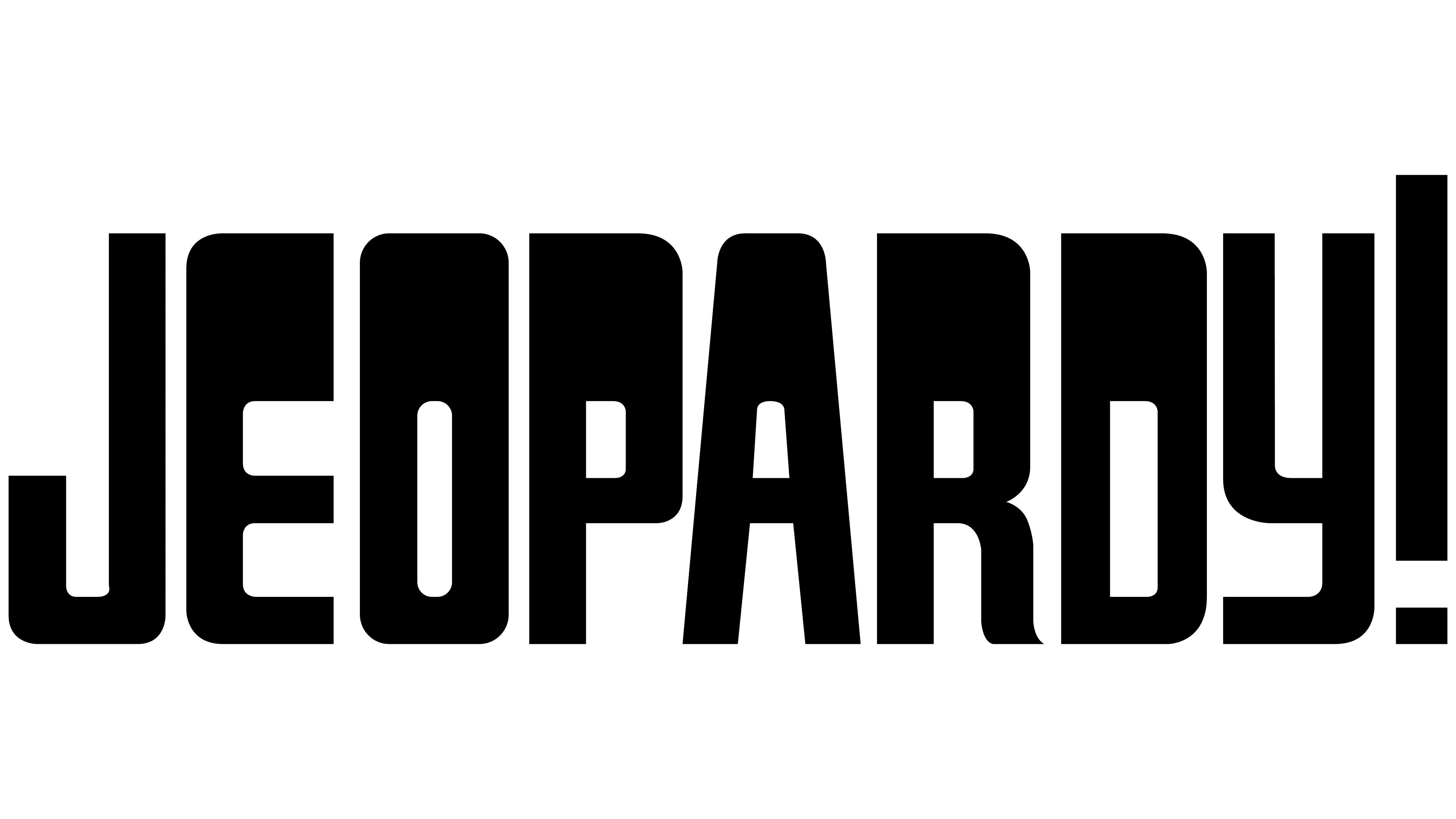
After a short pause, the game show resumed on TV. The logo has been updated, but its concept remains the same: text without graphics since the letters themselves are like a picture. They are wide at the top and narrow at the bottom, except for the first and last. The massive inscription not only conveys the danger but also looks the part. At the same time, the exclamation mark (!) is much higher than the top of the line.
1986 – today

After the redesign, the logo has changed a little. The only update was to the color: all letters are now painted blue instead of black. Otherwise, printed characters’ forms remained the same: a wide top, a narrow bottom, and elongated intra-letter gaps. The exclamation point is much shorter than before, as is the “y” hook.
Font and Colors
In the process of evolution, the Jeopardy logo has retained its original commitment to the text form. The reason is the TV show’s concept, which is more about words than pictures. The main focus of the redesign was almost always on the palette.
The developers chose an antiqua with one-sided shadows for the debut logo to make the inscription seem three-dimensional. Then there was a transition to the grotesque of individual design. Neither in the first nor in the second case do glyphs have analogs. The corporate palette consists of black, beige, and blue, which were used in logos of different periods.