


 KeyBank Logo PNG
The KeyBank logo conveys the company’s principles, creating a sense of reliability and confidence. Its design combines simplicity and symbolism, emphasizing the brand’s professionalism and stability. The color palette and shapes combine to create a memorable image of resilience and responsibility.
KeyBank traces its history to April 12, 1825, when the Commercial Bank of Albany was founded in Albany, New York, the same year the Erie Canal opened. Unlike many banks of the period, it served small merchants, craftsmen, and smaller shareholders. During the Panic of 1837, its conservative gold and silver reserves helped it resume specie payments earlier than many competitors.
A second line of the company’s history began in Cleveland on August 2, 1849, when Samuel Mather founded the Society for Savings. It started in the back rooms of Merchants Bank with $9,500 from 130 depositors. By 1867, it had built a ten-story headquarters on Public Square, and by 1920, one in six Cleveland residents held an account there.
In Albany, Commercial Bank became National Commercial Bank of Albany in 1865 and State Bank of Albany in 1958. In 1979, under Victor J. Riley Jr., it was renamed Key Banks Inc. It began expanding through acquisitions, including Pacific Bancorporation in 1986. In Cleveland, Society Corp grew through deals with Centran Corp. in 1986 and Ameritrust in 1991, shifting the regional balance in its favor relative to competitors such as National City Bank.
On March 1, 1994, KeyCorp of Albany and Society Corporation of Cleveland completed their merger. The new KeyCorp kept its headquarters in Cleveland and held $58 billion in assets. Under Bob Gillespie, who served from 1995, the bank moved toward a broader national financial services model. In 2016, KeyCorp acquired First Niagara Financial Group for $4.1 billion, adding branches across New York, Pennsylvania, Connecticut, and Massachusetts.
Meaning and History
What is KeyBank?
This well-known regional bank operates in the Northeast, Midwest, and Western United States. It offers a range of financial services, including asset management, investment banking, retail and commercial banking, and mortgage services. The bank stands out for its community-focused strategy, balancing the capabilities of a large bank with dedication to regional markets. It is well known for its strong relationships with mid-sized businesses and for its expertise in the real estate, technology, and healthcare industries. The bank distinguishes itself from many competitors through its charitable activities and emphasis on consumer financial wellness programs.
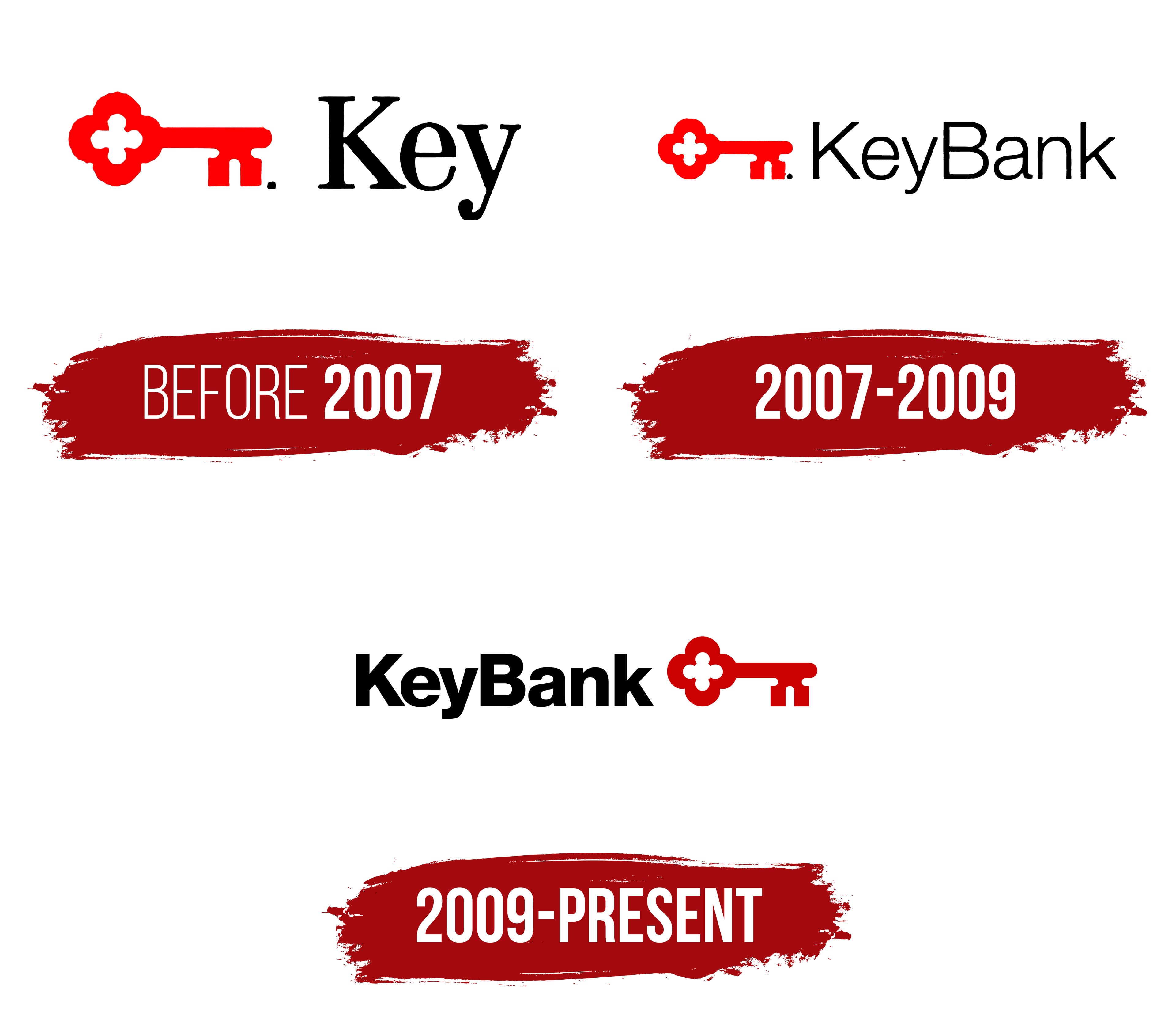
Before 2007

The original logo became the bank’s primary symbol, offering clients a wide range of valuable services. In the far-left corner, a precise image of a key sits on a white background. This element symbolizes the regional bank’s opportunities, opening prospects for clients’ financial growth.
The key was associated with access to new opportunities and strength. To enhance its impact, a rich red color was used. The bank’s name was positioned closely next to the key. The letters were designed to be proportionate to the key’s image, achieving harmony with the emblem. Despite the black text set against red, the logo’s overall appearance was balanced and visually appealing.
A dot separated the composition, highlighting meanings and organizing the informational elements. This feature linked the concept of the key as a symbol of opportunities with the textual part, creating a complete and cohesive image.
2007 – 2009

The new version of the bank’s logo continues to dominate the classic style. The unique combination of black, red, and white remains unchanged, emphasizing the company’s commitment to established traditions. The only noticeable change is the scale of the elements, which creates a sense of distance. The components are compact yet visually expressive.
The design emphasizes the word “Bank,” highlighted in bright colors. It is combined with the regional financial institution’s name. The key remains on the left side of the logo, while the text block is on the right. The dot near the key remains in place, symbolizing connection and completeness.
The text element has become more refined and sophisticated. The decision to write the bank’s name as a single word, with each word capitalized, adds a unique touch. The text is crafted elegantly and aesthetically. The logo’s elements invite reflection and analysis, pointing to high originality. The identity is filled with style and individuality, making it memorable and distinctive.
2009 – today
In 2009, the bank, having earned its clients’ trust, updated its identity. It retained key elements from the past while adopting distinctive and unique features. The key, a bank symbol for many years, changed its position. The new version is displayed in red and placed to the left of the bank’s name. The design makes the key realistic: small and elegant, evoking associations with access to new opportunities.
The company name, “KeyBank,” is rendered in black. The tall and bold letters are aligned horizontally with the key, giving the design a sense of balance. Both words are written as a single unit, each starting with a capital letter. The bold font makes the text presentable and expressive. Rounded edges and smooth lines create a sense of depth, enhancing the logo’s visual appeal.
The emblem appears vibrant and attractive due to the harmonious combination of white, red, and black colors. These shades emphasize the organization’s reliability, service quality, and stability.