Kubota Logo PNG
The Kubota logo reflects the character of a company that manufactures agricultural and construction machinery. The large metallic letters convey power, and the typeface’s shape resembles machine components. The style emphasizes the reliability, durability, and technological nature of the brand’s products.
Kubota Corporation traces back to February 1890, when Gonshiro Oide opened a small foundry in Osaka. Early output included weights, fittings, and cookware, but higher casting quality quickly attracted more complex orders.
In the 1890s, Japan needed domestic water pipes as part of sanitation reforms. Oide focused on this challenge, developing socket casting in 1897, vertical melting in 1900, and vertical rotary casting in 1904. These methods enabled the large-scale production of cast iron pipes nationwide.
Around that period, entrepreneur Toshiro Kubota adopted Oide, who took the Kubota name and renamed the company Kubota Iron Works. The workshop gained a name that later became globally recognized.
In 1922, the company began producing engines. In 1930, Japan’s Ministry of Trade recognized its Kubota Oil Engine, and the firm was incorporated as Kubota Limited. In 1953, Kubota launched a construction equipment division and, in 1960, introduced Japan’s first rice-farming tractor, followed by harvesters and transplanters.
In 1967, Ford approached Kubota about supplying OEM tractors. Although no deal was reached, it confirmed demand in the US market, where competitors like John Deere and Case focused on larger machines. Kubota developed compact diesel tractors, selling over 2,000 units in the US by 1972 and establishing Kubota Tractor Corporation in California with Marubeni.
After the 1973 oil crisis, Kubota expanded further. In 1974, it launched the KH1 mini excavator, which gained traction in Europe and Japan. By 1988, Kubota opened a major production facility in Gainesville, Georgia, producing over 100,000 machines annually.
Meaning and History
What is Kubota?
It is a Japanese multinational company that manufactures a wide range of products, including air conditioners, hardware, vending machines, engines, construction, and agricultural machinery. In America, Kubota Tractor Corporation distributes its products, and Kubota’s American Manufacturing produces them.
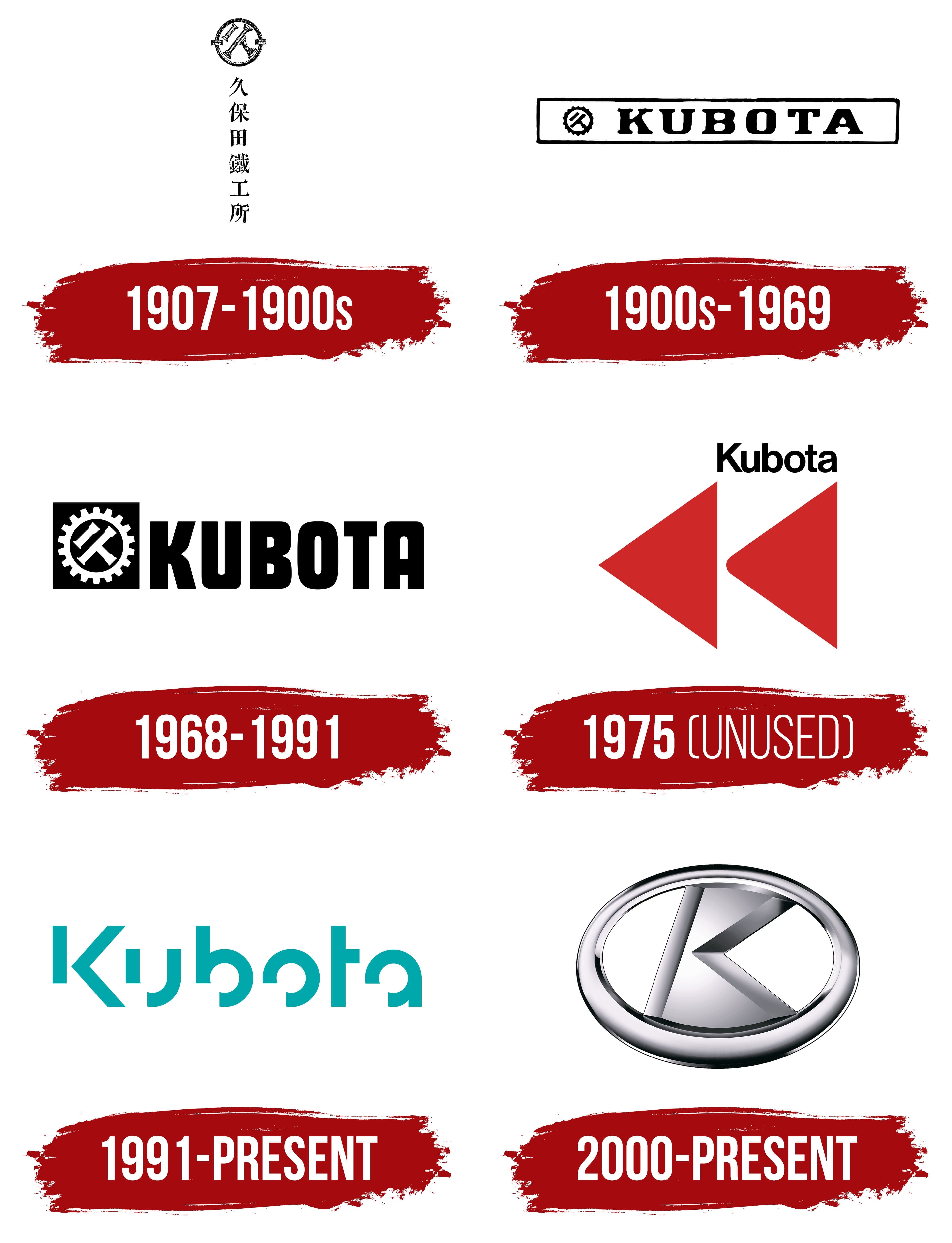
1907 – 1900s

The Japanese company Kubota’s logo originally looked very different from the emblem it is known for today. One early version appeared when the company was still known as 久保田鐵工所 (Kubota Tekkōjo), or Kubota Iron Works. This mark reflects a period when Japan’s heavy industry was developing, and metallurgy and mechanical engineering became symbols of progress and technological strength.
The composition is vertical. At the top, a circle contains three massive elements that resemble parts of a metal structure. The central bar, the largest and most elongated, rises diagonally from bottom to top. To the left and slightly above it, a shorter element runs parallel to the main one. On the lower right, by contrast, a smaller set of elements stands perpendicular to the long central segment. None of the elements touch, and gaps remain between them, emphasizing the composition’s mechanical nature. Two horizontal lines on either side of the circle mimic connections.
The elements appear massive and heavy, resembling metal profiles such as channels or I-beams. The logo evokes machinery and production processes, emphasizing the brand’s specialization.
Below the circle are six hieroglyphs written vertically from top to bottom in a calligraphic style. The characters carry an angular aesthetic with variations in line thickness. The inscription’s style is associated with the Japanese minkan tai tradition, a writing style used for official documents, industrial signage, and other serious texts.
The Kubota emblem evokes Japan’s early industrial era, when mechanical engineering relied on heavy, labor-intensive, entirely manual work.
1900s – 1969
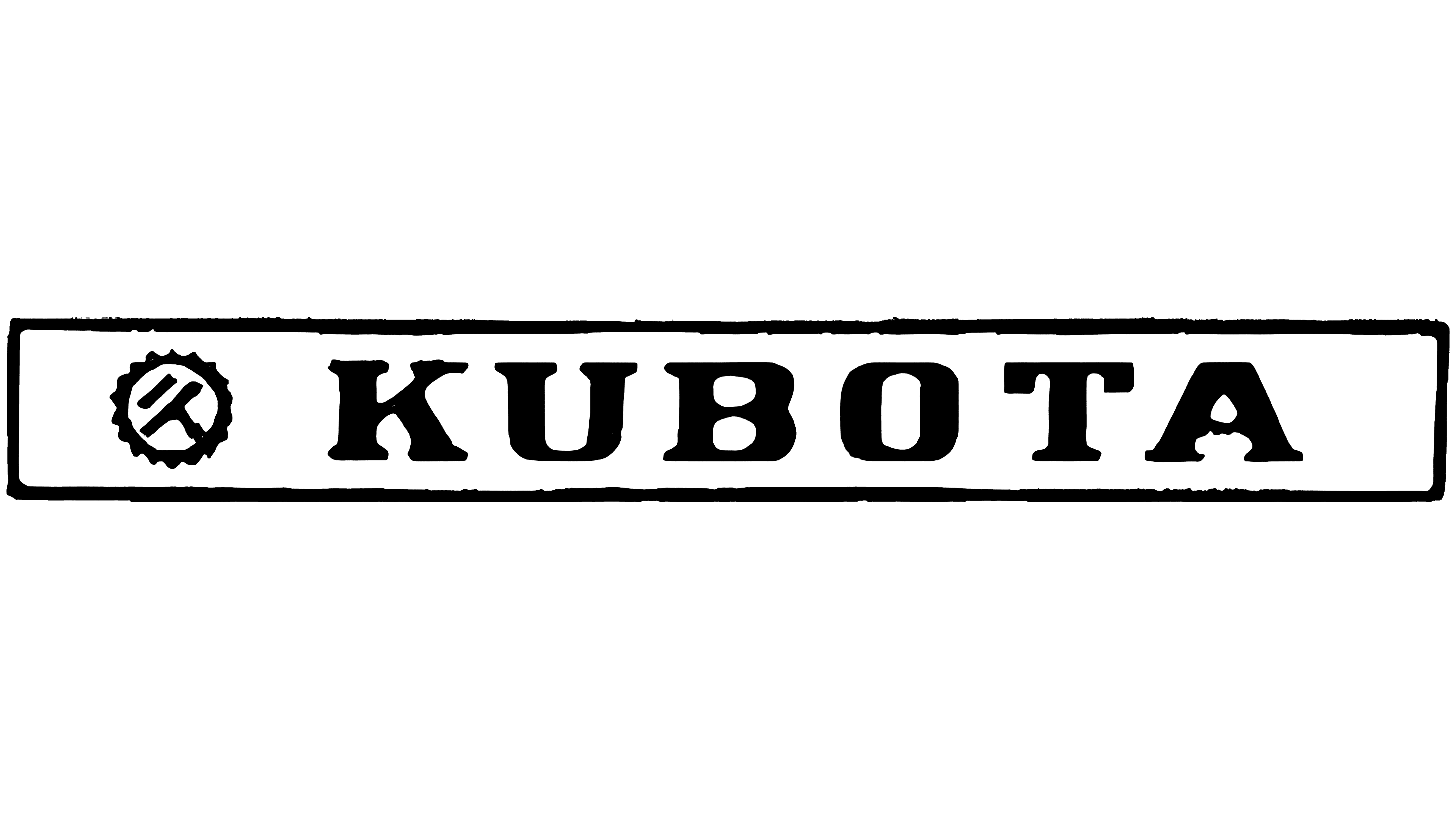
The next variation of the early Kubota mark also reflects an era dominated by heavy industry and manual labor. The name “Kubota” is centered within a framed rectangle. All letters are large, strict, and serifed, close to the Clarendon or Egyptian style.
On the left is a circle with raised teeth along the edge, stylized as a gear. Inside is an image of a heavy hammer with a massive head and a short handle. The hammer symbol conveys manual labor, blacksmithing, and metalworking. However, it may not be a literal hammer but rather a carryover from the previous symbol, as the graphics in this version do not make it entirely clear.
The overall look of the logo feels heavy and reliable, associated with the rigid technological foundation of mechanical engineering. The style reflects the era when Kubota developed industrial equipment and metal products, building a reputation tied to physical labor and industrial power.
1968 – 1991

When Kubota introduced a new logo in 1968, the company was already a well-known player in the markets for agricultural machinery, construction equipment, water treatment systems, and engines. In the updated design, the designers abandoned the frame and divided the mark into a strict wordmark and a separate technical symbol.
The word KUBOTA is set in large black capital letters. The type style is industrial, resembling a simplified version of Impact. Visually, the letters appear rigid.
On the left is a symbol familiar from earlier versions, enclosed in a square. Inside the square is a circle surrounded by gear-like teeth, pointing to the brand’s technical profile and engineering origins. Inside the gear are two elements. One is shaped like a letter T, and the second, smaller element runs parallel to it. Together, the two shapes form an image close to the Latin letter K, adding another reference to the company name.
1975 (unused)

In 1975, designer Ray Yoshimura proposed a logo for the Japanese company Kubota that ultimately remained on paper. Nevertheless, it differed from all previous brand symbols.
In the upper corner, the word Kubota appears. The first letter is capitalized; the rest are lowercase. The typeface is smooth and sans-serif. The font is close to Helvetica, although the letterforms appear slightly simpler and calmer. The text color is black.
The main emphasis, however, is not on the wordmark. Beneath it are two large red triangles with their points facing left. The shapes are placed side by side and visually form a symbol resembling a rewind arrow, familiar from audio and video players.
Both triangles are bright red. The association with a rewind or double-arrow symbol may be ambiguous, given the company’s field of activity, which includes mechanical engineering and agricultural and construction equipment. Because of this ambiguous perception, the logo was unusual for the company and was never officially adopted.
1991 – today

In 1991, designers Woody Pirtle and Michael Gericke of Pentagram introduced a new Kubota logo that reinterpreted the Japanese equipment manufacturer’s image. The brand retained only the name, while changing its visual approach.
The word Kubota became the center of the entire composition. The letters are lowercase, with the first K styled as a capital and larger than the others. All characters are set in a custom typeface that blends constructivism with restrained geometry. The lower left corner of each letter is cut diagonally. The exception is the letter t, where the left edge of the horizontal stroke is cut.
Despite these features, the typeface still feels soft overall. The text is colored in a bright turquoise tone with a slight hint of mint. The brand color stands out against typical industrial hues, creating a fresh, unusual image for a company previously associated mainly with heavy machinery.
2000 – today

The Kubota logo, created during a period when the company embraced an industrial style, moves away from earlier approaches toward a more technological look and volumetric forms. The emblem is built around a metal effect and the play of light and shadow, emphasizing the brand’s connection to mechanical engineering and heavy equipment production.
At the core of the mark is an oval with a chrome-like shine that resembles a metal component. The ring’s surface is polished, with light flowing smoothly across it. The emblem looks realistic and reads as a real industrial element rather than a flat symbol.
Inside the ring is the main figure, a stylized letter K formed by two angular facets. Each facet is treated to suggest relief and metal processing. The color gradient enhances depth and volume, making the figure resemble a cast or milled metal blank.
The emblem’s appearance points to machinery and production. Kubota is known for industrial equipment and agricultural machinery, and the mark aligns with the brand’s positioning, conveying its engineering heritage and focus on technology.
Font and Colors

The stylish graphic element complements the inscription; the letter “K” sits above it within an oval. For the image design, the designers chose a gradient transition in shades. As a result, the image appears voluminous. The metallic color reminds viewers of the company’s main activity.