


 Mercedes Benz Logo PNG
The Mercedes-Benz logo reflects the brand’s history, which began in Germany. The name and emblem honor the technical genius of Karl Benz and the legacy of the Daimler concern, which later became part of the company.
Mercedes-Benz traces its origins to parallel work by Karl Benz and Gottlieb Daimler. In 1885, Benz built the Patent-Motorwagen in Mannheim and patented it in January 1886. At the same time, in Stuttgart, Daimler and Wilhelm Maybach independently developed their own engine-powered vehicles.
In 1890, Daimler founded Daimler-Motoren-Gesellschaft. The name Mercedes appeared in 1900 after Emil Jellinek ordered racing cars and named them after his daughter. The 1901 model gained attention, and in 1902, Mercedes was registered as a trademark.
In 1926, Benz & Cie merged with Daimler-Motoren-Gesellschaft to form Daimler-Benz AG, creating the Mercedes-Benz brand. The three-pointed star and Benz laurel wreath were combined into one emblem.
In the 1930s, the W125 and W154 models dominated European Grand Prix racing. The “Silver Arrows” nickname emerged after weight reduction stripped away the white paint, revealing bare metal.
World War II halted production, but manufacturing resumed in 1946. In 1954, the 300SL introduced fuel injection and distinctive gullwing doors, competing with Ferrari and Jaguar.
In 1963, the 600 limousine became associated with political leaders. From 1976 to 1985, the W123 series reached nearly 2.7 million units.
In 1998, Daimler-Benz merged with Chrysler Corporation to form DaimlerChrysler, which was later dissolved in 2007. The same year, Smart launched with the Swatch. In 2021, Daimler Truck was separated, leaving Mercedes-Benz AG focused on passenger vehicles.
Meaning and History
The three-pointed star, the brand’s current logo, has been known for over a hundred years. Gottlieb Daimler first used it and patented it in 1901. The future automotive giant emerged from a merger of two large, competing companies: Benz & Cie (led by Karl Benz) and Daimler-Motoren-Gesellschaft (led by Gottlieb Daimler). The brand name came from the leading cars of these companies: the Benz Patent-Motorwagen (1886) and the Mercedes (1900).
Initially, Daimler used the brand name as a personal marker: it indicated his home’s location. It was a symbolic marker, not tied to a specific car or even a car brand.
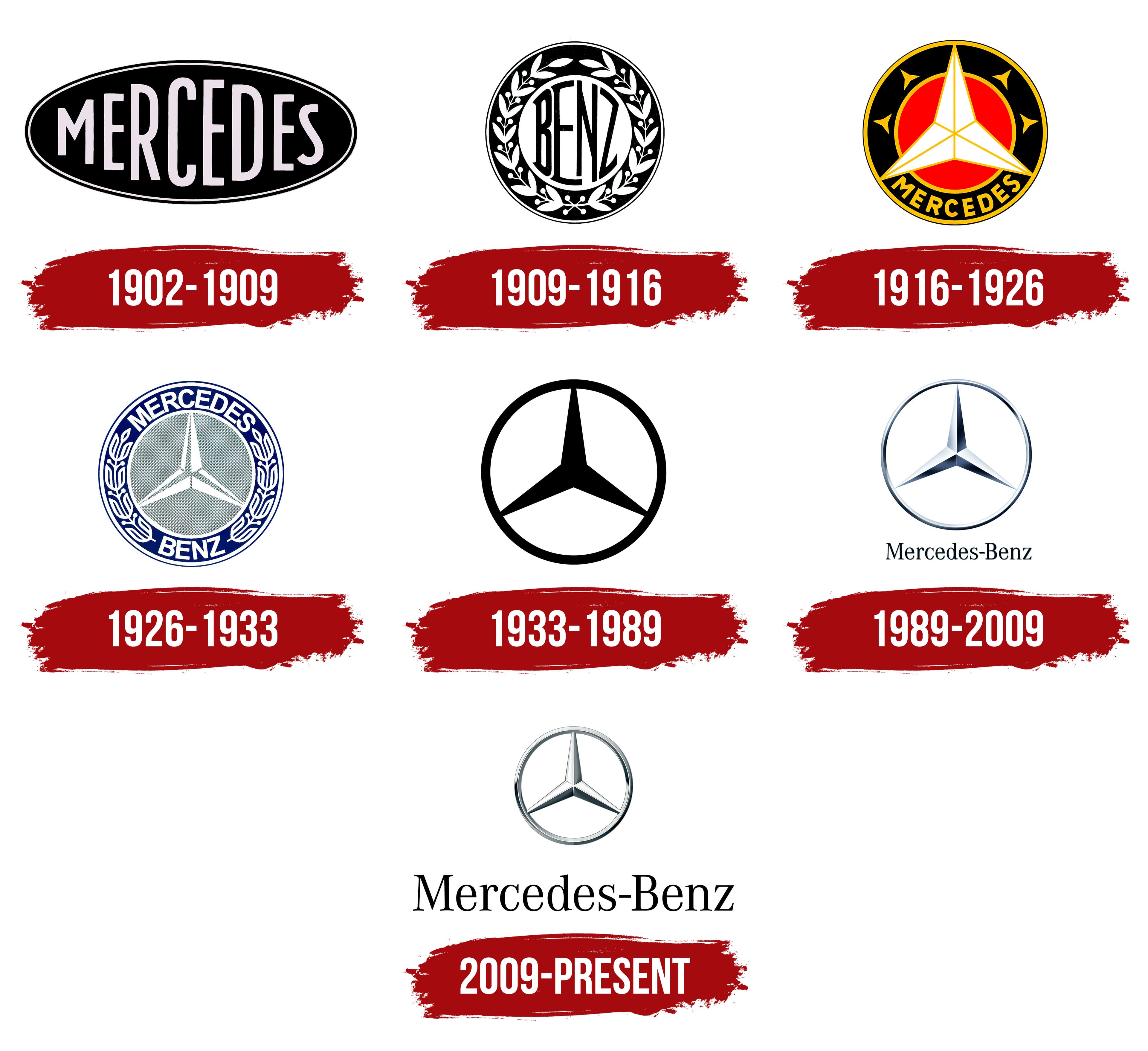
Before the two companies merged into the single concern Daimler-Motoren-Gesellschaft, the word “Mercedes” appeared in a horizontally stretched oval on the emblem. In 1909, the competitors made the central element a star. In 1916, they placed it in a double circle: a red inner ring and a dark gray outer ring. The backgrounds linked the emblem to the manufacturer’s field of activity. However, over time, they disappeared, as the company’s area of work was already well known.
Gradually, the logo evolved from a complex form to a simpler one until it was reduced to a three-pointed silver star within a circle. By the time the automotive companies merged, the new company already had its current appearance, so it became the distinctive symbol of the new structure.
What is Mercedes-Benz?
Mercedes-Benz AG is an automotive company from the German city of Stuttgart. It had several predecessors who, starting in 1926, united under a common name. The word “Benz” honors Karl Friedrich Benz, the inventor of the first internal combustion engine. Mercedes cars are manufactured in Germany and other countries on five continents.
1902 – 1909

Initially, the automotive giant’s logo was extremely simple. It consisted only of the word “Mercedes,” placed inside a horizontal oval with a double frame. The letters were uneven in height: small on the edges and large in the middle. The background was black, and the font was gray.
1909 – 1916

In the early days of its formation, the future company chose a round emblem, in the center of which, on a white substrate, was an elongated inscription “Benz.” On a dark background, a light laurel wreath surrounded it.
1916 – 1926

After the two founding companies merged, management combined their logos. The updated version includes the classic rondel and the word “Mercedes.” The name is located at the bottom of the double circle. In the center is a three-pointed star, divided by long, thin lines of the same color as the inscription below it. It reduced the central ray on the left
1926 – 1933
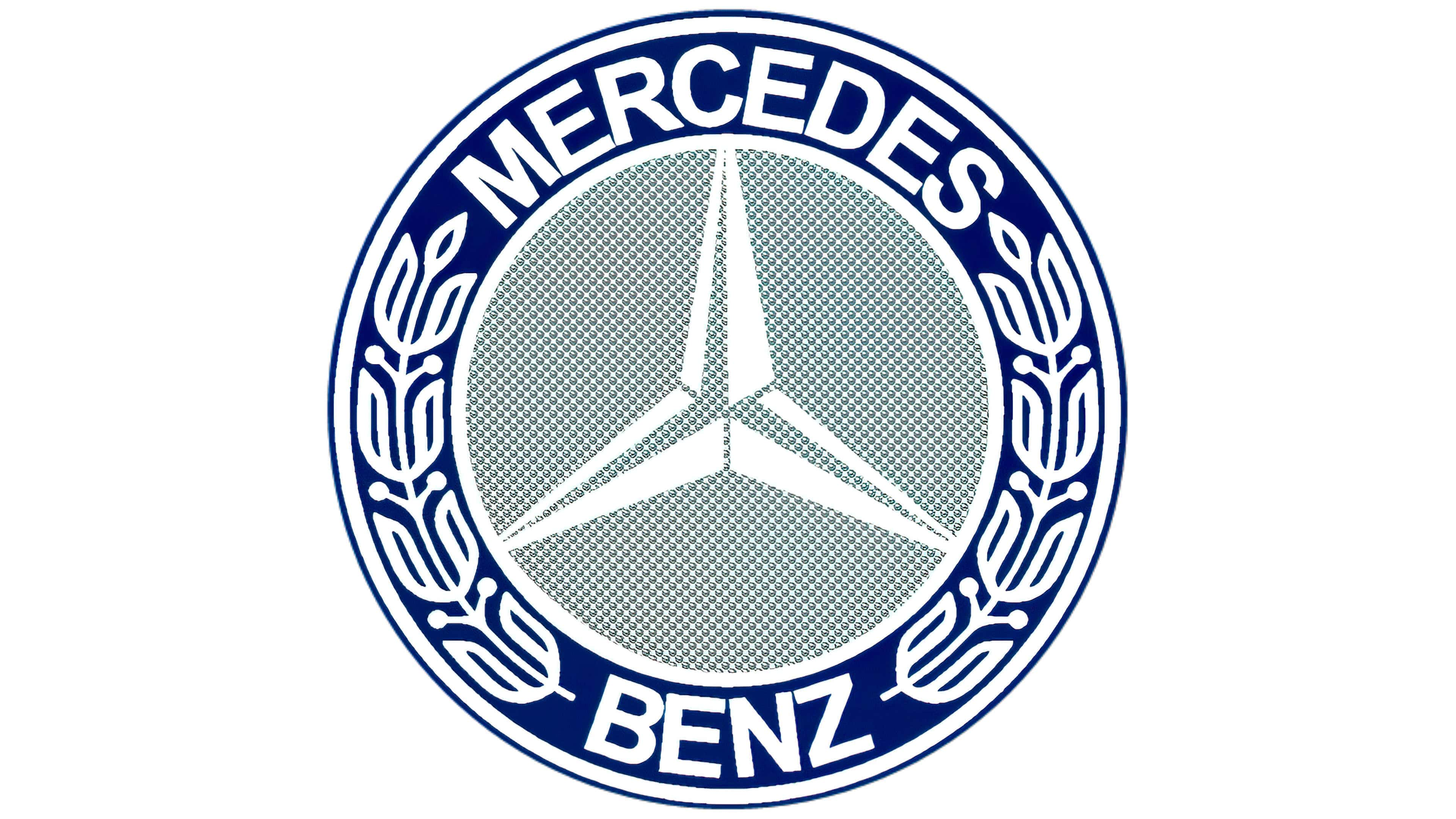
In this version, the company’s management chose to reflect the automaker’s shared past. As a result, the emblem bears both names: “Mercedes” (at the top) and “Benz” (at the bottom). The rest of the space on the wide border strip is occupied by a wreath of laurel branches – a sign of leadership and great honor. The central space features a smaller circle with a three-pointed star, each ray of which is white on one side and gray on the other, creating a three-dimensional effect.
1933 – 1989

This period is the least extensive in the history of the German concern’s logo. It consists only of a white circle and a black star.
1989 – 2009
In 1989, an emblem with the familiar design used today appeared. It represents a metallic star with three rays, set in a circle. Below it is the combined inscription of the founding companies: “Mercedes-Benz.”
2009 – today

In this version, the designers changed the scale ratio of the main elements. They increased the prominence of the company’s name and reduced the graphic icon, enhancing the effect of the steel’s shine.
Font and Colors
The image representing Gottlieb Daimler’s home has different meanings. Initially, it was a protective sign, but later it took on a broader meaning. The trinity (as indicated by the number of rays) has always been considered sacred, the number of perfection.
Thus, Daimler emphasized that his company’s products dominate three elements: water, air, and earth. After all, the company produced engines for marine and river transport, motors for the aviation industry, and power units for land vehicles. He created, developed, perfected, and tested them, adapting to the requirements of the time. It is no wonder that one of the first models was a racing car, on which engines are usually tested.
After the industrial sites merged, the Mercedes trademark was not approved for a respectful reason: similar symbolism (the name in an elongated ellipse) had already been secured by the Italian auto giant Maserati. As its closest competitor in the global market, its creators used a three-pointed star as its symbol.
Initially, they tried to explain it as a steering wheel; later (after the war), as a lifebuoy. However, such interpretations did not take hold because Daimler breathed an entirely different meaning into it. So it remained. Emil Jellinek, the French consul and distributor of the Gottlieb company, chose the name Mercedes. He convinced his employer that the name sounded cool and was already known in racing circles.
Before approving the three-pointed sign, they experimented with it: designers tried removing the circle, making the sign four-pointed, and changing the color. But after several attempts, they decided to leave it as it is. There were several reasons: the three-pointed star is unique and recognizable, and without the circle, it feels unrepresentable. The four-pointed version found no practical application.

The font has never played a dominant role in the logo, so the brand name is written in a classic font. All letters have the same thickness and are easy to read. But the color was given great attention. In the early years, the emblem was gold, white, red, and blue, and it was even topped with a yellow laurel wreath. In 1916, when the central element became a star, it was painted in silver.
FAQ
What does the Mercedes-Benz logo represent?
The silver three-pointed star surrounded by a ring of the same color symbolizes the incredible power and reliability of Daimler engines.
Why did Mercedes choose its logo?
The three-pointed star has been part of the Mercedes logo since 1916. Adolf and Paul Daimler created this design. The logo was inspired by a postcard their father, Gottlieb Daimler, sent in 1872. He marked his birthplace on the star and wished for it to shine over a prosperous factory.
What does the Mercedes-Benz emblem represent?
The Mercedes-Benz emblem reflects the company’s ambitions. The rays of the three-pointed star symbolize this automaker’s dominance in the air, on land, and on water. It’s also a tribute to historical tradition, as this element of the emblem has been used since 1916.
Which Mercedes has a glowing emblem?
The emblem with LED backlighting fits 2006+ CLS-Class, 2012+ M-Class, 2013+ GL-Class, and 2014 E-Class models. It represents a large star in a ring on the radiator grille.
What does the Mercedes symbol represent?
The Mercedes symbol, a three-pointed star, personifies the company’s worldwide dominance. Specifically, it symbolizes the automaker’s aspiration for its engines to dominate on land, in the air, and on water.