


 Renault Logo PNG
Wherever your journey takes you, the Renault logo shows that Renault is the best traveling companion. This brand’s cars are reliable and can handle long journeys, uphill driving, and off-road driving.
Renault was founded on February 25, 1899, when Louis Renault registered Société Renault Frères in Boulogne-Billancourt with his brothers Marcel and Fernand. Louis had built his prototype in a garden shed in late 1898, and its direct driveshaft helped it climb a steep Paris street where other cars struggled. The demonstration brought 12 orders.
Marcel died during the Paris-Madrid race in 1903. Fernand left the business in 1908 and died soon after, leaving Louis Renault in control. The factory moved toward flow production in 1905. It adopted the Taylor methods in 1913, while early racing wins, including French Grand Prix victories, helped build the company’s technical reputation.
During World War I, Renault produced trucks, ambulances, shells, and the FT17 light tank, whose 360-degree rotating turret influenced later tank design. Between the wars, Renault competed with Citroën and expanded into taxis, buses, tractors, and aircraft engines. Under German occupation, the factory produced trucks for the Wehrmacht. Louis Renault was arrested in 1944 and died in custody. On January 1, 1945, De Gaulle’s government nationalized the company and renamed it Régie Nationale des Usines Renault.
After the war, Renault focused on mass-market cars. The 4CV launched in 1946 and sold 1.1 million units. The Renault 4 arrived in 1961 and reached 8.5 million sales by 1992. In 1984, Renault introduced the Espace, Europe’s first minivan. After heavy losses in the 1980s, Renault stabilized and was partly privatized in 1996. In 1999, it bought a 36.8% stake in Nissan and acquired Dacia. Nissan later took a 15% stake in Renault, and Mitsubishi joined the alliance in 2016.
Meaning and History
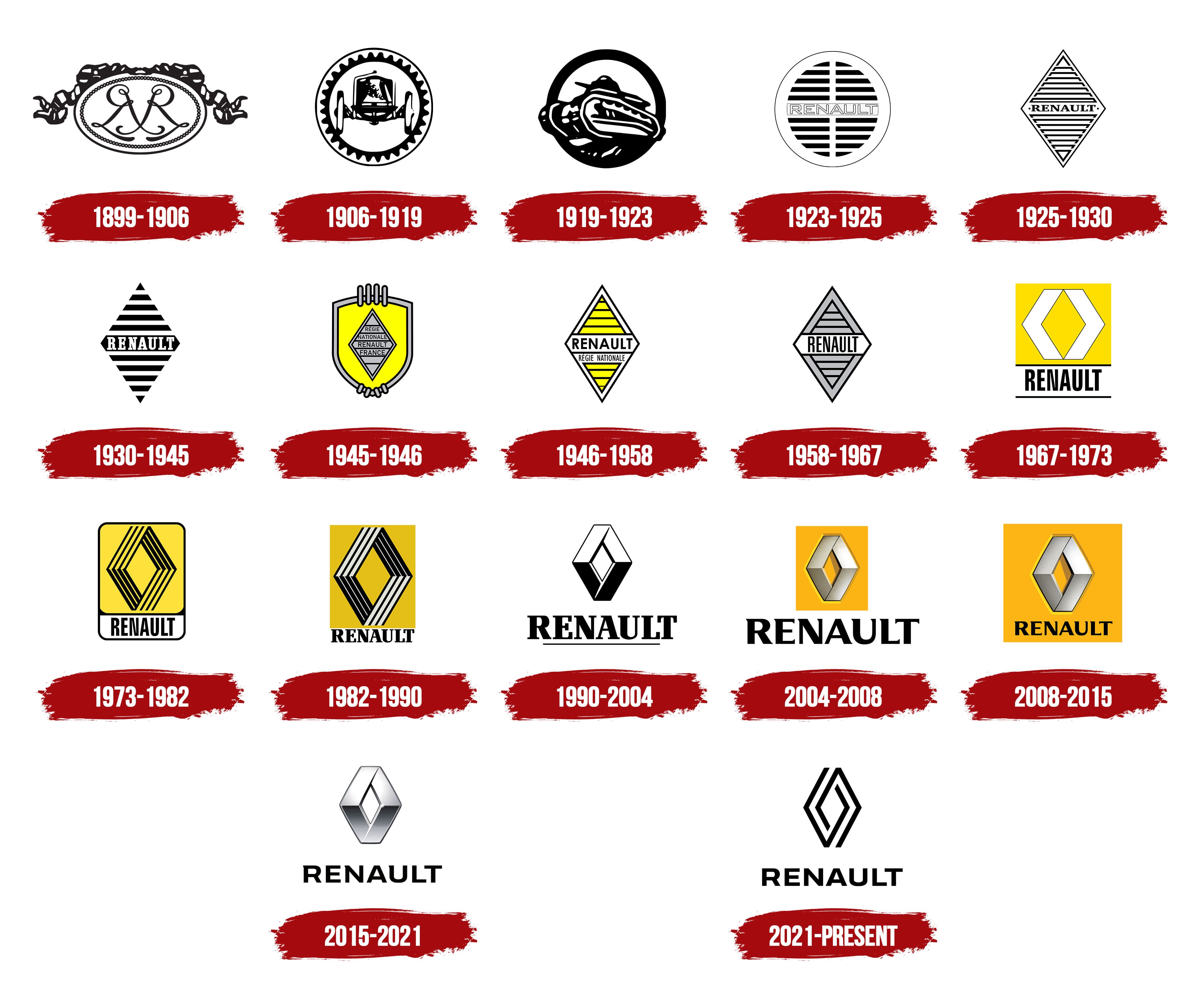
Although the company is officially believed to have been founded in 1899, the first car was designed in 1897 and sold to a family friend. After that, engineer Louis Renault started his own business, Société Renault Frères.
The company adopted its first emblem in 1899, right after registering the brand. Over its long history, it has undergone many transformations. As a result, the emblem has been widely recognized worldwide. It acquired its famous diamond shape during the redesign in the second half of the twentieth century and has kept it ever since. In total, the automobile giant has used 18 emblems in its history.
What is Renault?
It is a French car manufacturer, officially registered as Renault S.A. but better known internationally as Groupe Renault. Its history began in 1899 when the Renault brothers started producing four-wheeled cars. Now, the company offers a wide range of cars, including the Duster, Logan, Kangoo II, and Clio V.
1899 – 1906
The debut sign of visual identification is an exquisite example of its time. It takes the form of an oval medallion with a monogram on the inside. The first letters of the surname and first names of the brothers Louis, Marcel, and Fernand Renault are encrypted in an elegant interweaving of handwritten symbols. The horizontally elongated ellipse is decorated with a ribbon.
1906 – 1919

The second logo is made in a purely masculine style. It shows a car from that time, enclosed in a round, gear-shaped frame. On the outside, there is a solid, thin line.
1919 – 1923

During the First World War, the company retrained to produce military equipment, so it chose a powerful tank as its logo. Its tracks extend beyond the circle bordered by a wide stripe.
1923 – 1925
In 1923, the name first appeared on the automobile company’s emblem, which became central to its identity. It is arranged horizontally and appears as a frontal imprint on the car’s radiator grille. The emblem is circular and consists of 20 short, equal-thickness strokes enclosed in a thin line.
1925 – 1930
After the redesign, the logo changed significantly; it became a rhombus. This geometric figure has survived to this day. The developers replaced the grotesque with a serif font and affixed the name to an improvised plate with two screws at the edges.
1930 – 1945
The rhombus stripes widened, the bezel disappeared, and the letters became elongated.
1945 – 1946
During this period, designers placed the rhombus on a yellow shield with a wide gray border. The inner element with the French inscription “Regie Nationale Renault France” is also painted in gray. The shield also has vertical strokes, four at the top and four at the bottom.
1946 – 1958
The designers designated yellow as the company’s corporate color and reapplied it. But this time, they removed the shield and the word “France,” placed the lettering on a white background, and added a double border to the rhombus.
1958 – 1967
This period used an emblem with thinly sliced lettering on a white background. The remaining details were painted gray. The number of stripes was reduced to six, three at the top and three at the bottom.
1967 – 1973
In 1967, Renault introduced an updated rhombus design consisting of two wide triangular markers placed opposite each other. However, Kent sued because its logo also featured a similar rhombus rotated 90 degrees.
1973 – 1982

The scandalous emblem was replaced by another variant, proposed by Victor Vasarely. This is also a rhombus, but formed by the negative space inside the sixteen stripes, four on each side. The black shape is placed in a yellow, rounded rectangle. Below is the stamp’s name.
1982 – 1990
The designer removed the rectangle’s frame, replaced the serif font with a sans serif, and sharpened the rhombus’s edges to resemble a racetrack.
1990 – 2004
The rhombus lost its linearity, leaving only four flat edges. The upper part of the geometric figure is colored white, and the lower part is black. The inscription is enlarged and emphasized by a thin black line.
2004 – 2008

The developers painted the rhombus silver, added a yellow background, and chose a different font for the company name.
2008 – 2015
All items are saved and placed in a large rectangle.
2015 – 2021
The current logo is a gray rhombus with a metallic sheen and a graphite symbol of victory at the bottom of the Latin letter “v.”
In 2018, the car company celebrated its anniversary, so the management decided to respect tradition and approve the old logo. It resembles the 1925-1971 version and features alternating black-and-white stripes with an inscription at the center.
2021 – today

The company has unveiled the emblem expected to appear on updated Renault 5 models in 2025. It depicts a diamond-shaped pattern made up of broken lines resembling a labyrinth. Designer Gilles Vidal created this variant.
Font and Colors

The French automobile brand chose the rhombus as a visual identifier and presented it in various variations. It was first used in the late 1920s.

Different fonts were used for authentic emblems: Century Gothic Bold, Compact Light, Renault MN Bold, Renault Identite, and Renault Life Bold. The corporate palette is standard: iray (silver, metallic), yellow, and black.
FAQ
What does the Renault logo stand for?
The Renault logo is shaped like a rhombus formed by two broken lines. At first glance, it looks like an abstract design, but it represents a diamond and the brand’s most valuable qualities.
Has Renault changed its logo?
Yes, Renault changed its logo in 2021. It retained the overall lettering style but removed the small serifs in the top-left corners of the letters “R,” “N,” and “U.” The geometric shape was significantly redesigned: designer Gilles Vidal turned the wide silver stripes into thin black lines and doubled them. At the same time, the rhombus shape remained the same.