


 Ford Logo PNG
The Ford logo demonstrates elegance, brilliance, and a complete warranty package. The company’s cars will decorate any garage because it understands customers’ needs. The emblem signals strong technical performance and added benefits.
Henry Ford was born in 1863 near Dearborn, Michigan, and preferred mechanics to farm life. In 1896, he built his first car, the Quadricycle, in a shed behind his home. His first companies, the Detroit Automobile Company in 1899 and the Henry Ford Company in 1901, failed due to conflicts with investors. On June 16, 1903, Ford and 11 partners founded Ford Motor Company with $28,000 in capital.
The Model T arrived on October 1, 1908. Built from vanadium steel, with simple mechanics and a low price, it targeted ordinary buyers. Its price fell from $850 to $290 by 1924. Ford’s biggest production change came on October 7, 1913, when the Highland Park plant launched the moving assembly line. Chassis assembly dropped from 12.5 hours to 1.5 hours. On January 5, 1914, Ford introduced the $5 workday with an eight-hour shift, making factory jobs highly attractive.
By May 26, 1927, Ford had built 15 million Model T cars. The Model A followed, selling over 5 million units by 1931. In 1932, Ford introduced a successful mass-produced V8 engine. The company bought Lincoln in 1922 and created Mercury in 1939. Postwar icons included the Thunderbird in 1955 and the Mustang in 1964, later answered by the Chevrolet Camaro. Ford went public on the NYSE in 1956. It later bought stakes in Mazda, Aston Martin, Jaguar, KIA, Land Rover, and Volvo. During the 2008-2010 crisis, Ford avoided government bankruptcy, unlike GM and Chrysler.
Meaning and History
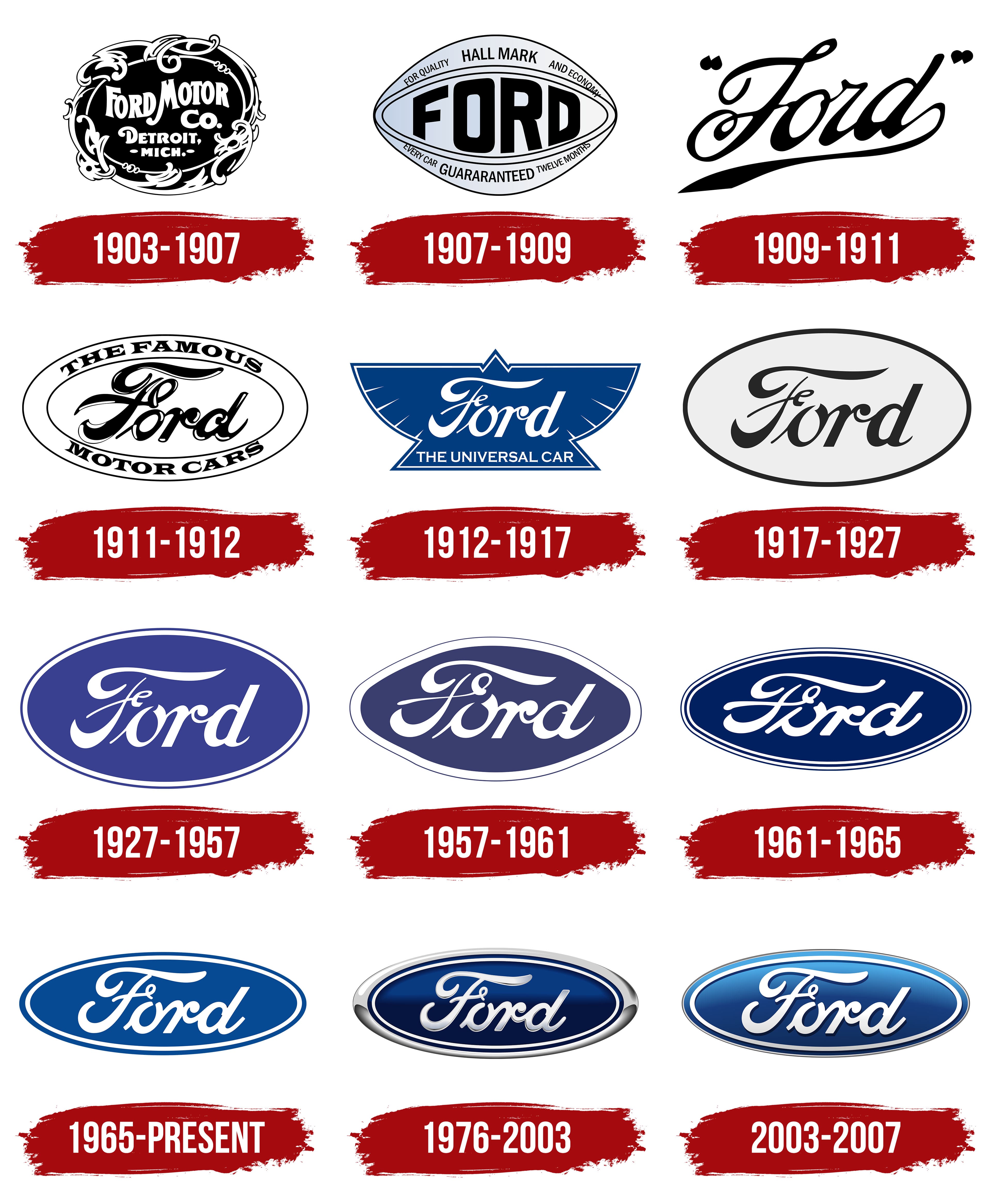
Ford changed the emblem several times as she sought the perfect balance of shapes and colors. As the main element, she used her name, set in cursive. This variant appeared in the early 1900s and was improved over time. After much experimentation, the inscription appeared inside a vertical ellipse, first white and then dark blue. The emblem sometimes became three-dimensional through a gradient, but a flat two-dimensional design recently appeared.
What is Ford?
Ford is the flagship brand of Ford Motor Company, the second-largest automaker in the United States and one of the world’s largest family-owned businesses. Its vehicles are sold almost everywhere: they are driven in cities, off-road, and on race tracks. In addition to gasoline-powered models, the manufacturer produces cars powered by alternative fuels.
1903 – 1907
The debut logo is a vivid example of its time. It looks like a round badge intertwined with a floral pattern of stems and leaves. In the center, in a diagonal oval, is the brand’s abbreviated name. The top row reads “Ford Motor”; the second row reads “Co.”; the third row reads “Detroit”; and the fourth row reads “Mich” (part of the state name). The lines are wavy.
1907 – 1909
In 1907, the company replaced the retro emblem with a modern one. As a result, the leaves, stems, and curls disappeared; it now looks stricter and resembles an eye or a rugby ball. The oval shape contains several inscriptions. The largest one is located in the center. This is the word “Ford” with uneven letters: the central ones are large, and the side ones are small. Then, they added color to the logo: the background became gray. Harold Wills designed this version of the logo.
1909 – 1911

At the time, the car company adopted a new logo that became the basis for all subsequent variations. It represents a single inscription – a handwritten stroke. The word “Ford” is written in cohesive italics, mimicking handwriting, and is enclosed in quotation marks as two merged dots. It features many curls and rounded shapes, with a long tail extending from the letter “d” to form the bottom line.
1911 – 1912
The designers took Henry Ford’s signature as a base. They placed it in a horizontal oval, enclosed by a double line, with a wide inner line (white) and a thin outer line (black). Around it, the developers placed the phrases “The Famous” (above) and “Motor Cars” (below).
1912 – 1917

After a radical redesign, the automobile manufacturer received a completely different logo. It resembles a coat of arms featuring a soaring bird with a wide tail and spread wings. The emblem is blue and contains the old signature with the slogan “Universal Car.”
1917 – 1927

For ten years, Ford used a minimalist version of the emblem. It consists only of the name, the founder’s signature shape, and an oval surrounded by a thin black band. The inner background is a light lilac.
1927 – 1957
The background color darkened by several tones, becoming a deep purple. A double border was also added. The text and lines are in white. However, the 1949 models used a different logo: the coat of arms.
1957 – 1961

The Ford emblem has an updated shape: an oval with a protruding center and tapering ends. The bright purple was replaced with a darker shade. The letters were slightly transformed: the strokes were lengthened, and the symbols were rounded.
1961 – 1965

Another redesign introduced a different lettering style, flattened and elongated. This is because the oval became narrower and more standardized, with no thickening. The developers removed the magenta color and replaced it with dark blue. A double stroke was also added.
1965 – today

The brand name was radically rethought: it is now an ellipse with a white inner contour, reminiscent of the 1927 emblem. The font is italic, tall, and elegant. In 1976, this logo was replaced with alternative logos, but the car company returned to the main logo again (in 2017). Two other emblems were used alongside it.
1976 – 2003
The Ford emblem became dark cobalt, elegant and voluminous, with highlights, a gradient, and a chrome border (now a wide, silver border with shadows).
2003 – 2017
For the centennial, the automaker redesigned the oval badge. Pantone Studios developed the new design, which removed the wide silver border, replaced the metallic texture with a blue gradient, and added a 3D effect. However, in 2017, the company switched to the old 2D logo from 1965. That said, the 2003 version hasn’t disappeared completely: some models still feature it inside.
Font and Colors

Ford Motor logo
The transformation of the Ford logo began with a complex structure and ended with a complex sign despite having only one main element. The designers focused on textures, colors, highlights, shadows, and transitions. In the latest versions, they also experimented with gradients.
The company chose a customized typeface for its logo based on Henry Ford’s signature. As a result, the text is italicized and handwritten. The corporate palette is diverse. It includes shades of purple and blue, from light to saturated. It also includes gray, metallic, silver, and chrome.
FAQ
What does the Ford logo mean?
The Ford logo has no hidden meanings. The lettering in an ellipse is elegantly done to inspire consumer confidence and present the company at its best. Only the colors are symbolic. Blue symbolizes perfection, excellence, strength, and reliability, while white symbolizes purity, permanence, and nobility.
Why did Ford choose their logo?
Henry Ford, the founder of the automobile company, asked his friend Childe Harold Wills to help design a logo. He approached the task enthusiastically and created the elegant “Ford” lettering with a curl on the letter “F.” Wills already had experience in this area, having used the same font for his business cards.
What is the Ford logo called?
The Ford logo is called the “Blue Oval” because of its shape: since 1927, it has featured a blue oval. This element forms the basis of the inscription and remains in place despite numerous redesigns; only its shades and shape change.