


 Hero Logo PNG
Confidence, progress, and strength define the identity of the Indian brand Hero, whose logo is characterized by relevance and dynamic execution. The elegant, refined sign reflects the corporation’s diversity and the continuity across generations.
Hero’s roots go back to 1944, when Brijmohan Lall Munjal and his brothers began trading bicycle parts in Amritsar. By 1954, they founded Hero Cycles in Ludhiana and initially produced components. A government license in 1956 allowed full-scale bicycle manufacturing, and by 1975, the company had become India’s largest producer, later reaching global scale by 1986.
In 1983, negotiations with Honda Motor Company led to the creation of Hero Honda Motors Limited on January 19, 1984, with equal 26% stakes. The first plant opened in Dharuhera, and on April 13, 1985, the CD100 motorcycle entered the market, gaining traction for fuel efficiency. By 1987, sales exceeded 100,000 units.
In 1994, the Splendor model was introduced and became one of the best-selling two-wheelers globally. Competition with Bajaj Auto shaped the domestic market, where Hero Honda focused on mass demand.
By 2001, the company became the world’s largest two-wheeler manufacturer, with daily output reaching 16,000 units in 2002.
Tensions with Honda grew over access to technology and export restrictions. In December 2010, Honda agreed to sell its 26% stake, with financing from KKR, Warburg Pincus, TPG, Bain Capital, and the Carlyle Group.
On July 29, 2011, the company was renamed Hero MotoCorp. The first independent model, Impulse, followed in the same year, and in 2013, a research center opened in Jaipur. In 2022, Hero launched the VIDA electric brand.
Meaning and History
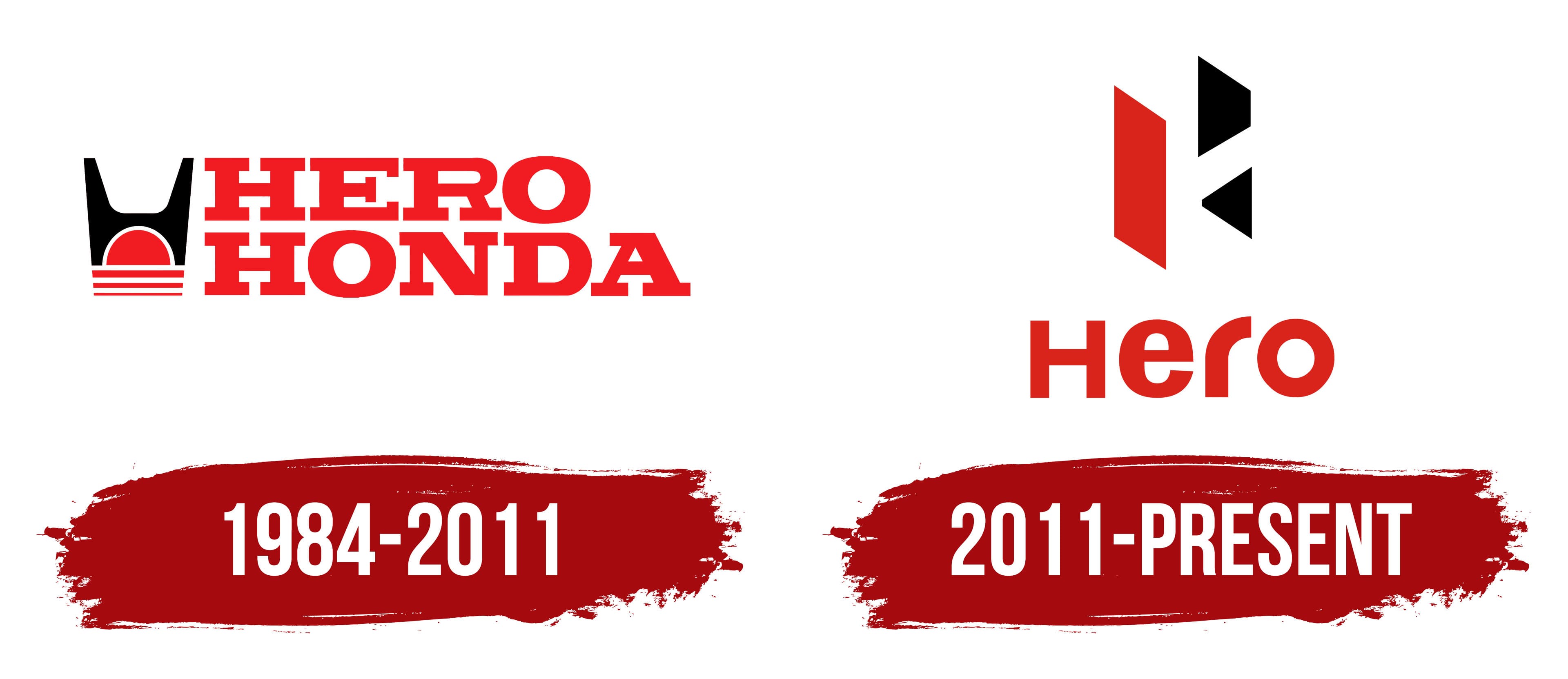
The company’s brand name appeared right after its opening. It is related to its name, which translates from English as “hero.” All versions of the logo (there were two) reflect the corporation’s central concept: the heroic personality within every person.
The original logo remained in use until 2011, when the company underwent a pivotal separation from the Japanese corporation. Then, the company underwent a major rebranding of all visual symbols. This was associated with the company’s renaming to Hero MotoCorp. The design agency Wolff Olins developed the updated logo and presented it at a cricket match in London between India and Great Britain.
In the debut version, the initial letter H was depicted as a superhero mask (Batman). The second logo reflects the theme of heroism: the English motto is “For a hero inside,” and the Hindi inscription is “Everybody has a hero.” Both versions use the same color palette: scarlet, black, and white.
What is Hero?
Hero is one of India’s most valuable brands. It represents Hero MotoCorp Limited, which adopted its current name after breaking ties with the Japanese conglomerate Honda in 2011. Today, it is the world’s largest motorcycle manufacturer. However, the company also produces other two-wheeled vehicles, such as electric bicycles and scooters.
1984 – 2011
At that time, the company was called Hero Honda, so the original label consisted of these two words. They are arranged in two tiers and colored red. All letters are uppercase and set in a classic serif font with bold lines. This lends the logo a sense of solidity and conveys the product’s reliability, stability, and power.
A drawn sign is to the left of the wordmark, stylized as the letter H and Batman’s headgear. Below it is a semi-disc of the rising sun, and even lower are three lines, like reflections of its glints on the water. The stripes also represent the tracks left by various types of two-wheeled transport.
2011 – today

In 2011, the logo was redesigned in connection with the name change to Hero MotoCorp. The variant proposed by Wolff Olins fits a modern flow, defined by relevance and dynamism. At the same time, it is an elegant, refined sign that graphically reflects the multifaceted nature of the Indian corporation.
The new logo also has two parts: a wordmark and a hand-drawn element. Below is the company’s name. All letters are lowercase except for the first. It is written in capital letters, although it is the same size as the others. The font is simple, sans-serif, reminiscent of Harabara. The small letter “r” is smooth and slightly rounded.
The graphic design is geometrically precise and meticulously calibrated. It forms the letter H in 3D, with two rectangular plates replacing the side walls. The connecting bar is made inconspicuous, emphasizing the invisible but constant succession of generations. The sign’s sharp angles make it energetic and dynamic, embodying the company’s confidence, progress, and strength.
Font and Colors

The redesign introduced a completely different style and font. Instead of powerful serifs, the emblem now uses smooth, streamlined symbols without sharp angles. The font’s shape and design closely match Harabara. Wolff Olins, the developer of the new logo, proposed such exquisite simplicity. In addition, the inscription has a subtlety that isn’t immediately noticeable. Look closely: although all the letters in the word “Hero” are the same size, three of them are lowercase (“e,” “r,” “o”), and one is uppercase (“H”).
Regarding color, the brand settled on the traditional combination of black and red. According to their respective concepts, black conveys strength, while red reflects beauty.