


 Angeles Angels Logo PNG
The Los Angeles Angels franchise has a logo that fits the sports environment and the locality it represents. The eponymous city has lent it a sense of lightness, sincerity, and monumentality unmatched by any other place in the country. The single-letter emblem looks clean and majestic.
The Los Angeles Angels’ history begins in 1961, when Gene Autry founded the franchise after receiving an expansion slot in Los Angeles. The team initially shared a stadium with the Los Angeles Dodgers before moving to Anaheim in 1966. In 1965, it adopted the name California Angels to reflect a broader regional identity.
A key moment came in 1972, when the club traded Jim Fregosi to the New York Mets for Nolan Ryan. In 1973, Ryan struck out 383 batters and threw two no-hitters, later recording four of his seven career no-hitters with the team.
In 1979, the Angels reached the playoffs for the first time but lost to the Baltimore Orioles. They returned to the ALCS in 1982 and 1986, with the latter ending in a decisive loss to the Boston Red Sox after they had led the series late.
After a decline, The Walt Disney Company acquired the franchise in 1996–97 and renamed it the Anaheim Angels. Under manager Mike Scioscia, the team rebuilt and reached the postseason in 2002.
That year, the Angels defeated the New York Yankees and Minnesota Twins, then beat the San Francisco Giants in the World Series after a Game 6 comeback.
In 2004, Vladimir Guerrero joined the team, and the team won multiple AL West titles. In 2011, the team drafted Mike Trout. In 2018, Shohei Ohtani joined the team, winning MVP in 2021 and 2023 before leaving for the Dodgers.
The team’s former name, the Los Angeles Angels of Anaheim, was used from 2005 to 2015. Nowadays, a shorter version of the Los Angeles Angels is preferred. The club has been renamed several times: from 1965 to 1996, it was the California Angels, and from 1997 to 2004, it was the Anaheim Angels. Legal proceedings forced these renamings.
The club gets its name from Los Angeles’s first sports team, the “Angels.” The team played in the southern part of the city and was a PCL franchise. Gene Autry bought the naming rights from Walter O’Malley, the then-owner of the “Los Angeles Dodgers.” Later, the prefix “of Anaheim” was added to indicate location.
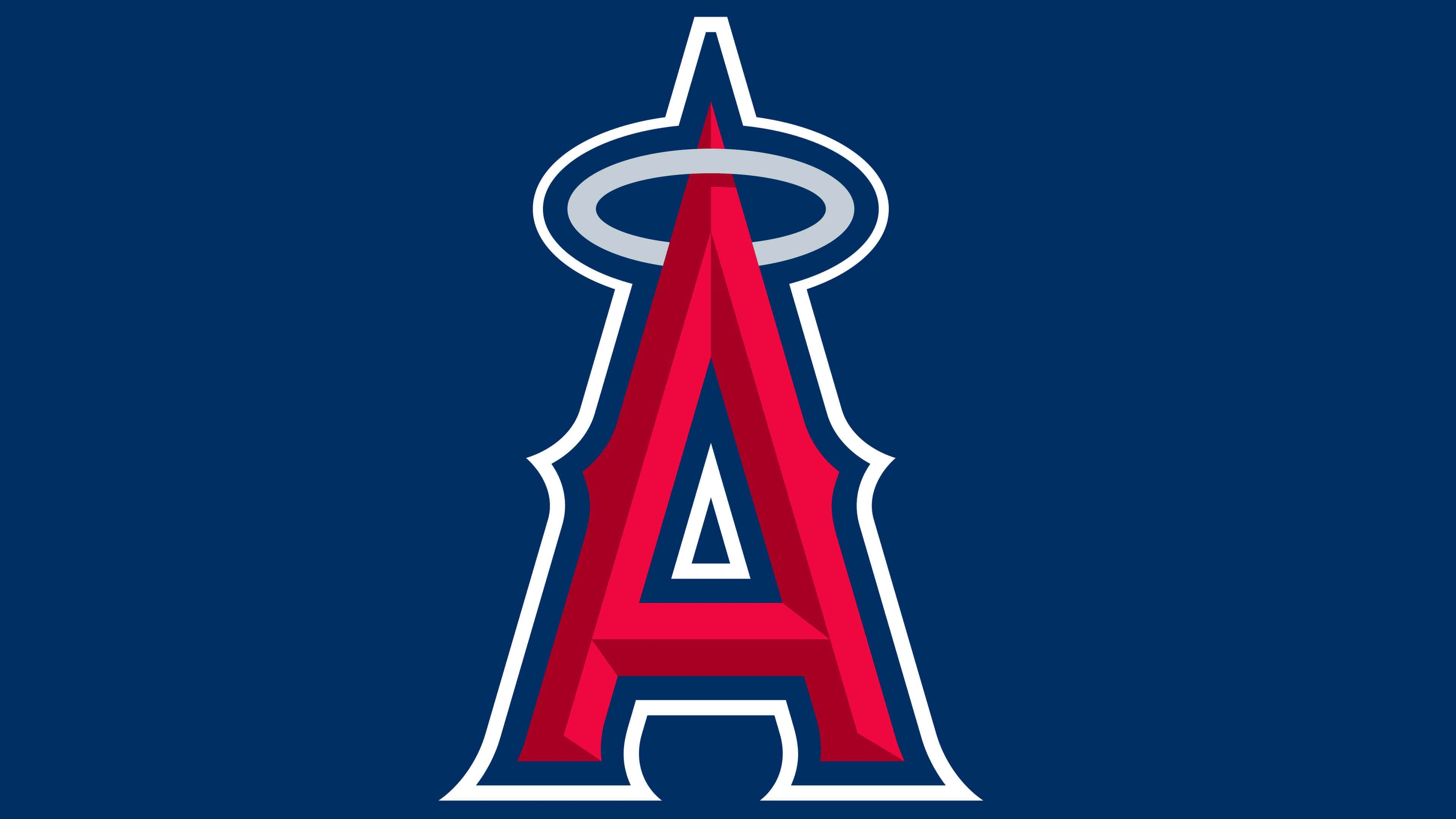
Since its appearance in the AL, the club has changed its logo ten times. The debut version was a winged baseball. Disney radically redesigned it, and the emblem featured a capital “A” with a white outline and a silver halo. The modern version features a graphic of the capital letter, while the rest of the emblem is simplified. It has no colorful background stylized as wings, nor an “ANAHEIM ANGELS” inscription.
The font used on the emblem approximates Bruce Double Pica. The primary color combines rich red (letter) and intense blue (outline). The blue outline also has a light gray halo at the top of the logo.
Meaning and History
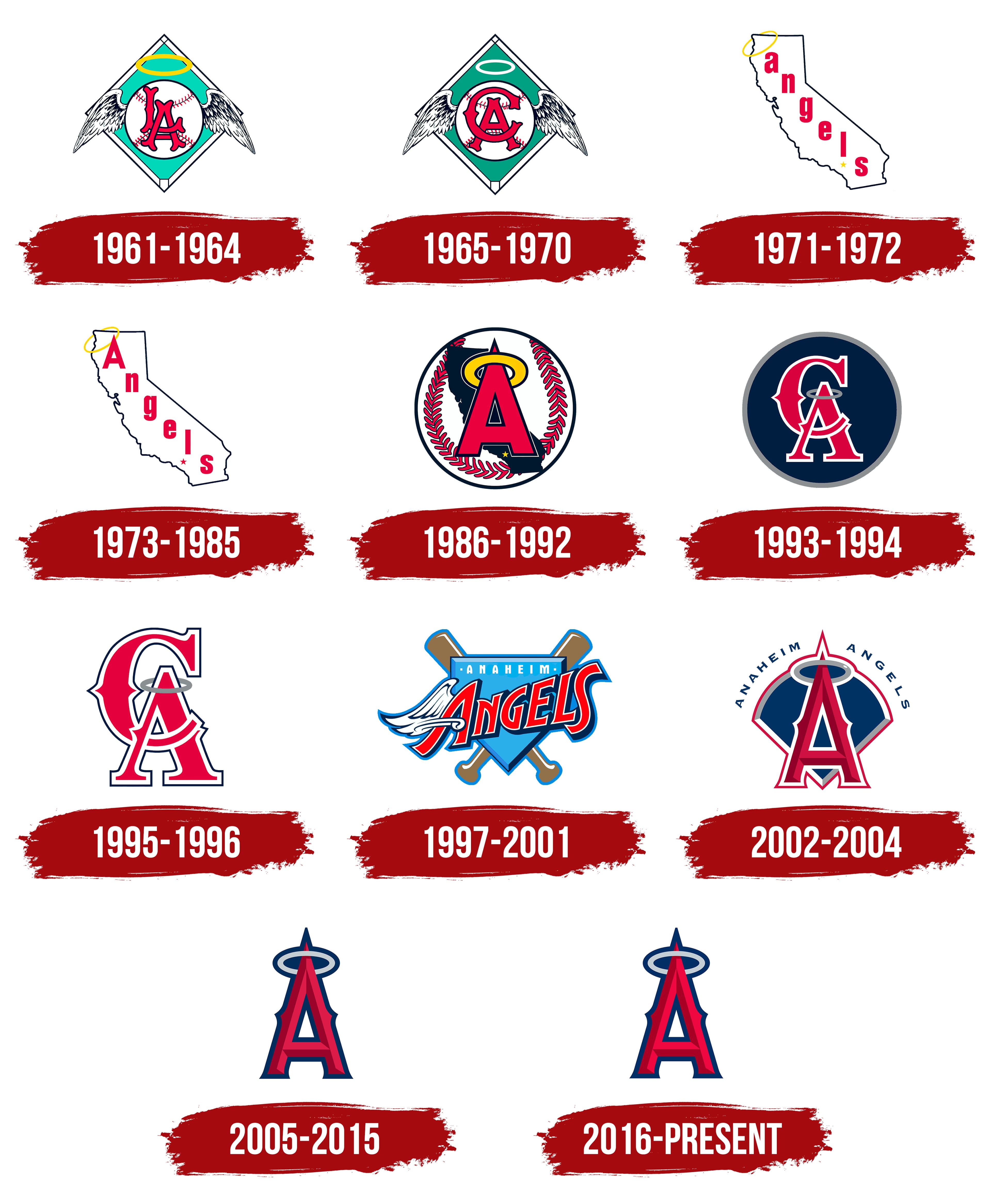
The key motifs of all eleven emblems that have appeared throughout the history of the Los Angeles Angels are a baseball and two iconic cities, Los Angeles and Anaheim. The “angelic” theme also suggests that these athletes are real angels and can do anything. Based on these motifs, the franchise owners have chosen wings, balls, halos, name-related letters, baseball bats, and even the map of California for their logos.
What is Los Angeles Angels?
It was one of the first Major League Baseball franchises. Musician and actor Orvon Grover “Gene” Autry founded it in 1961 to represent the Los Angeles metropolitan area in the American League. Under Gene Autry’s leadership, the team hardly ever won. It won its first league title only after Walt Disney took over as manager. It was then known as the “Anaheim Angels.”
1961 – 1964
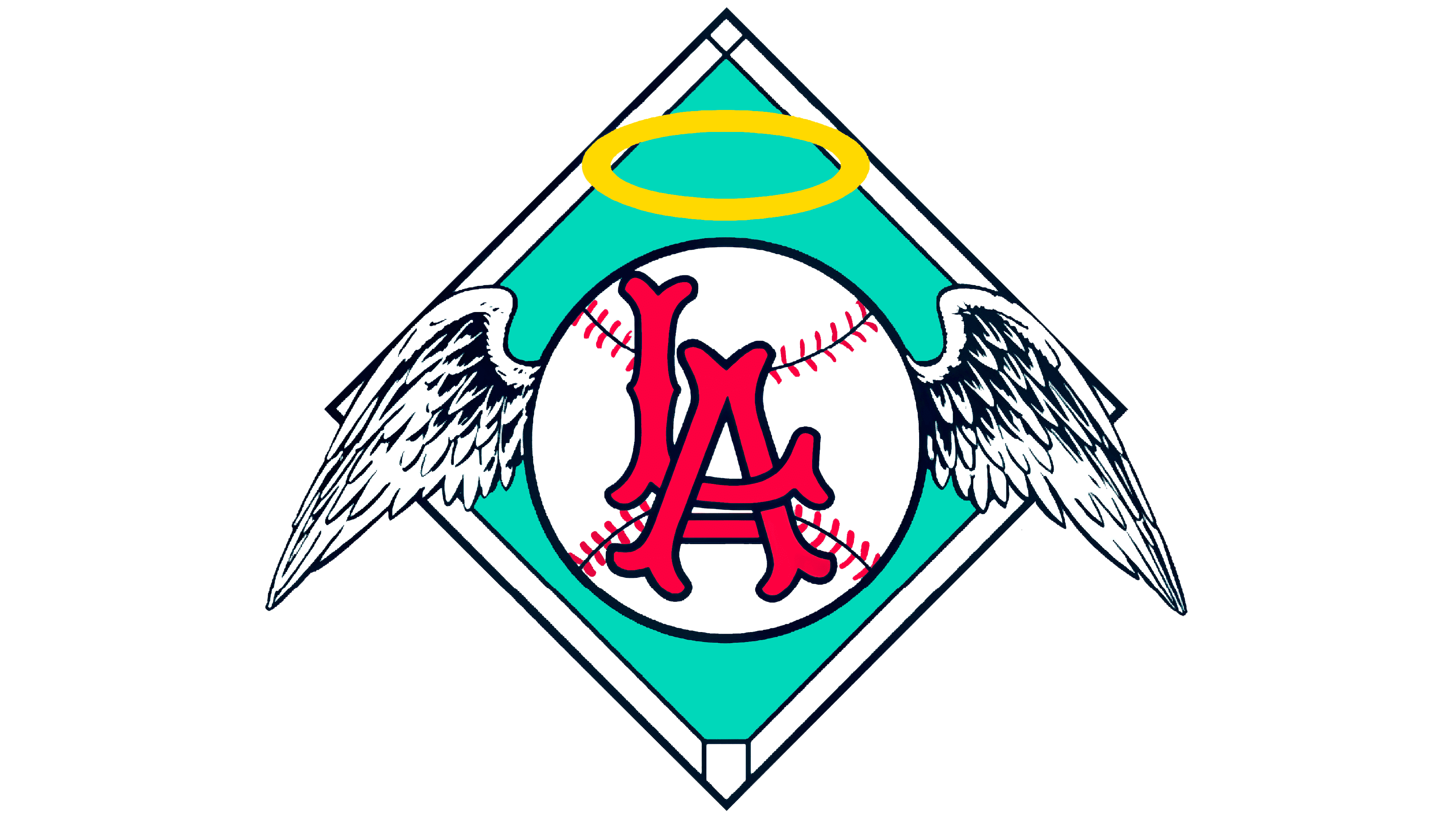
The “Los Angeles Angels” club was founded in 1961 and immediately adopted its logo. The background is a turquoise diamond with a white outline, with a red-and-white winged baseball placed on it. A golden halo sits above the ball. Inside the ball are also the letters “LA”, the initials of Los Angeles.
1965 – 1970
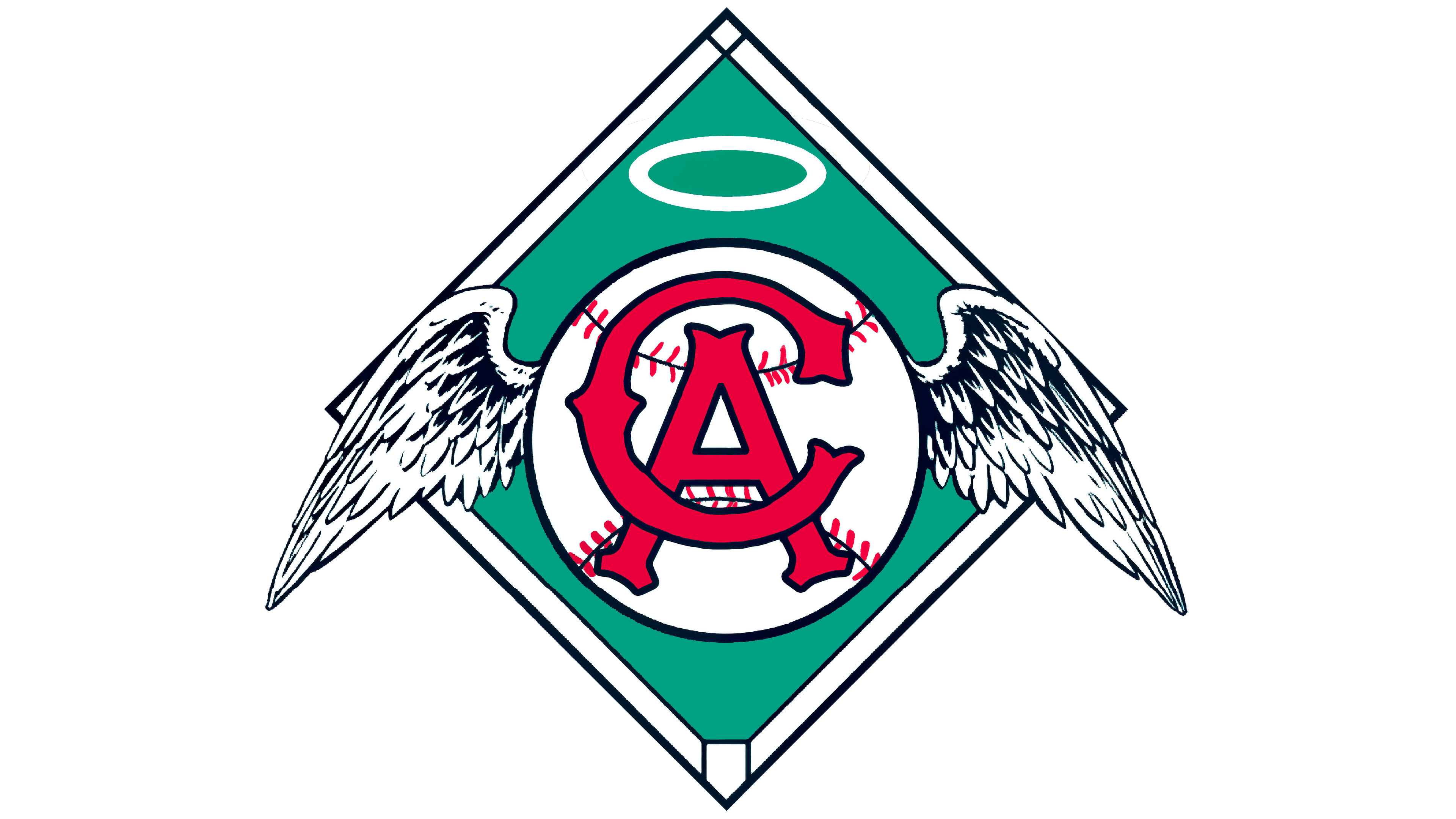
The club was renamed the California Angels, but its new logo resembles the previous one. The previously turquoise diamond turned green, and the halo above the ball turned white. Of course, the letters “LA” were replaced with “CA.”
1971 – 1972
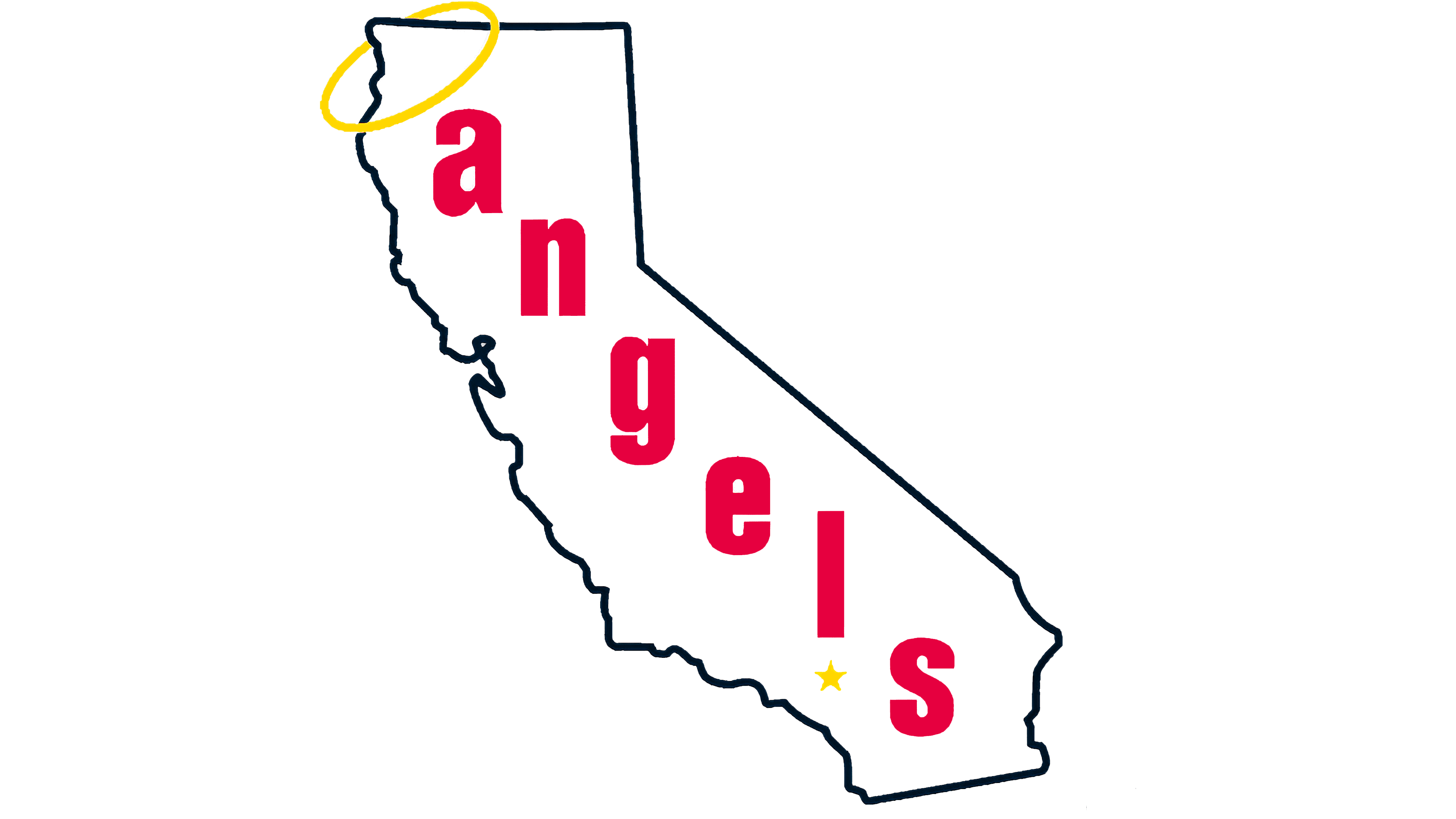
In 1971, the club changed the logo’s concept. It is now based on a white outline of the state of California, with the word “Angels” written diagonally in red. Above the small letter “a” is a golden halo attached to the edge of the state, and below the letter “l” is a small yellow star indicating Anaheim’s location.
1973 – 1985
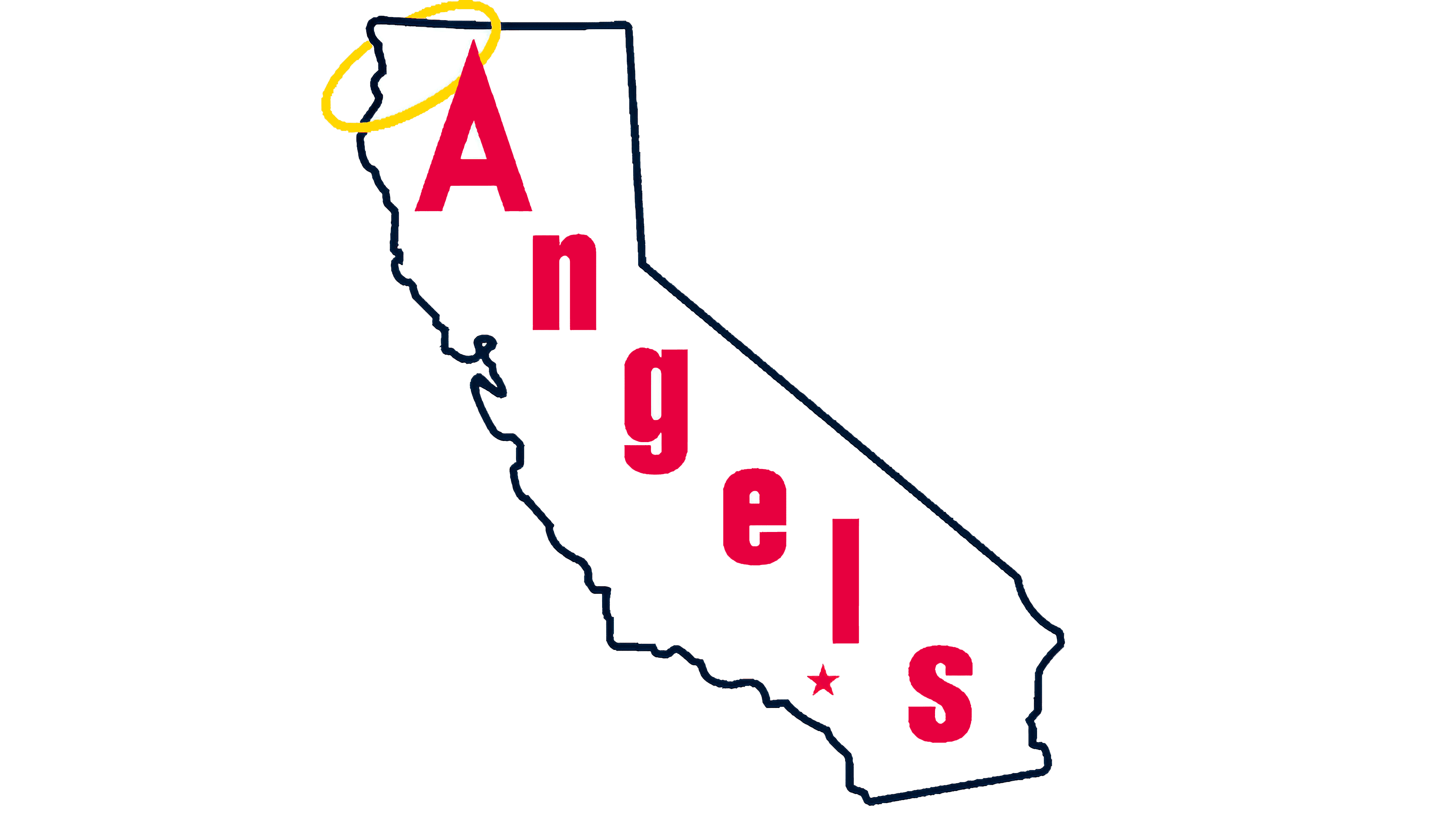
In 1973, the club made a few changes to the logo’s design. The lowercase “a” was replaced with a capital “A”, and the previously yellow star symbolizing the city of Anaheim became red.
1986 – 1992

The club’s fifth logo was a large red-and-white baseball with a huge red letter “A” inside and a yellow halo above it. In the background, California’s black shadow is visible. A barely noticeable yellow star under the letter “A” symbolizes the team’s location, the city of Anaheim.
1993 – 1994
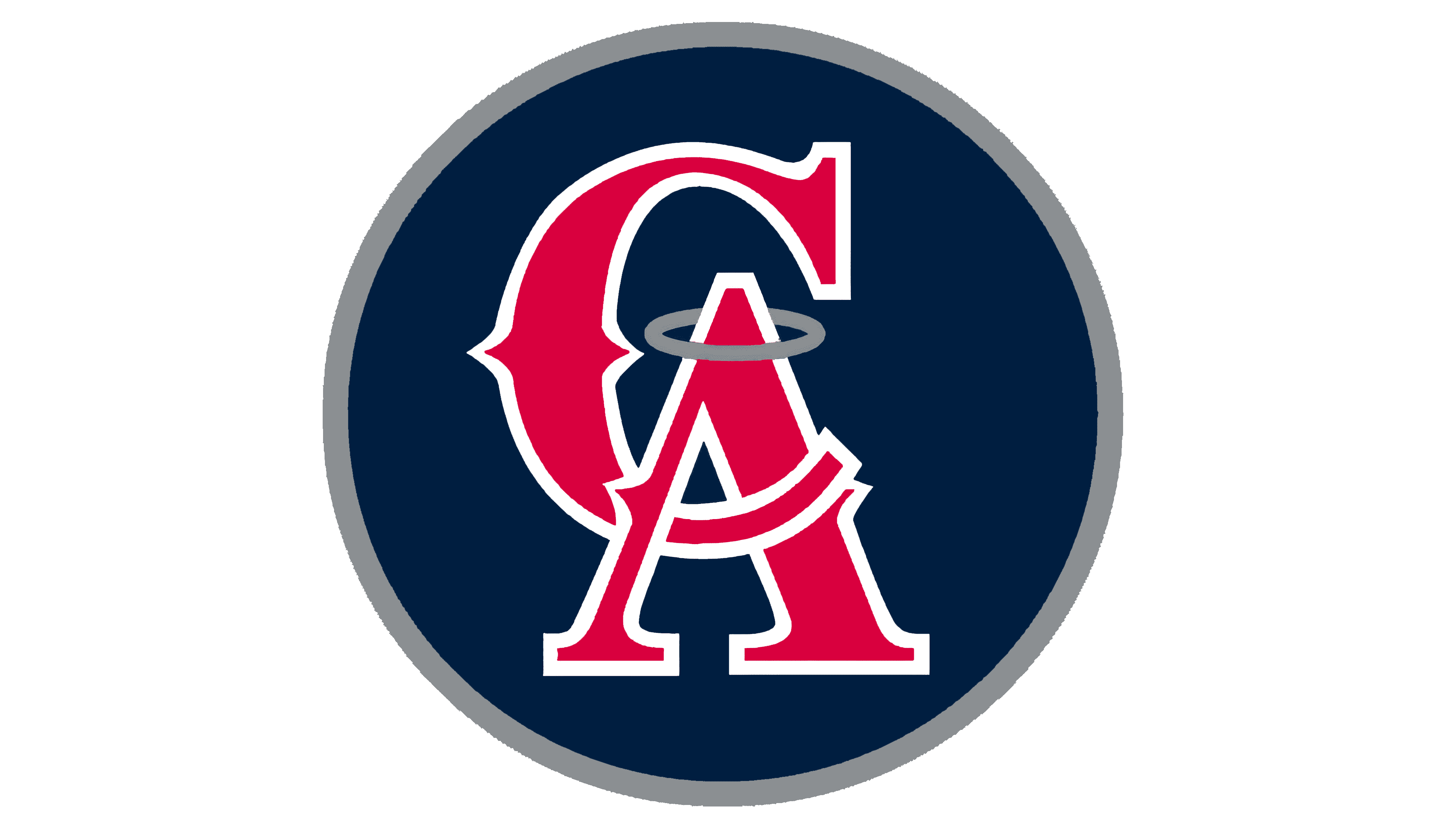
In 1993, the club returned to the 1965 logo’s concept, which used the initials “SA.” The main part of the logo is a traditional dark blue circle with a silver outline. Two large red letters, “CA,” are outlined in white, and above the letter “A,” a gray halo is drawn.
1995 – 1996
The new logo removed the blue circle and silver outline, leaving only the large red letters “CA” with a thin dark blue outline.
1997 – 2001

angel logo
The main logo change also marked the team’s renaming to the Anaheim Angels. The background is a blue triangle with two crossed brown baseball bats behind it. Against the blue triangle background, the word “Angels” appears in large red letters, with a white wing near the letter “A.” The city name also appears on the logo in small white letters on the blue triangle.
2002 – 2004

The logo design has been updated to a more modern, stricter look. Against a dark blue diamond background, a large red letter “A” symbolizes Anaheim. A black-and-gray halo sits above the letter. The entire logo has a thin red outline. Above the semicircular pattern is the inscription “Anaheim Angels.”
2005 – 2015
In 2005, the club returned to the name “Los Angeles Angels” and simplified its logo. After removing the diamond, only the large red letter “A” remained. The Bruce Double Pica font was used, and dark shadows and a dark blue outline were added to make the letter appear more voluminous. Above the letter, as before, is a gray halo with a dark blue outline.
2016 – today
The current version repeats the previous one from 2005 to 2015. It was adopted after approving a shorter team name. Since then, it has not changed once, as it meets the main criteria of modernity, conciseness, and capacity. That is, despite minimal detail, it conveys maximum information.
The emblem features a large letter “A.” At the top of the massive letter is a halo, hinting at a connection to the “angels.” Sharp protrusions appear in the middle of the Old English symbols. In the lower area, small notches appear. Along with the halo, a dark blue stripe outlines the entire letter.
Font and Colors
The first two periods of the sports club’s career featured a version of the logo with an azure rhomboidal background. In the center was a baseball and a monogram of the team’s name’s capital letters. The following versions include an administrative map of California, letters in a circle, flying bats, and a single letter, “A,” which has been in demand for three periods. The year of its appearance is considered 2002.
Two inscriptions, “Anaheim” and “Angels,” were initially on either side of the letter. The designers then removed them, along with the blue background of the inverted shield. Subsequently, the designers strengthened the shadows, forming a clear stripe in the middle of the legs to give them a 3D effect.
The iconic letter on the Los Angeles baseball players’ emblem was created in the custom Big A font. After the name was changed, the Bruce Double Pica font appeared.
However, the palette remained unchanged: crimson red, dark blue, and silver. The emblem also included azure, gold, blue, and white in previous years.
FAQ
What does the Los Angeles Angels’ emblem represent?
The Los Angeles Angels team is represented by a large letter A with a blue border. Its upper part is threaded into a blue ring, thus imitating a halo. Despite the shining circle, usually depicted above saints’ heads, the logo design is not angelic at all. The letter is painted in an aggressive red color and, in addition to sharp serifs, has triangular spikes on the sides.
Why did the “Angels” change the logo?
The baseball franchise often changed its name, and its logos had to be updated to match the dynamic branding. The last time it dropped the nickname Anaheim Angels, it was removed from all identity elements. Designers retained only the main part of the logo, the red letter “A” with a halo, and complemented it with a blue outline.
Who designed the Angels’ logo?
Professional designers worked on the Los Angeles Angels logo, refining and adapting the old design to modern trends.
When did the “Angels” rename to “Los Angeles”?
The club is based in the Los Angeles metropolitan area but plays its home games at Angel Stadium in Anaheim, where it moved in 1966. In 2019, it bought the stadium and is now obligated to stay on it at least until 2050. Despite this, the city of Anaheim added the word “Angels” to the lease, even though the team’s name had already dropped the word. As a result, the team did not move to Los Angeles.