


 Marvel Comics Logo PNG
The Marvel Comics logo is grand and bright. The emblem is full of energy, new ideas, and concepts. The sign points to superheroes, their extraordinary strength, and their feats, as reflected in comic book pages.
Marvel Comics began in 1939, when pulp publisher Martin Goodman founded Timely Publications. In October of that year, the first issue of Marvel Comics appeared, priced at 10 cents and selling about 900,000 copies after an extra print run. The debut introduced the Human Torch and Namor the Sub-Mariner, characters shaped by the tense mood before World War II.
In 1941, Captain America arrived, created by editor Joe Simon and artist Jack Kirby. The patriotic hero became a major wartime success, with Timely characters often fighting Nazis and Japanese forces before the United States entered the war. After superhero sales declined in the late 1940s, Goodman shifted to westerns, romance, horror, and war stories. In 1951, the company became Atlas Comics, but industry pressure and distribution trouble left it dependent on help from DC Comics.
The major revival came in 1961, when the Marvel Comics name returned. Stan Lee, Jack Kirby, and Steve Ditko reshaped the superhero format with flawed, conflicted characters. The Fantastic Four debuted in November 1961, followed by Spider-Man in 1962, then the X-Men and the Avengers in 1963. Marvel quickly became DC Comics’ main competitor in the U.S. comic book market.
Goodman sold Marvel to Perfect Film and Chemical Corporation in 1968. The 1970s brought growth through projects such as the Star Wars comic adaptation. In comparison, the 1980s featured major work by Frank Miller and Todd McFarlane. In 1992, artists including McFarlane and Jim Lee left to form Image Comics. Marvel declared bankruptcy in 1996, emerged in 1998, and turned toward film. Iron Man launched the Marvel Cinematic Universe in 2008. On December 31, 2009, Marvel Entertainment was acquired by The Walt Disney Company.
Meaning and History
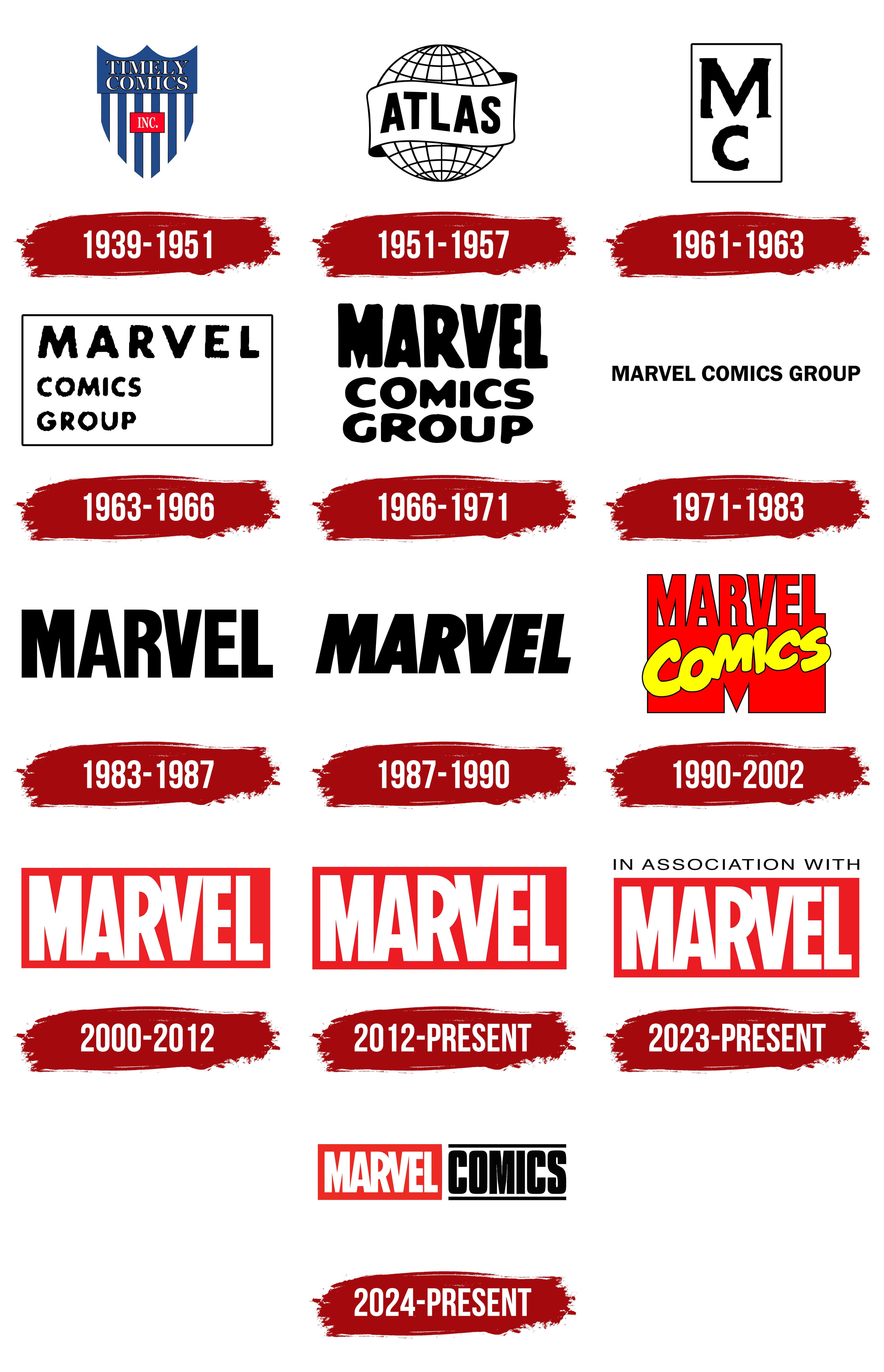
The company has experienced many ups and downs. It has gone through periods of peak popularity and near bankruptcy. The studio’s logos vividly reflect each stage of history. Rebranding is tied to changes in name and ownership. The only constant feature is the large word ‘Marvel,’ which gradually became the publishing house’s central name, having originally been the name of a comic book.
What is Marvel Comics?
It is a comic book publisher that has given the world 22 famous superheroes and 20 teams of superpowered individuals, from The Avengers to S.H.I.E.L.D.
1939 – 1951
The company’s logo is a shield that closely resembles Captain America’s first attribute, only in blue and white. At the top of the structure was placed the name of the publishing house, Timely Comics. Under this name, Martin Goodman released the first magazines. These were the issues now known as Golden Age comics. The shield symbolizes the protection superheroes provide.
1951 – 1957
In 1951, the publishing house’s name was changed to Atlas Comics. The logo of the period consisted of a globe surrounded by a white strip of paper bearing the word Atlas. The symbol was called Globe. It belonged to the Atlas News Company, through which Marvel’s founder, Goodman, distributed comics. And since 1951, the symbol has also served as a studio emblem.
The image spoke of striving for global coverage and expanding themes for comic magazines. Superheroes did not enjoy success after the war, so Marvel tried science fiction, animals, westerns, crime plots, and even love stories. The white paper in the symbol is like a canvas for creating new stories.
1961 – 1963
True fame came to the publishing house in 1961, when The Fantastic Four was released, and the concept of a shared superhero Universe began to take shape.
The emblem of the period is the black outline of a vertical rectangle. One above the other were the letters M and C. The abbreviation stood for Marvel Comics. The unofficial name has been used since 1957. But it was only reflected in the logo in 1961.
The name came from the first series of Timely Comics, published in the 1939-1940s, which was called Marvel Comics.
The choice of a vertical logo indicated a desire to grow and develop. It hinted at a new stage in the emergence of a superhero team that was head and shoulders above all past characters individually.
1963 – 1966
In 1963, The Avengers appeared, marking another milestone in the development of the comic book industry. The popularity of the series grew. To ensure the name of the company that produced The Avengers was visible and memorable, the vertical rectangle was rotated to a horizontal orientation, and the full name, Marvel Comics Group, was written inside.
1966 – 1971
The previous emblem was no longer suitable for such a large and famous organization. Therefore, the frame was removed from the logo. The letter size was increased several times to highlight the company’s achievements. The inscription was arranged across three levels to reflect the heroes’ globality and superpower.
1971 – 1983
In 1968, Martin Goodman sold the company to Perfect Film and Chemical Corporation. A couple of years later, at the beginning of the 70s, he left the publishing business altogether. After leaving his screenwriting job, Stan Lee took the helm. His leadership began during a downturn, with closures of sales kiosks and low demand for comics. Therefore, the period’s logo once again decreases in size. The words “Marvel Comics Group” are written on one line in small but capital letters. The sign signaled a slight decline but also conveyed the publisher’s confidence in its capabilities.
1983 – 1987
Jim Shooter took over leadership. He took the publishing house to a higher level, normalized royalties, and ensured deadlines were met. Even the company logo became clear and strict, shortening to Marvel. The word is written in large, confident lettering, symbolizing order and rise.
1987 – 1990
Perfect Film and Chemical sold Marvel to New World Entertainment. The new owners changed the emblem, making the Marvel inscription slanted to signal their commitment to promoting the studio’s development.
1990 – 2002
The company is sold again. This time to MacAndrews and Forbes, owned by Ronald Perelman. He made Marvel Entertainment Group public and shifted the publishing house onto more commercial tracks. He improved the covers, launched the collectible card release, and ensured crossovers were released.
The logo also became more commercial, a bright, large letter M with a flat-cut top. On the resulting platform, the company’s full name is written in smaller letters. In the center of the large M, the word Comics is written in playful yellow letters. The sign gave a sense of laughter, fun, and humor. It looked flashy and colorful. The icon seemed to call for purchase, promising: an amazing show was about to begin.
2000 – 2012
Marvel Entertainment Group merged with Toy Biz, Marvel’s toy company, forming Marvel Enterprises. From this point, a new development cycle began for the company. The emblem, in the form of a red rectangle with large white letters reading “Marvel,” excellently reflected the situation. The sign showed renewal, energy, demand, and new popular projects.
2012 – today
The team moved its headquarters to Los Angeles to be closer to its new owners (in 2009, Marvel was purchased by The Walt Disney Company). At the same time, the company’s emblem underwent minimal changes, introduced by British designer Rian Hughes. Mostly, they touched on the writing of the letter R. A slight rounding of corners gave the upper part more smoothness, highlighting the elegance and logic of the stories. The insignificance of the edits indicated that the company had finally found its perfect visual sign.
2023 – today
To the existing logo, “In Association with” was added in thin black capital letters at the top. The change is associated with the restructuring and merging of Marvel Entertainment, Marvel Comics, and Marvel Games with other Disney divisions. Any company within Disney can now produce goods related to the heroes of the Marvel Multiverse. In this case, the “In Association with Marvel” logo is added.
2024 – today
Font and Colors
The main colors of the logo are white and red.
- Red symbolizes the studio’s characters’ strength, energy, speed, endurance, and other superhuman abilities. It also represents the comics’ color, their vast popularity, and their worldwide fame.
- White signifies novelty. Constant updating of stories, the birth of interesting series and crossovers, and the victory of good over evil.
The font of the inscription is quite simple, similar to Kristall H MfD Pro Condensed Bold. Its main feature is the scale and sharpness of the letters, indicating a global-scale company.