


 Maryland Terrapins Logo PNG
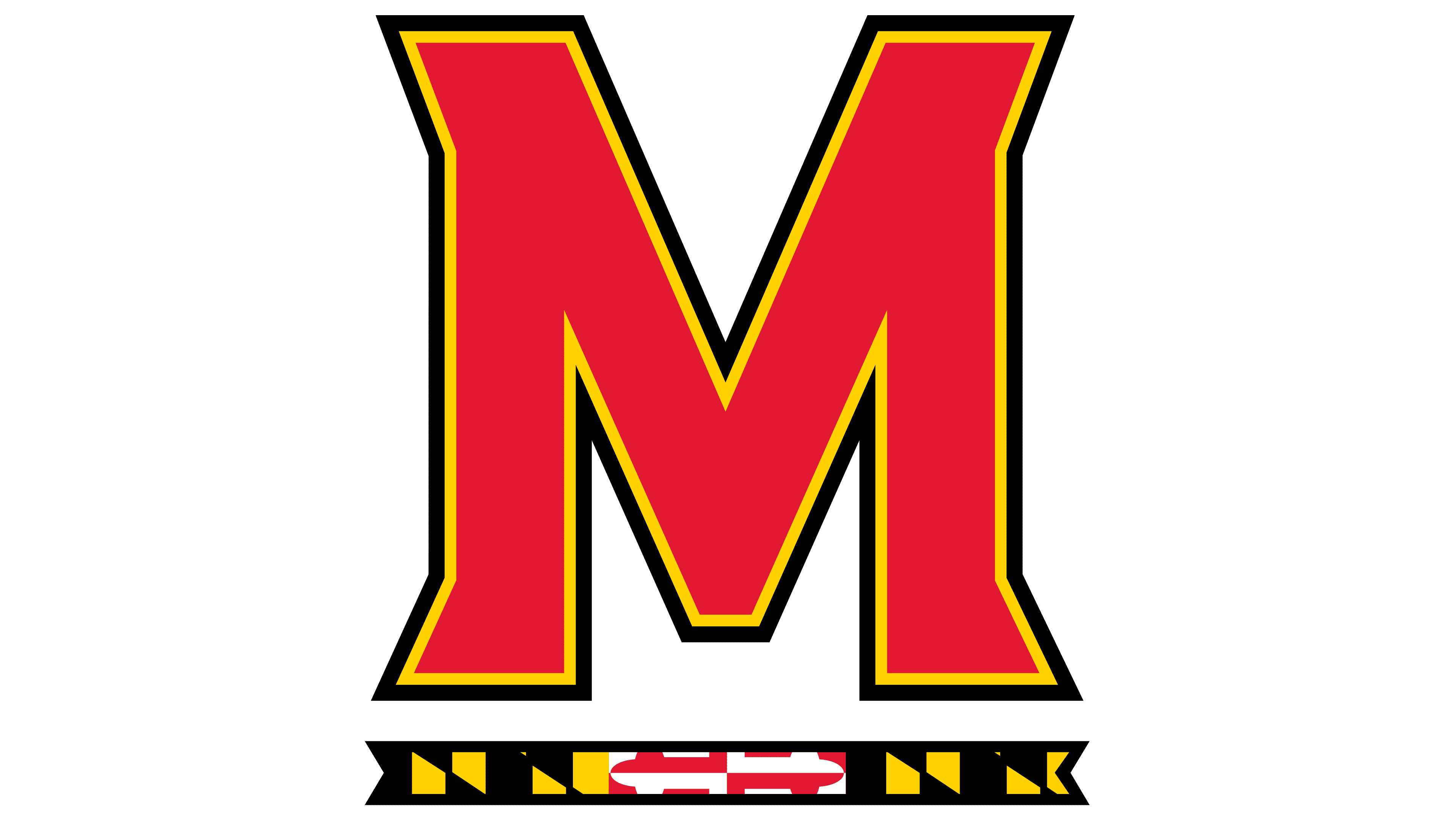
Like most varsity sports teams’ emblems, the Maryland Terrapins logo reflects the institution’s official colors. At the same time, it looks impressive, thanks to its large elements and protruding corners. This well-designed graphic sign conveys determination, steadfastness, and self-confidence.
Maryland Terrapins trace their roots to the University of Maryland in College Park, founded in 1856 as Maryland Agricultural College. Baseball and football appeared on campus during the Civil War era, but the teams lacked a fixed athletic identity. For decades, they were known as the Farmers, Aggies, and later the Old Liners, after Maryland’s nickname, the Old Line State.
The modern football program began in 1892. In 1902, John Markey became Maryland’s first professional coach. The Terrapins’ name was adopted in 1932, when football and baseball coach Harry “Curley” Byrd proposed the diamondback terrapin as the official mascot after a call from the student newspaper, The Diamondback. Byrd came from Crisfield, Maryland, a region associated with terrapins. In 1933, the bronze Testudo statue was installed outside Ritchie Coliseum.
Under Jim Tatum, football brought Maryland its first NCAA national title in 1953 with a 10-1 season. That same year, Maryland left the Southern Conference with six other schools. It became a founding member of the Atlantic Coast Conference. The program also built a major lacrosse record. The men’s team began as a club in 1895. It became a varsity sport in 1924, while the women’s team later won 15 NCAA national titles, including seven straight from 1995 to 2001.
Basketball peaked on April 1, 2002, when Gary Williams led Maryland to its first NCAA men’s title, beating Indiana 64-52. Juan Dixon earned Final Four MVP honors. In 2014, Maryland left the ACC for the Big Ten Conference. By then, the athletic program had won 47 NCAA team titles and 16 individual national championships.
Meaning and History

Until a certain point, the Maryland Terrapins were known as the Old Liners because Maryland was informally called “The Old Line State.” But the independent student newspaper The Diamondback, which began publishing in 1910, decided to rename the sports teams. Harry Clifton “Curley” Byrd, a football coach who later became university president, ended this issue. He proposed the Terrapins option. What is the reason for this choice?
The diamondback terrapin (tuberous turtle) lives in Maryland’s Chesapeake Bay region and is the state’s official reptile. It differs from its relatives by its diamond-shaped shell pattern. So, in 1932, H. C. Byrd suggested using this freshwater animal as a mascot. With consent, he arranged for a monument to be built on campus across from the McKeldin Library. The huge bronze turtle remains, a reminder that the 1933 graduates saved at their graduation party to pay for the statue.
The real tortoise, Testudo, opened the monument, which became its prototype. She died two days after the solemn occasion, partly due to stress and partly because two holes were drilled into her shell. Ribbons tied to a large sheet were threaded through the holes. The cloth covering the statue slipped off as soon as the turtle crawled away. At that moment, everyone present burst into loud applause. After death, the reptile ended up in the archive: stuffed and mounted on a board.
She was depicted on most of the old Maryland Terrapins logos. Until 1996, she was presented as a gambling fan, until she was turned into an aggressive ninja warrior. In 2012, sports teams began using the emblem with a single “M” and incorporating elements from the state flag.
What are the Maryland Terrapins?
Maryland Terrapins is the common name for all University of Maryland sports teams in College Park. The abbreviated version is Terps. The nickname comes from the mascot and was adopted in 1932 at the suggestion of the school’s former president, H. C. Byrd. Now UMD has two dozen teams, and they all compete in the Big Ten Conference.
1967 – 1970

The first Testudo logo was black and white. The artists drew the turtle in a cartoonish style, highlighting only the outlines, as in a children’s coloring book. She ran to the left, and clouds of dust rose behind her. Beneath her feet were lines, the so-called speed lines, that emphasized the energy of high-speed movement. At the same time, the freshwater animal looked friendly and smiled.
1970 – 1983

In 1970, the creators of the Maryland Terrapins logo humanized the turtle, presenting it as a gambling fan. She was leaning on a large red “M” with rectangular serifs. Interestingly, the forward paw was very muscular, like a bodybuilder’s. It symbolized the strength and power of sports teams. The artist decorated the carapace with a red-and-black diamond pattern so no one would doubt the reptile’s species. Another red element was the tongue, which was visible in the open mouth.
The letter seemed voluminous because of the black outline. The uneven lines expanded on the right side and, in those places, looked like side faces. This illusion of three-dimensionality highlighted the “M,” making it the drawing’s dominant part
1983 – 1988

In 1983, the Maryland Terrapins introduced a turtle-less logo. Its main element, based on the size ratio, was the letter “M.” It consisted of many short, horizontal red lines. On the left side, the stripes were very thin. Then they gradually expanded, reaching their maximum thickness on the right side of the letter.
At the bottom was the red word “MARYLAND.” The inscription’s font matched the line proportions in the “M” composition: the first “MA” was the thinnest, and the last “ND” was the boldest. The gradual increase in stroke thickness and pronounced rightward tilt created the illusion of movement, as the designers intended.
1988 – 1996

In the second half of the 1980s, the teams began using the Testudo logo again. It looked the same as in the 1970 version and was based on the same letter. But the artists corrected the drawing, removing the extra lines and raising the “M” slightly. They also added a new element, the state flag, which the turtle held in an outstretched paw. The name Maryland Terrapins was written at the bottom. The designers split it into two lines, centered. All letters were capital, bold, black, and had rectangular serifs.
1996 – 2005

In 1996, the first logo appeared with a warlike turtle standing on its hind legs. Her forelimbs became powerful, muscular arms, bent at the elbows and resting on her hips. In body language, this posture subconsciously conveys superiority and aggression.
An anthropomorphic animal towered against a black triangular shield with a bright red outline. At the top, “UNIVERSITY OF” appears in white letters; below it, the large word “MARYLAND” appears in red, surrounded by white lines. An additional black outline extended beyond the shield where the state name protruded. The designers deliberately enlarged the first “M” and the last “D” to emphasize the text’s arched shape.
The turtle’s skin turned yellow-brown, and the nails and shell edge took on a bright yellow tint. On the animal’s chest was a large red “M,” similar to a superhero’s emblem.
2005 – 2006

After the redesign, the “M” grew larger, making it look as if the turtle were holding it in front of him. The black shield and inscriptions disappeared, leaving the sports team’s mascot on a blank white background.
2006 – 2012

In 2006, only the logo’s palette changed. Black became more saturated, and red became a pale crimson. For the turtle skin, they used one of the coffee-with-milk color options.
2012 – today

In 2012, the anthropomorphic animal disappeared and was replaced by a large “M.” It is also raspberry-colored, like the previous version, but brighter. It also has two contours: yellow (internal) and black (external). On both sides, the “M” is decorated with symmetrical triangular serifs, paired above and below.
Beneath the letter is a long horizontal stripe in the colors of the Maryland state flag. It is divided into three parts. Black-and-gold polygon patterns appear on the left and right. A red-and-white ornament separates them.
Font and Colors
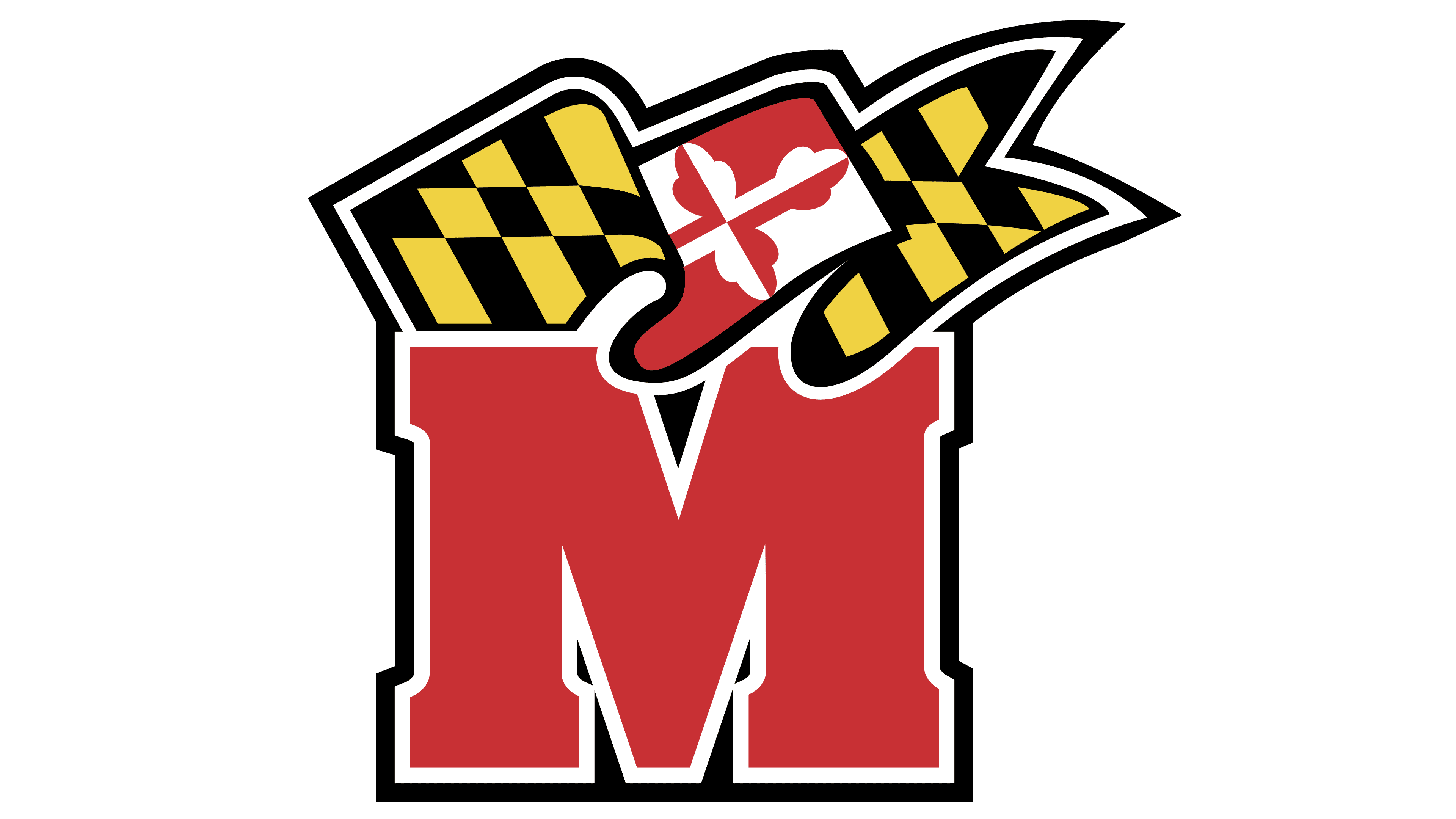
The Maryland Terrapins logo is patriotic because it incorporates elements of the state flag. Two patterns, black-and-gold and red-and-white, come from the family symbols of Lord George Calvert. The big red letter “M,” which complements the picture, indicates a team’s territorial affiliation.
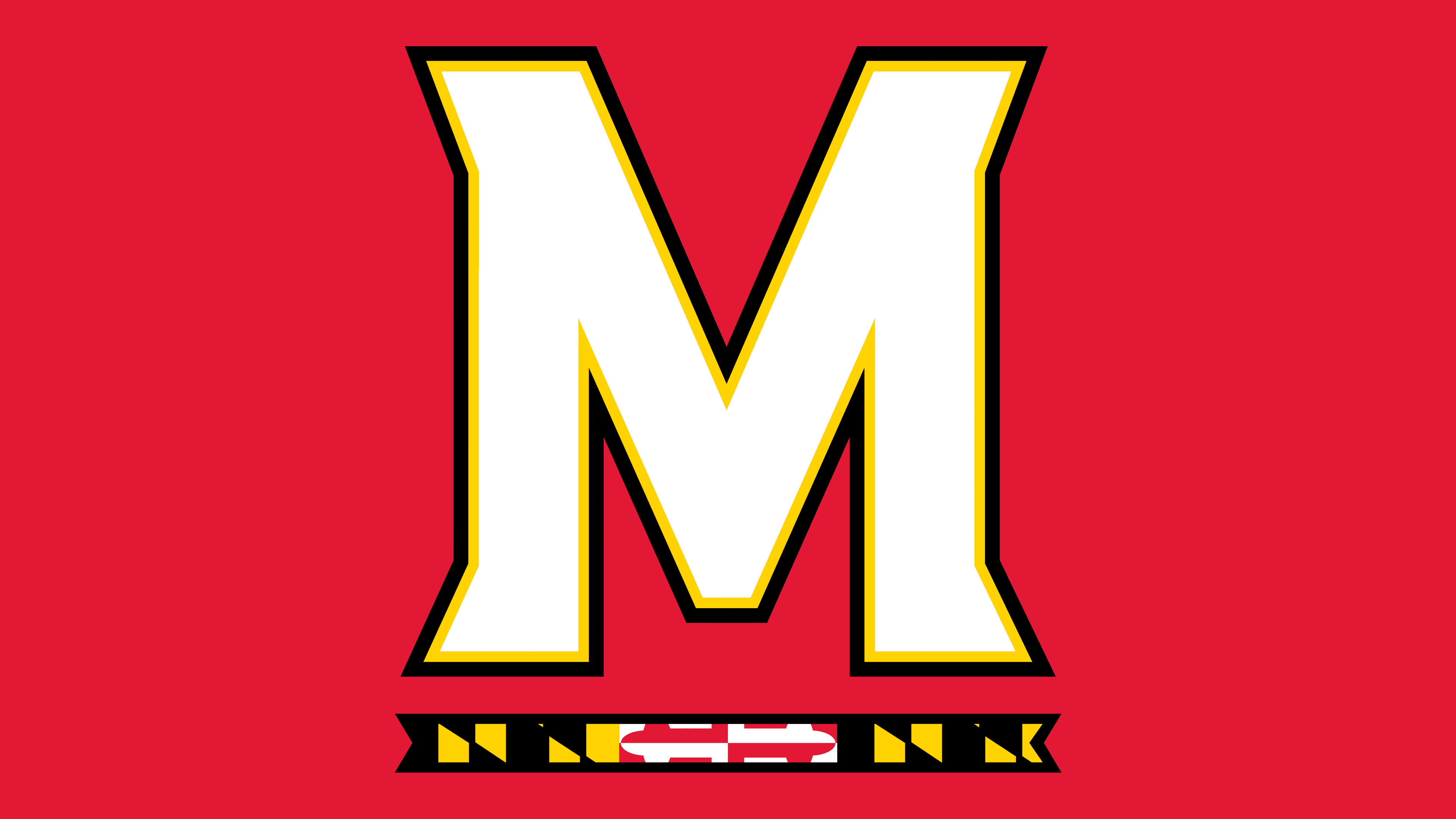
The stylized “M” refers to a special Terrafont typeface created for the Maryland Terrapins. It is a bold serif with huge triangular serifs. The colors match the Maryland flag’s palette: gold (#FFD200), white (#FFFFFF), red (#E21833), and black (#000000).