


 Memphis Tigers Logo PNG
The Memphis Tigers logo features a tiger, the team’s primary mascot. The tiger symbolizes speed, aggression, and a predatory style of play. The team’s identity is characterized by constant pressure on opponents, sharp attacks, and a physically intense style of play.
The University of Memphis basketball program began in 1912 when the school was known as West Tennessee State Normal School. Initially called the “Teachers” or “Tutors,” the team adopted the “Tigers” nickname in 1925, becoming a key part of the university’s sports identity.
The team first competed nationally in 1957, participating in the NIT. In 1962, under the guidance of coach Moe Iba, Memphis made its NCAA Tournament debut. Significant progress followed in 1973, with coach Gene Bartow leading the team to the NCAA finals, where they lost to UCLA. This squad featured future NBA talent Larry Kenon.
During the 1980s, coach Dana Kirk regularly guided the Tigers into NCAA competition, reinforcing Memphis’s national reputation. Former player Larry Finch assumed coaching duties in the 1990s, leading the team to the school’s first Great Midwest Conference regular-season title in 1992.
A resurgence emerged with the arrival of coach John Calipari in the 2000s. In 2008, the Tigers returned to the NCAA Finals but lost to Kansas. Although these results were later vacated due to NCAA violations, this era remains a significant part of the team’s history.
Memphis transitioned to Conference USA in 2009 and quickly excelled within the league. The school joined the American Athletic Conference in 2013, broadening opportunities against stronger competition. In 2019, former NBA star Penny Hardaway returned as head coach, elevating the program’s competitiveness.
Today, Memphis basketball continues to maintain national recognition, highlighted by alumni such as NBA stars Penny Hardaway and Derrick Rose.
Meaning and History
What is Memphis Tigers?
They are one of the most dynamic collegiate athletic teams, with a vibrant blue-and-gray identity that perfectly reflects the character of their hometown. Teams in the American Athletic Conference are known for their powerful basketball, making FedExForum one of the most exciting places for fans, and for their equally impressive football teams, which draw large crowds to the Liberty Bowl. A unique feature is their living mascot, Tiger Tom III, who adds a sense of unity and enthusiasm to game days.
1963 – 1965

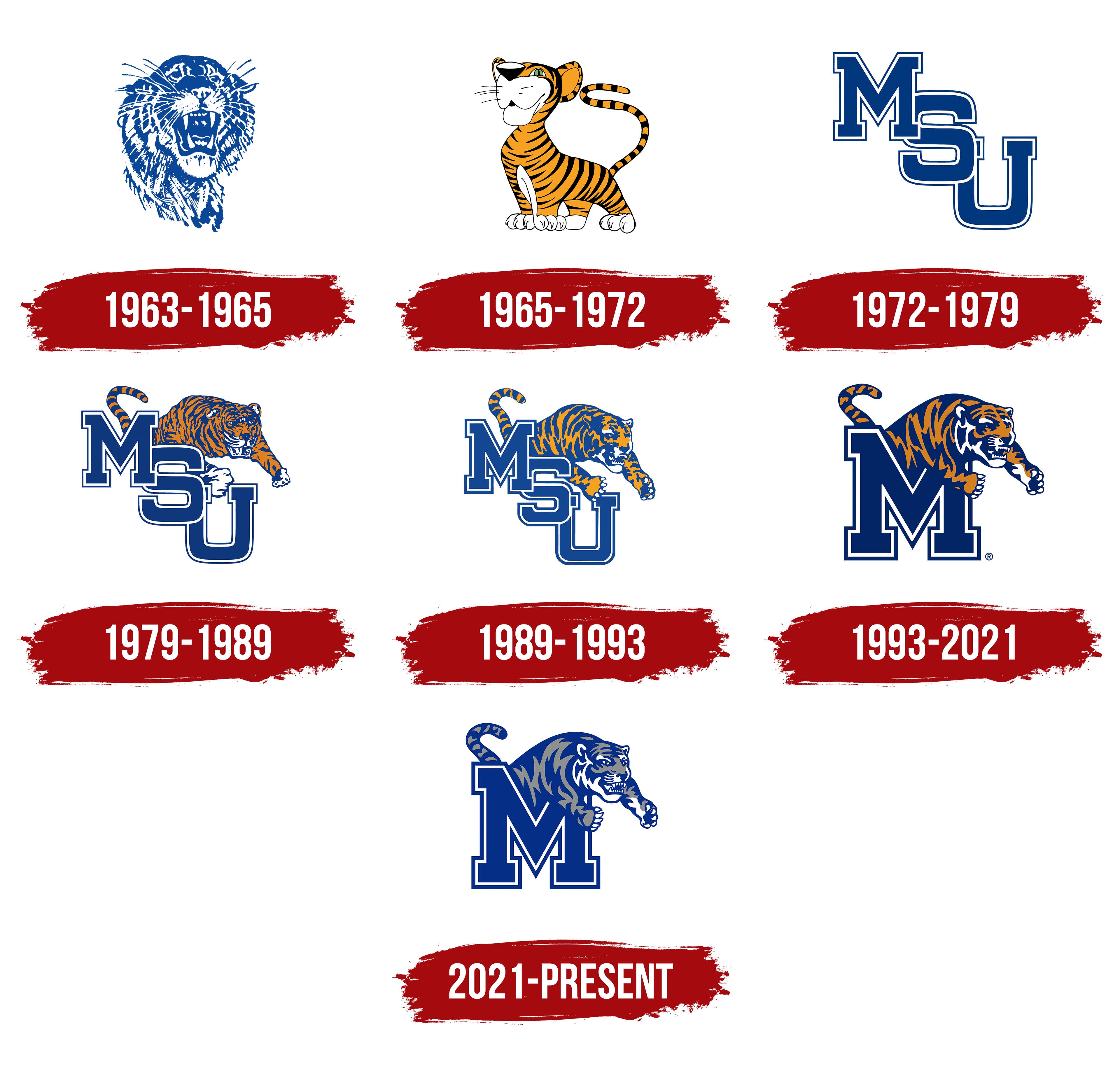
The development of college sports at the University of Memphis required strengthening the teams’ visual identity. The growing interest in basketball and football among students and fans contributed to the creation of a symbol that expressed the spirit of competition. In 1963, an emblem was introduced featuring a deep-blue tiger head as the central image.
The design was based on a frontal depiction of the animal. The contrast between blue and white defined the tiger’s head. The predator was depicted mid-roar, with an open mouth and carefully drawn fangs and teeth. The animal’s facial expression conveyed tension and power, emphasized by the lines of the muzzle and nose, which created emotional energy.
The image of the tiger became a visual equivalent of athletic character and courage, laying the foundation for the future development of the athletic identity. Later versions of the Memphis Tigers identity were based on this model, preserving the plastic structure and emotional emphasis of the original design.
1965 – 1972

In the mid-1960s, the university’s symbolism shifted toward a lighter and more playful style. Instead of athletic aggression, the identity adopted a cartoon tiger influenced by the visual culture of American studios such as Disney and Hanna-Barbera. This style, characterized by soft lines, rounded shapes, and large eyes, reflected popular artistic trends in mass animation at the time.
The animal figure was drawn in a caricatured manner with deliberately distorted proportions. The elongated body was combined with short, sturdy legs. The ratio of forms created a playful character and emphasized the image’s comic quality. The tail was drawn as a large arc.
The facial expression was intentionally stylized. Narrow eyes with a squint, a slightly turned profile, and a wide smile created the impression of a confident and friendly character. There was no tension or threat as in the earlier version of the emblem. The figure was perceived as a positive image directed at the viewer, intended to establish a connection and foster an atmosphere of participation in campus sports life.
The shift from realistic depiction to an anthropomorphic character reflected trends in mid-20th-century American culture, when television and comic-book heroes began to appear in university and corporate symbolism. The Memphis Tigers logo in this style effectively engaged the audience, relying on a visual language of simplified forms and accessibility.
1972 – 1979

The shift from cartoon imagery to academic formality marked a step toward unifying the Memphis Tigers’ visual system. The new logo, based on typography, reflected the university’s intention to create a modern, restrained look that would bring together academic and athletic environments under a single visual identity. The design centered around the abbreviation MSU, which evolved into an independent mark without incorporating animal imagery.
The design was constructed from three letters arranged diagonally from top to bottom, with overlapping contours. The top letter M stood out with thick, straight strokes and rectangular serifs, creating a geometric structure. The middle letter S had smooth curves and consistent line thickness. Its form interacted with adjacent elements: the left side extended beneath the vertical stroke of the M. In contrast, the right side overlapped a section of the U. The bottom letter U was rendered in a simplified sans serif style with a wide curve that created a solid base for the composition.
The main letters were colored in the university’s blue tone, accented with a white outline and a thin external blue line. The flat design style was emphasized by the absence of shadows and gradients, giving the mark a precise, complete form.
The use of strong geometric typefaces and straight forms corresponded to the college block lettering tradition. The diagonal arrangement provided compactness and rhythmic tension, while the overlapping elements symbolized the connection between Memphis State University’s academic and athletic directions.
1979 – 1989

The contrast between academic formality and athletic energy became the key principle in creating the new Memphis Tigers logo, which features a tiger breaking through the letters “MSU.” The university sought to combine two aspects of identity into a single visual. The first reflected the educational sphere; the second, athletics. The new emblem combined a restrained typographic structure with an expressive predator figure.
The design was formed by three letters, MSU, arranged diagonally from top to bottom and left to right as before. The construction was stepped, with a dense geometric pattern and partial letter overlap.
A tiger was depicted over the letter block, stretched diagonally, in a forward leap. Its body was oriented in the same direction as the letters’ diagonals. The animal’s figure was painted bright orange, with dark blue stripes that conveyed its body structure and muscle relief. White areas highlighted the muzzle and front paws. The tiger had an open mouth with visible fangs, a tense gaze, and fine hatching on the coat that conveyed energy and physical strength.
Figuratively, the tiger was perceived as a symbol of overcoming and striving for victory. Its breakthrough through the monumental letters reflected the spirit of athletic rivalry and persistence.
1989 – 1993

The growth of interest in sports branding in the late 1980s prompted Memphis State University to update the visual appearance of its athletic symbols. The university sought to retain the previous image while adapting it to new aesthetic requirements. The updated version of the Tigers’ emblem, used from 1989 to 1993, preserved the compositional principles of the previous logo. Still, it gained a stronger visual accent through a reworking of the tiger figure.
The typographic part with the diagonally arranged MSU abbreviation remained the basis of the construction. The letters retained large proportions and a geometric structure, characterized by rectangular serifs. The only adjustment was to increase the blue saturation.
The main focus was on modernizing the tiger image. Its pose and leap direction were preserved, but the detailing and color structure were changed. The size of the orange sections increased, enhancing the animal’s visual presence. The blue stripes became larger and more contrasting, creating a clear rhythm across the body’s surface. The muzzle and front paws received additional drawing; the lines became sharper and denser, conveying a sense of tense energy. White elements in the cheeks, eyes, and fangs enhanced contrast and the emotional intensity of the gaze.
1993 – 2021

The rebranding of Memphis State University, culminating in the official transition to the name University of Memphis, required an update of the visual system. The primary objective was to create a unified image that combines the university’s academic structure and athletic direction. The logo, featuring a tiger above the letter “M,” became a symbol of the transition. It was officially introduced on July 1, 1993, marking the beginning of a new stage in the Memphis Tigers’ visual style.
The letter “M,” created specifically for the new emblem, has been designated as a key element. Its construction was based on classic collegiate proportions with serifs and balanced verticals. Dark blue was the dominant color in the design.
Unlike previous versions, which featured a simplified interpretation of the animal, the new image was more closely aligned with natural anatomical proportions. The predator’s pose conveyed the moment of a leap. The body was stretched diagonally, the front paws directed forward. The head was turned toward the viewer; the open mouth and clearly drawn white fangs enhanced the sense of attack. The muzzle was complemented by folds and lines conveying muscular tension. The tail curved upward, echoing the torso’s curve and maintaining balance.
The color structure retained the traditional University of Memphis combination of blue and orange, but in the updated version, the shades became deeper and darker. Orange was used as the primary body color, with blue stripes applied in broad strokes.
2021 – today

The updated University of Memphis Tigers logo was developed in collaboration with the studio Summit Athletic Media. The project involved analyzing the university audience’s attitudes toward the previous emblem and aimed to eliminate outdated elements to enhance reproduction quality across digital and print formats. The updated version was presented on April 6, 2021.
The mark’s structure was preserved without change. The stylized letter “M” served as the base, with a dynamic tiger figure above it. At the same time, every detail was professionally refined. The primary blue intensified, and the tiger’s stripes were rendered in a dark gray.
The Memphis Tigers logo redesign combined respect for historically established symbolism with the requirements of modern branding. It ensured the mark’s visual and technical adaptability for various digital platforms and printed materials.