


 Kansas Jayhawks Logo PNG
The Kansas Jayhawks logo indicates a readiness to compete for top places in sports. It intimidates opponents, prepares the team for serious challenges, commands respect, and drives success. The simple yet vivid image serves as a mascot for the teams, emphasizing their connection to the locale where the university is situated.
The Kansas Jayhawks name goes back to the 1850s, before the University of Kansas opened in 1866. During Bleeding Kansas, “jayhawk” was used for anti-slavery fighters tied to the Union side. The word combined the blue jay and the sparrow hawk, and by the late 19th century students had adopted it for KU teams.
The athletic identity formed without a formal launch. Students were calling the teams the Jayhawks by the 1880s, and the first football game was played in 1890 against Baker University. The chant “Rock Chalk, Jayhawk, KU” began in 1886 with Professor Edgar Bailey and later became the university’s main rallying cry.
Basketball gave the brand its strongest national profile. James Naismith arrived in 1898 as KU’s first basketball coach, having invented the sport in 1891. His student Forrest “Phog” Allen coached from 1919 to 1956 and won the 1952 NCAA title. Allen Fieldhouse opened in 1955, the same year Wilt Chamberlain came to Kansas; KU lost the 1957 NCAA final to North Carolina in triple overtime.
The Jayhawks added NCAA basketball titles in 1988 under Larry Brown, 2008 under Bill Self, and 2022 after a 16-point comeback against North Carolina. Football had its clearest modern peak in 2007, when Mark Mangino’s team went 11-1 and won the Orange Bowl over Virginia Tech. KU has played in the Big 12 Conference since its creation in 1996. The current Jayhawk logo, introduced in 2005, reworks the 1946 bird with a yellow beak, blue head, and red shoes.
Meaning and History
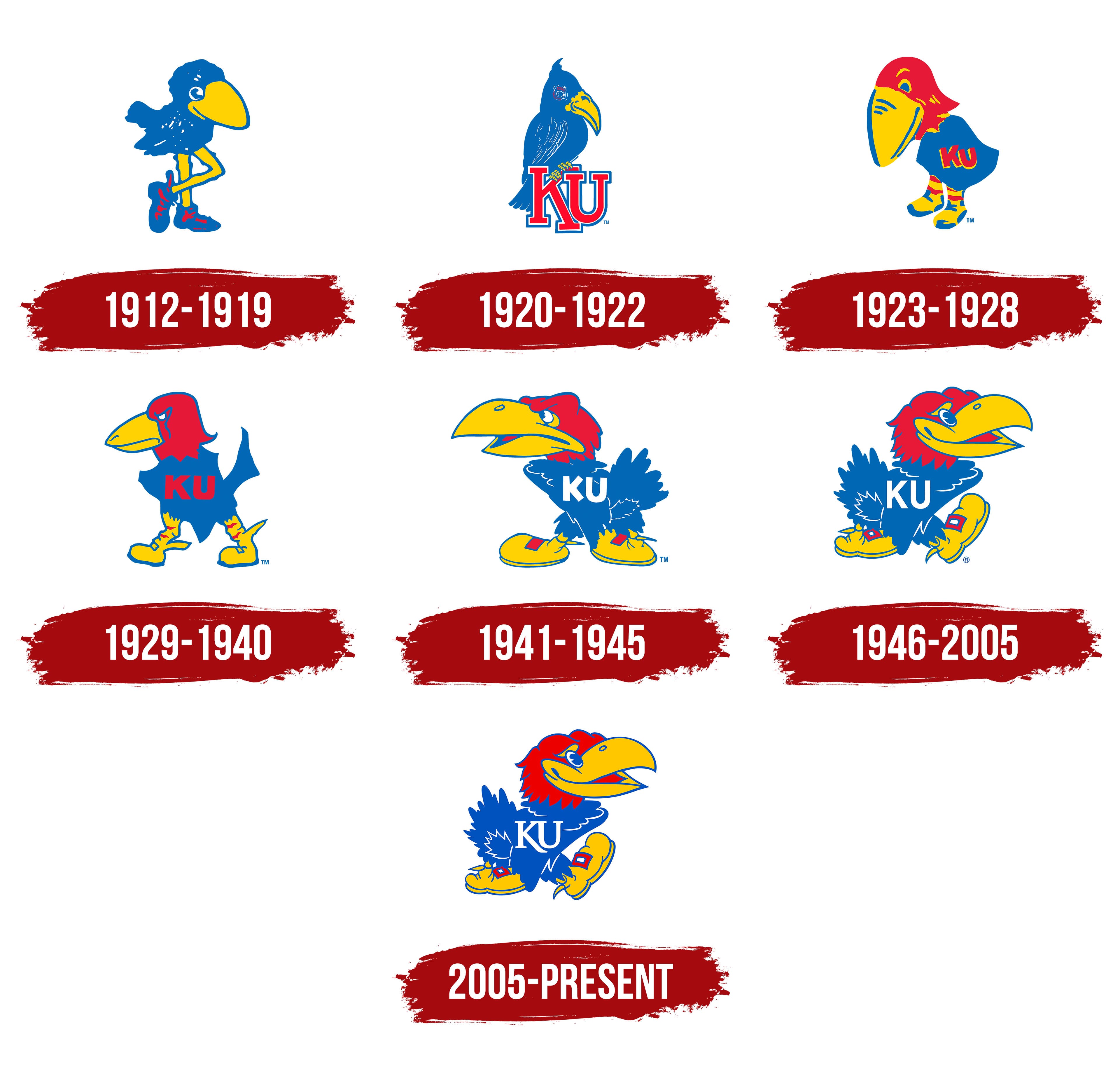
The original design of the Kansas Jayhawks logo didn’t emerge immediately: it was drawn in 1912 by cartoonist Henry Maloy, a student working for the university newspaper. His style significantly influenced the logo: it was cartoonish, lacking details but full of character. Besides the anthropomorphic bird, the emblem featured the intertwined abbreviation “KU” with a daisy at the bottom, as the flower was then considered a symbol of Kansas. The bird is a hybrid of two birds, including the noisy blue jay and the cunning sparrow hawk.
The first notable change to the logo dates back to 1929, when the bird gained distinct wings, formidable spurs, and an uncompromising character. The iconic image was radically modified again in 1946 to convey the university’s spirit. Jim Wilcox refined the typography in 1996. He introduced curved lines to the letters, making them more dynamic and imbuing them with symbolic meaning: the elongated leg of the “K” represents the hill at the main campus in Lawrence. The bird’s footwear was a gift from its first creator: Henry Maloy drew the boots as a threat to opponents. His idea was for the mythical creature to kick competitors in the face.
What is Kansas Jayhawks?
The Kansas Jayhawks refer to the sports teams belonging to the University of Kansas in Lawrence. They are formed from students who participate in the intercollegiate program and are members of the NCAA Division I and the Big 12 Conference. Overall, the department comprises 16 teams: 8 women’s and 6 men’s. Their name derives from the American Civil War militia and is historically associated with local settlers. The mascot is a bird that combines a sparrow hawk and a blue jay.
1912 – 1919
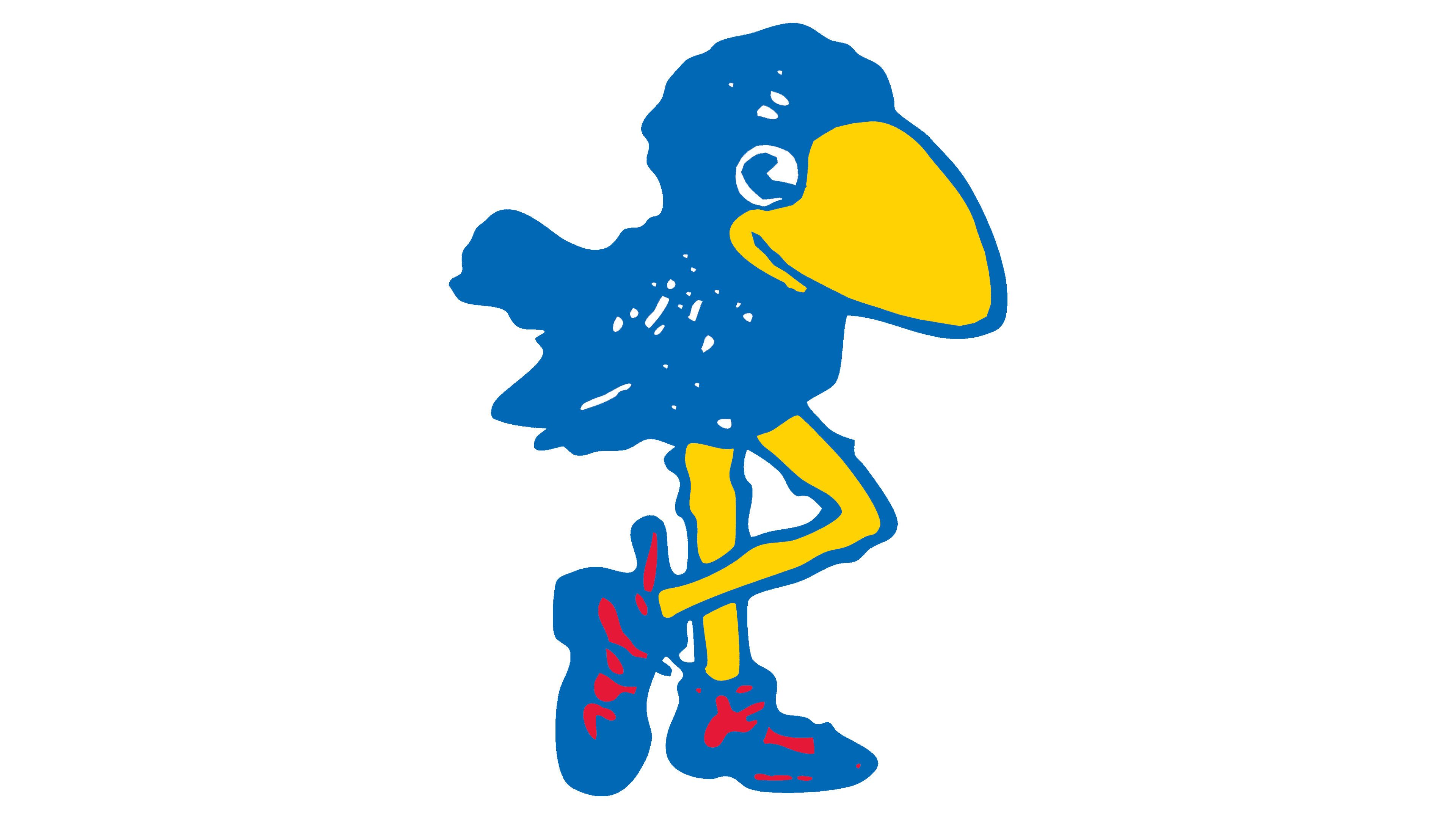
The logo features a caricature of a semi-anthropomorphic bird. Its upper part looks normal, but the lower part does not. It has long human legs in boots. To make the footwear more prominent in the drawing, Henry Maloy colored it red. The artist made the bird’s beak yellow and its plumage blue with white unpainted areas. These appeared due to the drawing style: the body, wings, and tail are applied with chaotic lines that do not connect in some places, leaving these white spots.
1920 – 1922
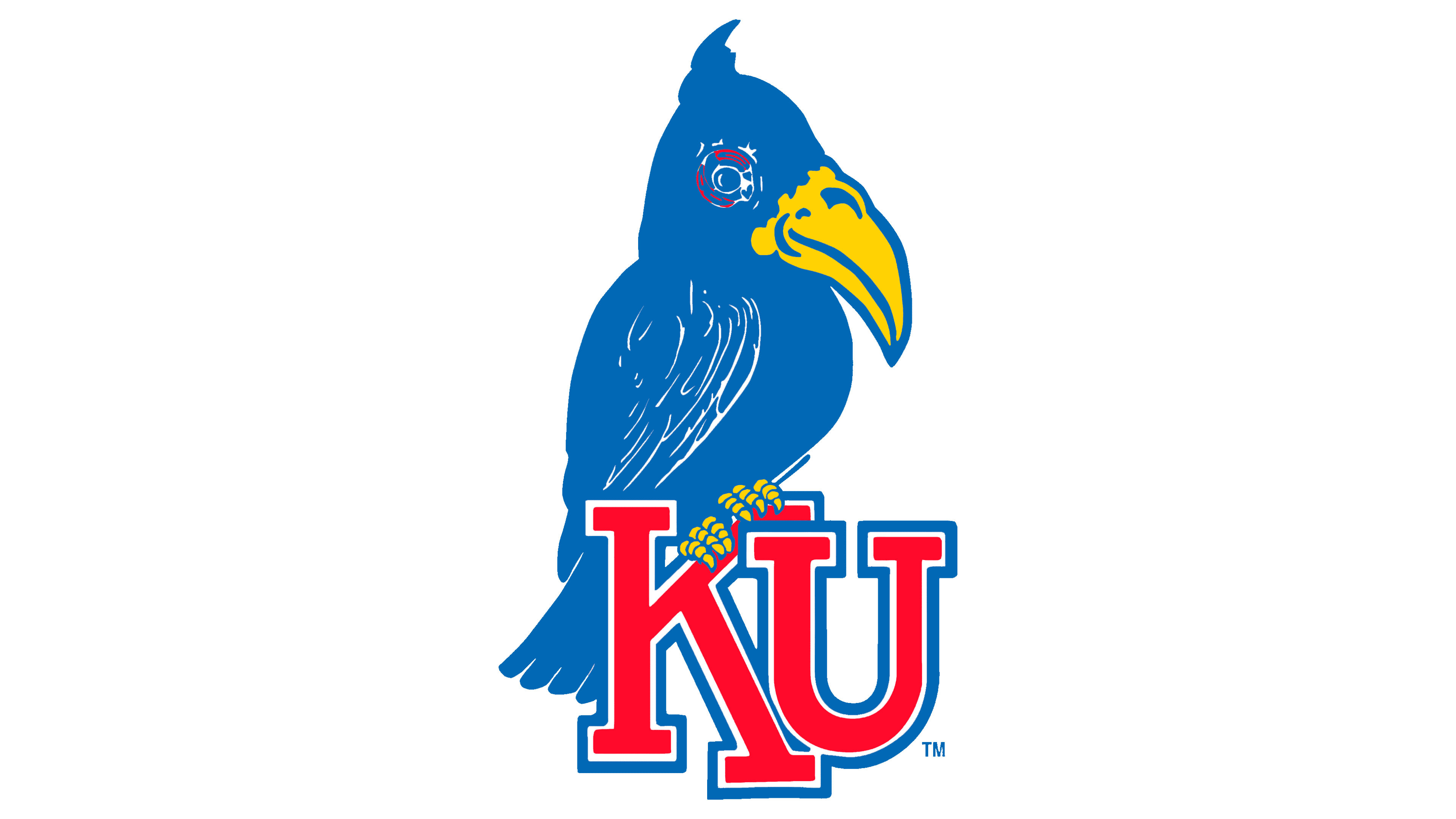
In 1920, the Jayhawk image became more realistic. A traditional-looking bird sits on the upper stroke of the “K” in the “KU” monogram. It is still colored blue and yellow, but it no longer wears boots. The red moved to the abbreviation. The plumage of the Jayhawk-sparrow hawk symbiosis is distinct, highlighted by thin white strokes.
1923 – 1928
Two sophomores (Jimmy O’Bryon and George Hollingbery) proposed a new version of the Kansas Jayhawks logo that again adopts a cartoonish style. The structure and color scheme remained the same: the picture depicts the Jayhawk, a mysterious creature combined with two birds. It has a blue body, a red head, a yellow beak, and sports shoes on its feet. The bird is turned to the left and drawn in profile. Unlike the inscription, enhanced with contrasting highlights, its wings and tail are not emphasized.
1929 – 1940
Forrest O. Calvin depicted a somber bird with a menacing look, achieved by rendering the eye white without a dark pupil. The artist removed almost all contrasting strokes, retaining basic colors: blue, red, and yellow. Their combination was limited to the legs (resembling socks), the head (around the eye area), and the beak (a single stroke at the end). The bird developed powerful spurs to further intimidate opponents in the sports arena. The “KU” monogram is placed horizontally and rendered in bold font.
1941 – 1945
The author of this logo, Gene “Yogi” Williams, opened the bird’s beak and eyes, giving it a sporty look. Fans nicknamed it Angry Jayhawk for its combative mood, muscularity, decisiveness, and readiness to meet even the fiercest opponent. This version laid the foundation for the familiar emblem known today. Moreover, the designer significantly altered the typography: he changed the inscription from red to white to make it stand out clearly against the blue background.
1946 – 2005
The university’s administration considered the previous Kansas Jayhawks logo excessively aggressive and held a competition. Student Harold D. Sandy won, turning the bird to the right, adding friendliness to its gaze, and drawing a smile. For his victory, he received $50. The university registered the copyright for the new emblem in 1947. Jim Wilcox altered the font in 1996, transitioning it from a playful design to a classic one.
2005 – today
The emblem gained expressiveness through enhanced shades. Each color was significantly refined to the desired brightness, eliminating dullness and adding depth. The font was also modernized: it is now linked to authenticity, as the elongated leg of the “K” represents the hill at the main campus in Lawrence and conveys inner movement. Otherwise, the logo remained the same.
Font and Colors
In the latest Kansas Jayhawks emblem, the abbreviation on the bird’s body is set in the Trajan font, a soft serif with thin serifs. In earlier logos, a grotesque font predominates, with all letters made in a geometric style.
Blue and crimson were officially approved in the spring of 1896. Yellow was added later and became complementary. It perfectly balances the bright palette, adding liveliness and realism. Red here signifies the peak of emotion as it flares up in the stadium. Blue conveys loyalty. Yellow symbolizes superiority.