


 Mortal Kombat Logo PNG
The Mortal Kombat logo introduces the participant to the world of martial arts and hand-to-hand combat through amazing creatures that wield power and hold the secrets of ancient techniques. The emblem looks mysterious and magical, with elements of formidable grandeur.
In 1991, a small team at Midway Games, led by Ed Boon and John Tobias, began work on a fighting game meant to rival Capcom’s Street Fighter II. An early concept with Jean-Claude Van Damme collapsed, pushing the team toward a darker fantasy idea. Instead of hand-drawn animation, developers digitized real actors, creating a more physical visual style.
On October 8, 1992, Mortal Kombat entered arcades. Fatalities became its core mechanic, turning finishing moves into graphic executions. By 1993, arcade cabinets generated over $300 million in revenue. On September 13, 1993, “Mortal Monday” launched console versions for SNES, Sega Genesis, Game Boy, and Game Gear. Nintendo censored violence, while Sega allowed it via code, leading to stronger Genesis sales.
On December 9, 1993, US Senate hearings led by Joe Lieberman and Herb Kohl targeted Mortal Kombat and Night Trap. Pressure resulted in the creation of the ESRB in 1994, with Mortal Kombat among the first titles rated M.
Sequels followed quickly. Mortal Kombat II (1993) set early sales records, while MK3 and Ultimate MK3 expanded the roster. Paul Anderson’s 1995 film earned $122 million, while the 1997 sequel did not. MK4 introduced 3D, but later entries lost momentum.
In 2009, Midway went bankrupt, and Warner Bros. Interactive acquired the rights. NetherRealm Studios, led by Ed Boon, rebooted the series with Mortal Kombat (2011), followed by MKX (2015) and Mortal Kombat 11 (2019). The franchise surpassed 100 million copies, ahead of Tekken by Bandai Namco and Street Fighter by Capcom.
Meaning and History
It is believed that the Elder Gods from Mortal Kombat can transform into dragons when they transform into their true form. Such imagery occurs periodically throughout the video game series. This means the logo partially overlaps the plot without revealing it, leaving room for imagination. The formidable mythical creature serves as MK’s main symbol because of its mystery and the qualities it represents: courage, fury, strength, fighting spirit, and a desire to win.
What is Mortal Kombat?
The Mortal Kombat video game series, in the action-adventure and fighting game genres, formed the basis of the same-name franchise. Numerous films and cartoons have been shot based on it; novels and comics have been written; theatrical performances have been created; and online gambling has been developed.
1992

The legendary black dragon on a fiery background appeared that year and has remained on the franchise logo ever since. Only his environment changed, but not himself. A round medallion with a wide frame depicts a mythical creature with a forked tongue and empty eye sockets. The top of the circle is yellow, the bottom is red, and they mix to form an orange glow in the middle. The gradient is smooth and soft, without sharp transitions. The dragon’s silhouette is gracefully curved, with wavy strokes that, while not detracting from its threat, still convey its menace.
1993
This year’s logo variant retained the previous contours and received new ones. A round sign with a curved dragon is placed in the center of a vertical rectangle. Moreover, it became darker to convey the oppressive atmosphere of the game’s plot. The emblem uses flashes of lightning, thunderclouds, gray smoke, and dark blue to convey intimidation. Hope for good comes from a shining reflection on the forehead and eyes of a mythical creature. Below are the inscriptions “Mortal Kombat” and the background number “II.” They are colored yellow-red with a gradient.
1995
The 1995 logo has a completely different style. It features a 3D design with a rocky texture, giving it a marble-like appearance. Even the relief’s roughness, with dark spots, is visible. The black background and precise shadow placement make it so. The dragon is the same: large and intimidating, with a protruding tongue, spikes along its back, and curved lines. The feeling of fear adds to the realism of the mythical animal and its burning red eye.
1996
The next modification introduced a black dragon silhouette on a red brick background, with flames rising. Above the circle appeared the inscription “Trilogy,” which clearly states that this is the logo for the game’s third installment. The name sits at the top, set in capital letters with small serifs. The composition fits within a vertical rectangle.
1997
A year later, the video game’s icy visual identity was born, as the story takes place in extreme cold. This is shown by adding the fourth part of the title, “Sub Zero.” The inscription matches this design: it is white with a bluish gradient and sharp serifs. As before, the emblem is voluminous. It exactly matches the cold style and looks like a figure made of ice. The dragon’s background is a black-and-blue square with a white blizzard trace.
1999
The series’ name, “Mortal Kombat Gold,” is rendered in gold. A black dragon on a yellow background looks very impressive and conceptual. The inscription is superimposed over a circle with a mythical creature. It is textured, bright, and convex.
2002

A few years later, a computer game dedicated to the Alliance was released, as its title indicated. The disc with the dragon is scaled down and placed inside a large V-shaped, stylized melee weapon with spikes. Blood is dripping from the tip of the letter (at the bottom). The mythological creature’s background is painted the same red and rendered with a metallic texture.
2003

In this episode of the game, the emblem’s cold metal has been preserved. It still decorates the dragon, making it an impregnable element. Not only is it metalized, but the surrounding frame and the side elements also resemble a cutting tool. The background is the same everywhere, blood red. The logo has two inscriptions: one at each level, beneath the round sign. The top line is set in a block type with a three-dimensional effect and is backlit on the left. The word combination in the bottom row is written in careless letters with a cut edge; each character looks as if it were cut with a sharp object. All components are placed in a black square.
2004
The 2004 logo returns to a round shape. The dragon seems illuminated from below, as shown by the upward-directed rays. He himself is black, as is the frame surrounding him. The background is a yellow gradient. The lettering is white. The top line is completely taken over from the previous emblem. The lower line uses a font with wide, pointed letters.
2005
A year later, the Mortal Kombat logo’s drawing style changed: a vertical black rectangle appeared, a large yellow inscription, and, under it, a small red one. The name is so large that it overlaps the lower part of the dragon. By the way, the background it’s on is now darker than before. The yellow color is preserved as a smoky stroke around the perimeter of the black silhouette.
2008
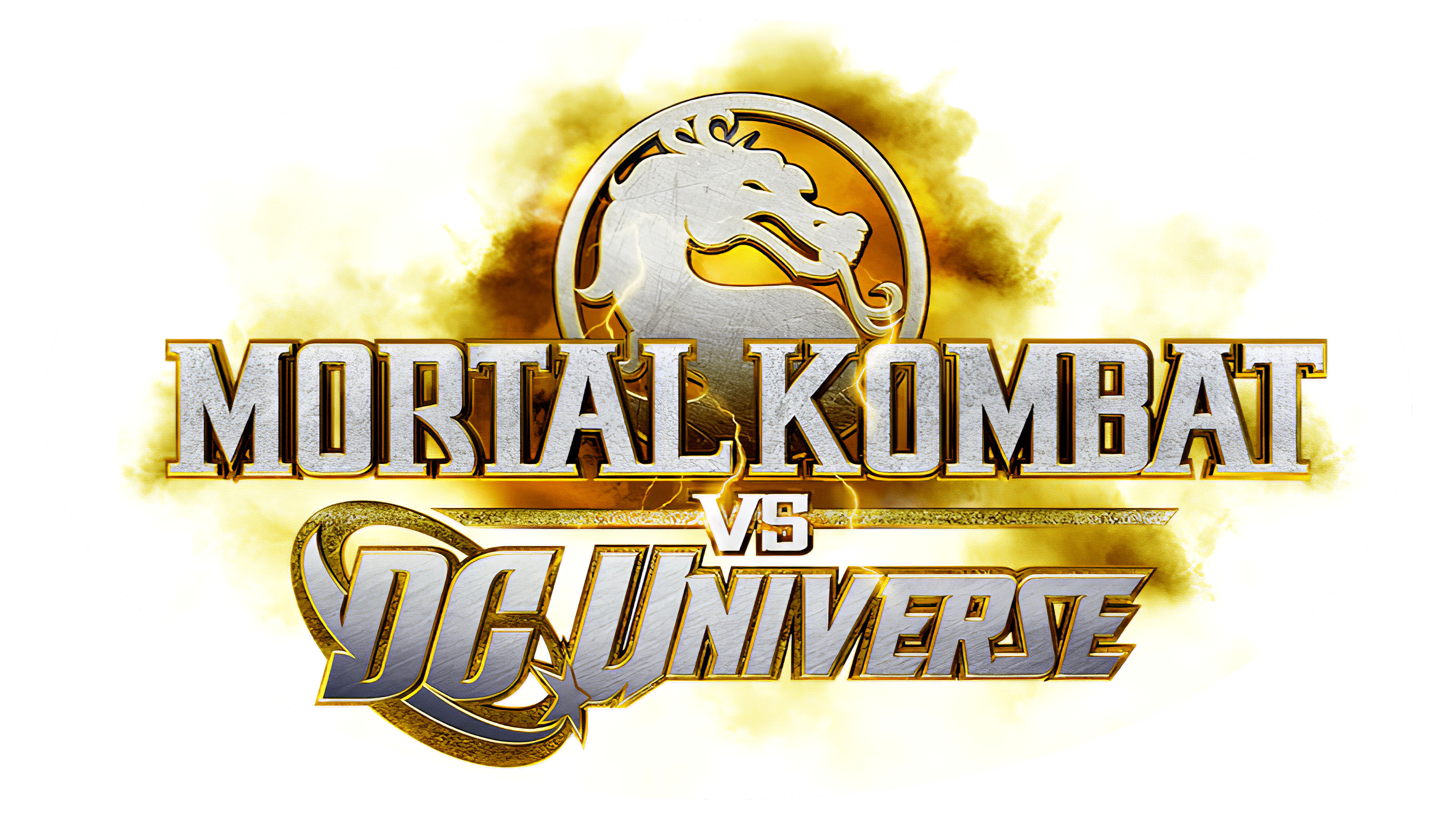
The video game Mortal Kombat grew into something grandiose, and its identity reflected that immediately. As a result, the emblem became light, but with a large-scale smoke screen in the background. Thin lightning cuts through the yellow, olive, and brown colors concentrated within it. They are on the dragon and on the top inscription. The bottom line has an additional graphic element, an oval with a star. In fact, this is a circle, but because of the diagonal arrangement, it appears visually displaced and looks like an oval.
2011
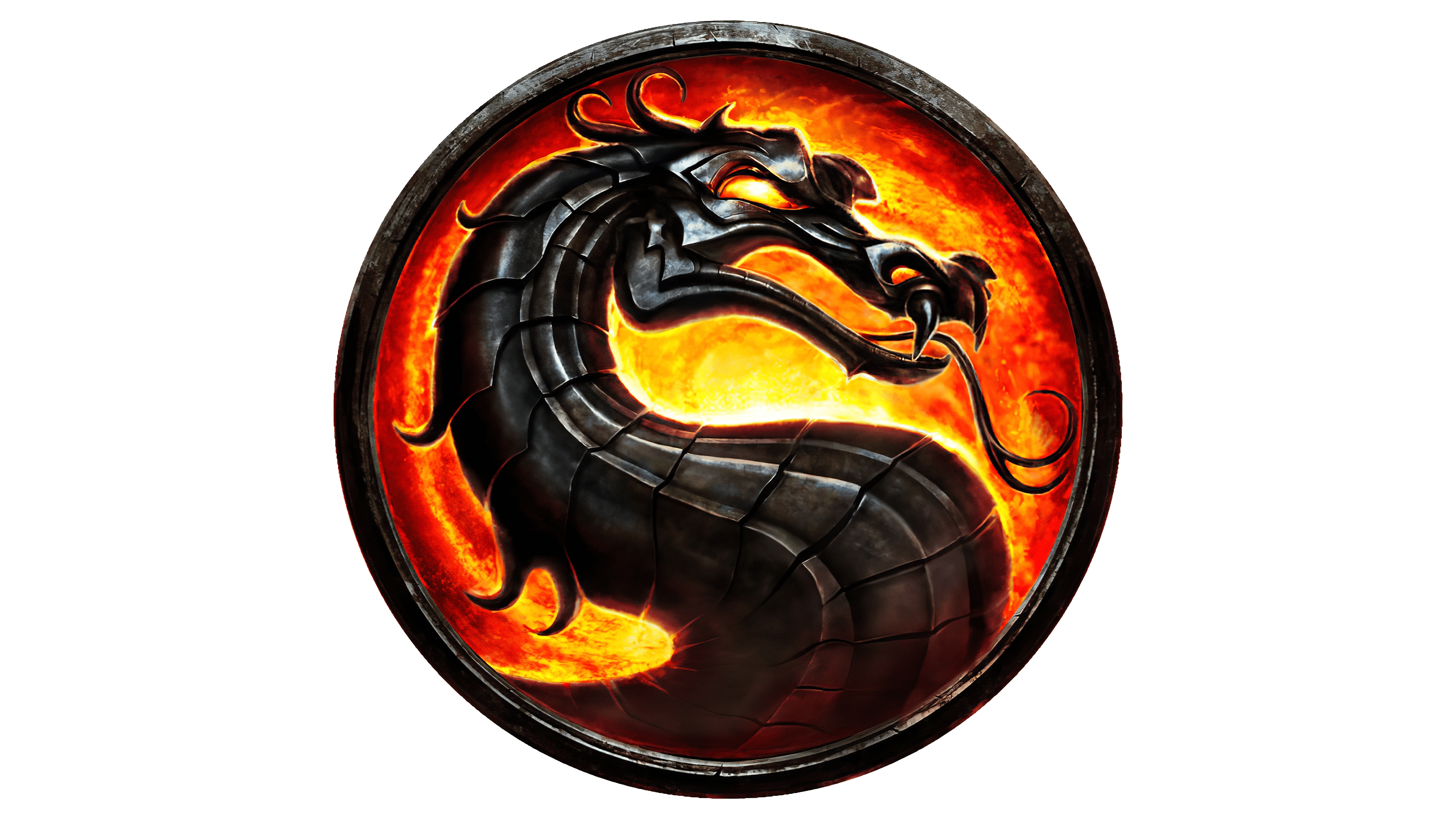
The 2011 logo has an updated design that, at first glance, shares nothing with the previous one. However, the dragon remains the common element, again referring to the popular franchise. The designers enlarged the medallion featuring the mythological animal, added a shell-like texture, and moved it away from the edge to lengthen the spikes and make them slightly sharper. The forked tongue also became thinner and more elegant. The eye glows with golden light reflected from a yellow-red background. The edge is wide, voluminous, and black. The emblem has no inscriptions.
2015

After the release of the next Mortal Kombat installment, the logo became monochrome and restrained. A white dragon silhouette in a white circle sits on a black rectangle, along with the franchise name. The inscription is strict, lowercase, with needle serifs at the ends of the letters. Next to it is the issue number X.
2019
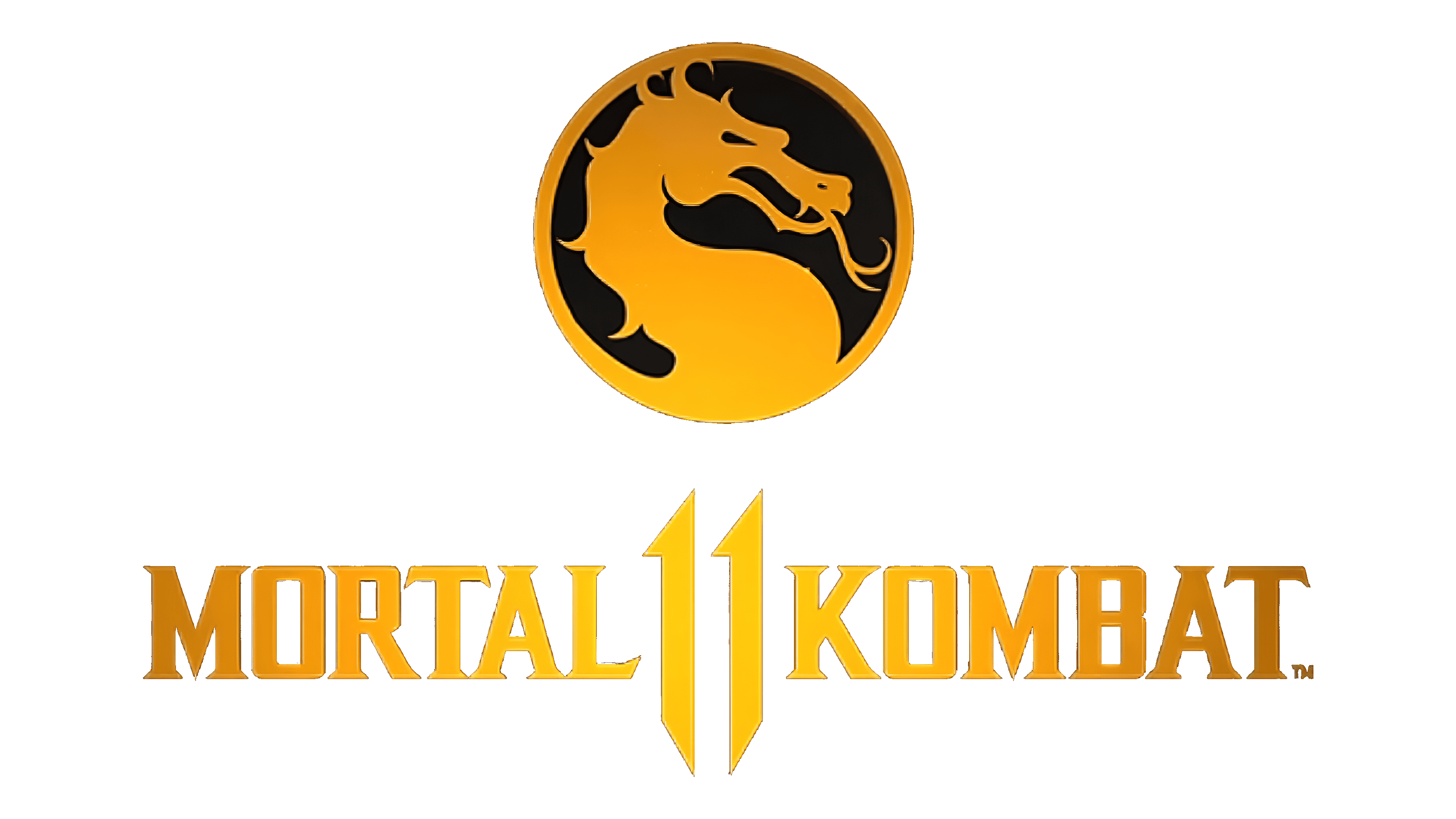
The latest part of the landmark video game is back, with a golden logo that represents passion, fire, confrontation, and high voltage. At the same time, the dragon in the frame is painted yellow, as is the inscription beneath it. However, the color is not solid; it is a gradient. In the icon, the lightest part is at the bottom; in the title, it is in the center. The dimming extends to the left and right of the number “11” to the extreme letters.
Font and Colors

The original Mortal Kombat graphic sign is in a red, yellow, and black palette. The dragon here appears as a shadow, suggesting its elusiveness. The artist depicted the head on an elongated neck, leaving only the transparent eye visible. The curved lines give the picture a dynamic feel.
Because of the dragon’s curved neck, the emblem is associated with the Taijitu, an ancient Chinese diagram consisting of two interlocking spirals. Western culture has popularized this divided circle as a “yin-yang symbol.” It represents two opposites that complement each other in harmony.

However, in the Mortal Kombat logo, the circle’s right side is empty. The black dragon is contrasted with the bright red and yellow space. The designers used this contrast to make the character more visible. The colors can also symbolize its fiery element, so a simple white background would be inappropriate.
The logo has several variations with additional elements. The main version contains only a dragon without inscriptions, so there is no talk of fonts. The color palette is more varied: the dragon and the edging ring are colored black, and the space inside the circle is colored red and yellow. Moreover, the last two colors appear in several shades that flow smoothly into one another. The gradient symbolizes fire and passion. By the way, the dragon’s long tongue also looks like a flame, and this coincidence is no coincidence.