


 MotoGP Logo PNG
The MotoGP logo symbolizes the speed and dynamism of the motorcycle racing championship. Its graphics highlight the tournament’s competitive nature, the professionalism of participants, and the high standards for technical equipment and rider skill.
The motorcycle Grand Prix World Championship began in 1949 under the FIM. Several engine classes made up the series, with the 500cc category as its leading division. European manufacturers dominated the early period, and Italy’s MV Agusta won the premier-class championship for 17 consecutive years.
The competitive balance shifted during the 1960s as Honda, Yamaha and Suzuki entered with larger engineering programs. Giacomo Agostini’s 1975 title on a Japanese motorcycle marked the end of the earlier European era. Through the following decades, Japanese manufacturers controlled much of the premier class. At the same time, American riders Kenny Roberts, Freddie Spencer, Wayne Rainey and Kevin Schwantz shaped the racing of the 1980s and 1990s.
In 2002, the leading category was renamed MotoGP. Four-stroke 990cc engines replaced the 500cc two-strokes, beginning a new technical period. Valentino Rossi became its main figure, winning consecutive championships and titles with different teams. In 2007, Casey Stoner won for Ducati, giving an Italian manufacturer its first premier-class championship in 30 years and interrupting the long Japanese run.
Marc Márquez emerged as the dominant rider from 2013 and captured six championships in a relatively short period. His results placed him among the most successful competitors in Grand Prix history. In 2023, organizers added shorter sprint races to race weekends, creating a second competitive event alongside the main Grand Prix during race day.
Meaning and History
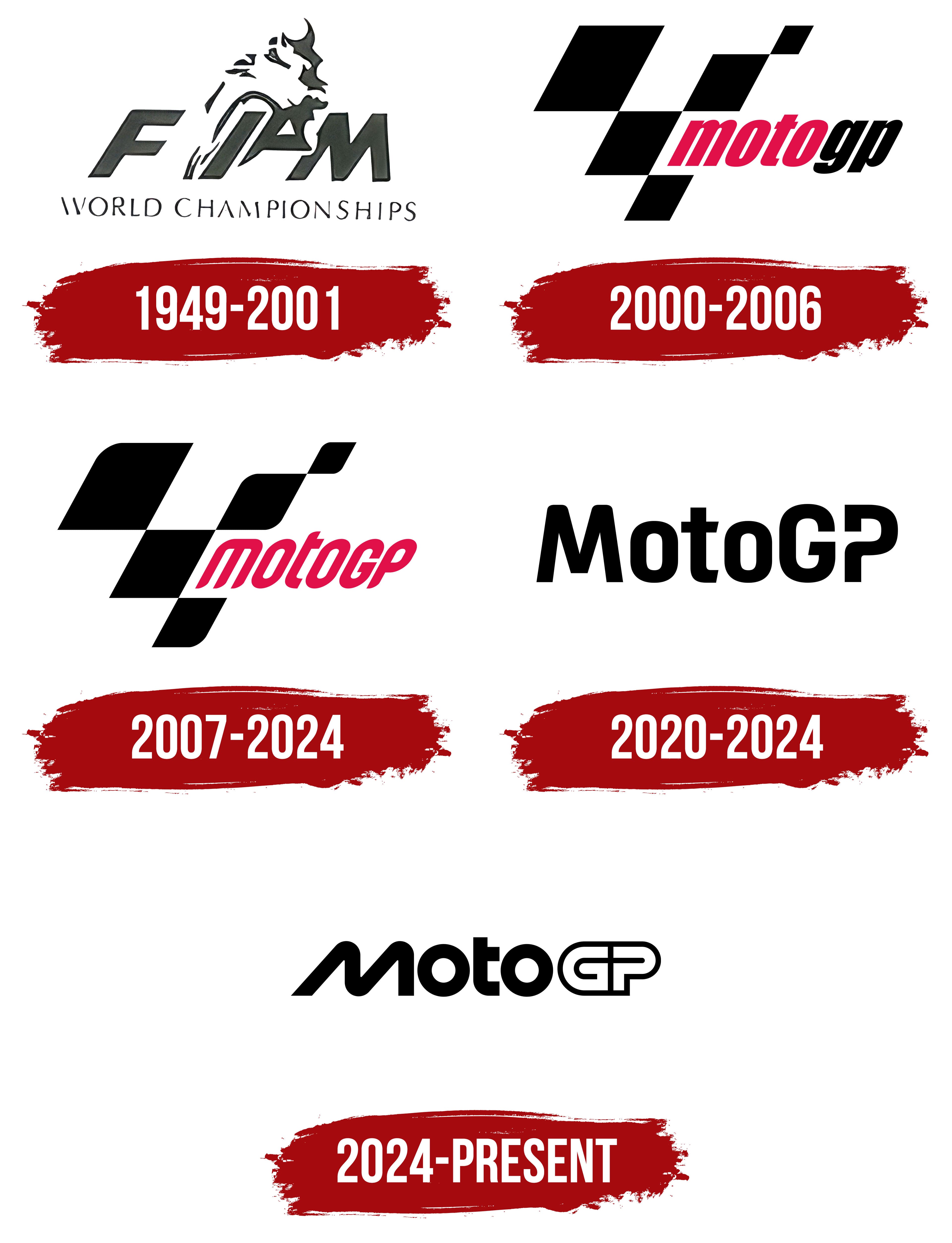
What is MotoGP?
It is a global championship of motorcycle road racing, with bikes exceeding speeds of 350 km/h (217 mph). Racing motorcycles are specially designed for circuit tracks featuring sharp turns. The championship includes various classes, including fully electric motorcycles. The season comprises over twenty races on different continents. Factory teams from major global manufacturers compete in the events. Races average speeds above 170 km/h (106 mph) and last under one hour.
1949 – 2001

The logo that accompanied the Road Racing World Championships, under the management of the Fédération Internationale de Motocyclisme (FIM), was introduced when the series launched in 1949. At that time, the tournament’s name was limited to “FIM World Championship,” emphasizing its official status but excluding a separate marketing brand or trade name such as MotoGP. This trademark embodied the specifics of the analog era, when identity was perceived as secondary and served only as the official designation of the championship, far from commercial exploitation and global distribution of merchandise bearing its symbols.
The mark was monochrome with a metallic shine, conveying the technical nature and toughness of motorsport. The graphics consisted of large gray letters “FIM,” executed in an italic, slanted typeface that evoked speed and forward motion. A key aspect of the composition was integrating a motorcycle’s front wheel into the lettering’s geometry, creating a frontal view of the wheel as it is embraced by the letters. The silhouette of a rider on a motorcycle was drawn in abstract lines, the figure leaning into a racing maneuver, blending with the typography’s tilt. This symbolically conveyed speed and the aggressive character of racing, visually reflecting the tension of competition on the track.
During this trademark’s use, a whole racing era emerged, marked by the triumphs and drama of legendary riders such as Mick Doohan, Wayne Rainey, Kevin Schwantz, and Àlex Crivillé. As a result, the logo’s visual image became firmly fixed in fans’ perceptions, remaining an integral part of the collective memory of the FIM Road Racing World Championship Grand Prix’s pre-digital era.
2000 – 2006

Dorna Sports developed the next championship logo. It emerged with the introduction of a new top category in motorsport, known as MotoGP. For the first time, the championship’s name was registered as an official trademark. It replaced the previous FIM emblem and gained independent commercial status.
The design was based on a composition of slanted black rhombuses forming a diagonal grid structure. In terms of meaning, these elements visually echoed the checkered racing flag, signaling the end of the race and emphasizing the championship’s competitive nature. The use of rhombuses of varying sizes and their slanted arrangement created a dynamic that conveyed a sense of speed and motion.
The typographic part of the trademark contained the lowercase word “motogp,” where color distinguished two semantic parts: “moto” was highlighted in red. At the same time, the abbreviation “gp” remained black. The visual division created an intuitively appealing neologism by combining “motorcycle” and “Grand Prix.” The typeface was an italicized grotesque with moderately rounded letterforms and characteristic diagonal cuts to the strokes, giving it a dynamic, sporty character. It was presumably based on the popular Impact font, later modified specifically for this mark.
2007 – 2024

MotoGP’s identity update in 2007 coincided with the presentation of the first Tower of Champions trophy. It emphasized the championship’s transition into a new stage of development. The previous composition was preserved to maintain recognition. The slanted shapes imitating a checkered finish flag continued to be used. However, the rhombuses, previously geometric and angular, were given rounded corners, adding smoothness and a streamlined look to the overall image. This softened the emblem’s visual impact while maintaining its connection to the themes of speed and racing dynamics.
Instead of the Impact typeface, an adapted grotesque was used, specifically developed for the MotoGP brand’s needs. The font stood out with increased letter spacing and geometrically shaped glyphs. The type remained italic, conveying a sporting focus. Still, it became cleaner and softer thanks to smoother contours and balanced proportions.
The word MotoGP was no longer split into two colors (“moto” and “gp”); it was now presented as a single red block. Nevertheless, the distinction between the parts remained through contrasting capitalization. The capital letters “G” and “P” separated the second part of the name from the lowercase “moto.” This emphasized the dual meaning, presenting the brand as a blend of motorcycling and grand prix racing.
This version of MotoGP identity became the longest-running mark of the four-stroke engine era. Visually, it became the symbol of a mature period of the championship, when well-known riders such as Casey Stoner, Jorge Lorenzo, Valentino Rossi, Marc Márquez, and Francesco Bagnaia dominated the tracks.
2020 – 2024

Beginning in 2020, MotoGP periodically used an alternative version of its identity, presented in monochrome and set in the new MotoGP Display font. While the main 2007 logo remained the primary logo, this alternative composition was frequently featured in television broadcasts and digital brand design until early 2024.
The creators of the new typography were designers from Fontsmith, part of the Monotype Imaging group, working with Dorna Sports. The logo adopted a minimalist design, with emphasis on the championship’s written name.
The entire composition was reduced to a strict black-and-white palette, eliminating the previous contrasts. The font was a stable sans-serif grotesque characterized by smooth outlines and uniform stroke thickness. The most distinctive feature was the curve of the letter “P,” broken along its vertical stroke, which created a subtle sense of dynamism.
2024 – today

The presentation of the new MotoGP style took place on November 17, 2024, at the closing MotoGP Awards ceremony following the Motul Solidarity Grand Prix in Catalonia. The updated brand version, developed by the renowned studio Pentagram in collaboration with the type bureau F37, marked the most radical change in visual concept in the last two decades and received critical acclaim from championship fans. The style emphasized its connection to the recent rebranding of Formula One, also owned by Liberty Media, which had acquired control of Dorna Sports’ commercial rights earlier that year.
The main change was a complete reorientation of the brand, shifting its focus toward strict typography and abandoning the checkered flag emblem that had long been a part of MotoGP’s visual language. Instead of the previous dynamic slant and fluid forms, the new logo was characterized by rigid letter geometry, a monochrome black-and-white palette, and the elimination of decorative elements.
The typography was divided into two visually opposite parts, combined into a unified structure. The lowercase “Moto” was written in the MGP Display font, distinguished by the expanded shape of the letter “M,” whose rounded peaks resembled the silhouettes of two riders overtaking each other. The remaining symbols in this part (“oto”) were interpreted schematically as a racer positioned between two wheels. The second part of the name, the abbreviation “GP,” was executed in massive white capital letters with a black outline, forming a single, compact shape that symbolized the contours of a racetrack. The name was written with minimal letter spacing and no slant, creating an impression of technology and rigor.
The new logo reflected the championship’s departure from classic sports metaphors toward a modern industrial-technological aesthetic, with a focus on the brand’s typographic identity.
Font and Colors

The typeface was built on smooth lines and slanted letters, creating a sense of forward momentum. The angles were softened, giving the construction a more fluid appearance, while the italic form emphasized dynamism. Visually, it resembled the direction of airflow or a speed trajectory, where each letter seemed drawn into a single rhythm. The strokes were thick, giving the inscription weight and confidence.
The project’s color story was divided into two stages. For a long time, the dominant palette was a duo of black and a cool shade of red, striking a balance between strictness and energy. The red accent strengthened associations with racing and engine power, while black served as the base tone, restraining excessive brightness. Beginning in 2024, the palette was reduced to a single color: black. Rejecting an additional shade made the composition even more unified and strict. All of this emphasized restraint and concentration, with the entire visual image gathered into a single line, free of distractions.