


 My Hero Academia Logo PNG
The My Hero Academia logo is filled with pride and grandeur. The emblem shows a desire to be at the forefront of protecting the good. Alongside the franchise’s heroes, the sign moves forward with power, sweeping away everything evil and unworthy in its path.
My Hero Academia is a media franchise based on the manga of the same name. It follows Izuku Midoriya, who was unlucky at birth: he had no superpowers, so he could not become a hero. But the legendary Ōrumaito helped him. He awarded Izuku a unique gift for his bravery and dedication. Beyond the manga, the media franchise includes several animated films and a series of video games.
Manga and anime with the same name were created at different times. The Japanese comics My Hero Academia came first. This happened in 2014, when readers of the weekly magazine Weekly Shonen Jump first learned about Izuku Midoriya. The manga is still ongoing and has more than 30 volumes. The debut animated series My Hero Academia was released in 2018, followed by a sequel and a continuation of the original story. Work is now underway on the third part, a joint project of several film companies.
Meaning and History
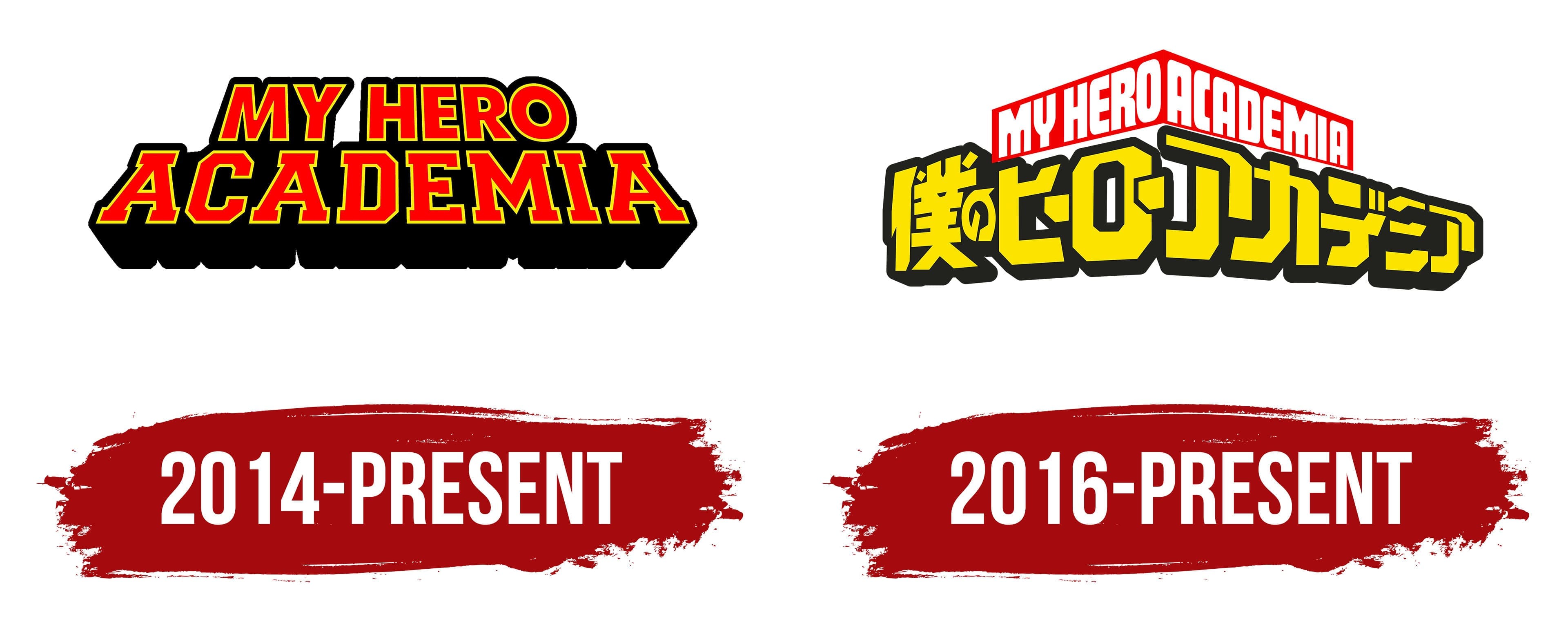
The media franchise does not have a single common logo; for each product, be it manga or anime, its identity system has been developed.
What is My Hero Academia?
My Hero Academia is a popular media franchise that includes manga, video games, films, and anime series. Artist Kōhei Horikoshi created the original Japanese comics, which began publication with major publisher Shueisha Inc. in 2014. The story is set in a world of superheroes and follows a boy born without supernatural abilities. Studio Bones adapted this story into a multi-season anime, with the first season released in 2016.
2014 – today

In 2014, readers saw the first chapter of a Japanese manga. A little later, its English version appeared. For the American covers, a logo was created with the words “MY HERO ACADEMIA” in bright red. Because of the specific geometry, the text appears tilted backward, as if it were on a different plane. The phrase “MY HERO” occupies the top line and is almost twice as large as the word “ACADEMIA,” written at the bottom. Each letter is outlined in yellow and has a wide black halo. Dark shadows are pulled downward, which creates a three-dimensional effect.
2016 – today

In 2016, Funimation acquired the rights to the TV series My Hero Academia, which was announced in 2015. The logo contains two-level multi-colored lettering. It is based on Japanese characters, probably the anime’s name in the original language. The symbols are colored a bright yellow and outlined in black. The phrase “MY HERO ACADEMIA” is inscribed on top inside a red polygon that looks like an arch or boomerang. The letters are white, with no outlines.
Products related to the media franchise have their logos. They vary in design but share a similar structure, as they contain only text (in English or Japanese). The design is not as simple as it might seem at first glance. The designers played on visual perception and, using simple techniques, turned two-dimensional inscriptions into 3D objects. They achieved this with wide black shadows. Asymmetry also played a role, particularly the narrowing and varied inclinations of the letters.
Font and Colors
For the My Hero Academia logo, they chose a Futura Display analog. The German typographer Paul Renner designed the original. The creators of the wordmark have retained the characteristic shape of all letters except “M.” They made it look like an inverted “W.” The elegant sans-serif typeface is the exact opposite of the typeface used in the manga logo. The lettering on English-language covers seems cumbersome due to the large rectangular serifs and many corners. This applies only to the word “ACADEMIA” because the phrase “MY HERO” looks grotesque.

The manga logo looks very bright: the designers combined red, yellow, and black in different proportions. The My Hero Academia anime branding is colorful too, but its shades are more subdued. The palette is based on white and yellow. They are used for text. Yellow and black serve as background colors, creating contrast.