


 New Line Cinema Logo PNG
Movie rentals and production are key elements of the New Line Cinema logo. The former has a long history; the latter has modern relevance. But the logo combines them perfectly, showing a close relationship between past and present. This tribute to cinematic art is reflected in the visual identity.
New Line Cinema was founded in 1967 in New York by 27-year-old Robert Shaye, a Columbia Law School graduate who started with $1,000 in savings. At first, the company rented foreign, art-house, and controversial independent films, then screened them on college campuses, where students were more open to material that mainstream theaters ignored.
In 1972, Shaye reissued the 1936 anti-marijuana film Reefer Madness, which unexpectedly became a campus hit because viewers treated it as an absurd comedy. New Line also distributed John Waters’ Pink Flamingos and Female Trouble, strengthening its reputation for unusual cinema. In 1977, the company released its first in-house film, the low-budget thriller Stunts.
The major break came in 1984 with Wes Craven’s A Nightmare on Elm Street. Shaye paid $14,000 for the script, and the film earned more than $25 million on a budget under $2 million. Freddy Krueger became the studio’s defining figure, and A Nightmare on Elm Street 3: Dream Warriors was New Line’s first national release in 1987. In 1986, New Line went public, and in 1990, Shaye created Fine Line Features for art-house films.
Turner Broadcasting System bought New Line for $500 million in 1994, and Time Warner absorbed Turner in 1996. The studio’s greatest success came with Peter Jackson’s The Lord of the Rings trilogy, released from 2001 to 2003, which earned more than $2.9 billion worldwide. The Return of the King won 11 Oscars in 2004. After a legal dispute with Jackson, New Line merged into Warner Bros. Pictures in 2008 and continued as a Warner Bros. division, unlike Miramax.
Meaning and History
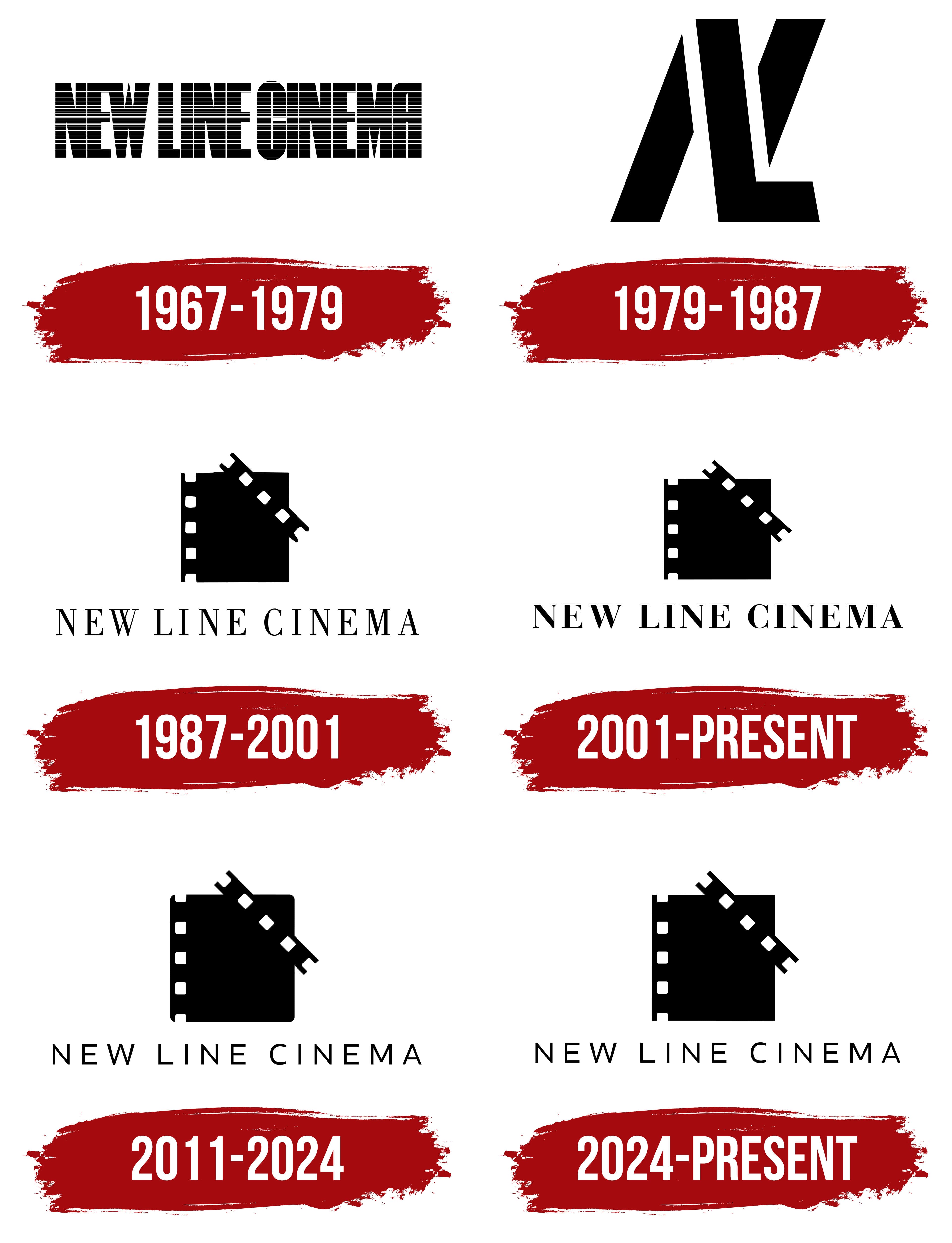
Long ago, when New Line Cinema was just a small movie rental store, it didn’t use a consistent logo. It appeared in the early 70s and was text-based because the company needed a sign that represented it and made it memorable to potential customers. Therefore, it adopted its first official emblem in 1972 after stabilizing its work and confident growth in the number of clients.
What is New Line Cinema?
New Line Cinema is an American television and film company specializing in producing and distributing films. The company skyrocketed to success after producing A Nightmare on Elm Street, which became a global blockbuster. Student Robert Shaye founded the company to showcase domestic and foreign films in university towns. It was established in 1967. In 2008, it became part of Warner Bros. Discovery and ceased to exist as an independent unit, becoming a division of the film industry giant.
1967 – 1979

The emblem consisted of a black horizontal rectangle bearing the film rental studio’s name. The letters were geometric, vertically elongated, smooth, and carved, with many sharp internal and external angles. This was most evident with “W” and “M,” presented as inverted copies. The capital glyphs were painted red, with thin black lines crossing them horizontally. The widest foggy stripe ran along the entire inscription and was in the middle. It seemed to cross out the phrase “New Line Cinema.”
1979 – 1987

This logo was brief, expressed as a minimalist composition. It looked like a monogram composed of the abbreviated name “New Line”. The letters were stencil-like, bold, smooth, and carved. The glyphs overlapped, with “L” overlapping “N” and serving as its diagonal crossbar. This looked stylish and futuristic, with the “N” made of two pointed lines on the right and left. The emblem was monochrome.
1987 – 2001

The next logo kept the black-and-white dominance, but it was graphic rather than textual, with the drawing taking up almost all the sign’s space. The text was also present, hidden at the bottom, and appeared as a single-line inscription with thin letters. Even in uppercase, the letters weren’t bulky or flashy. But the image looked large. It was a frame from a film strip, black with side perforations consisting of three full squares and two half squares in white. A second such strip was located in the top right corner.
2001 – today

The modernized New Line Cinema logo features a black square with several holes along the left edge and a perforated strip that crosses the top-right corner. The inscription is made in semi-bold Roman font. The letters are not tall but expressive. They are slightly flattened, so they seem wide.
2011 – 2024

The emblem is designed in a traditional style: a black film strip frame with the left edge perforated. Here, a square replaces the vertical rectangle, so the geometric figure is taller than in other logo versions. All of its corners are rounded. The bold serif font has been replaced with a thin sans-serif one, adding a visual lightness to the sign.
2024 – today

The New Line Cinema logo has always been a simple yet recognizable symbol in the film industry, and the changes made in its latest version emphasize this minimalism while staying true to the brand’s history.
The central symbol remains a film reel, which fits a film company. However, while the reel’s corners were previously rounded, the updated version features sharp edges. This change adds rigor and sharpness to the emblem, reflecting the company’s decisiveness and professionalism. The new film reel look feels more modern while maintaining a connection to the past.
The font for “NEW LINE CINEMA” is in a strict, simple style. The letters are vertically elongated, adding solidity and stability to the visual mark. This typographic approach underscores the company’s seriousness and significance, which have remained key in the film world for decades.
The color scheme remains black and white, underscoring the company’s classic approach while making the emblem recognizable and versatile. Black symbolizes power and confidence, while white represents purity and clarity of purpose.
As time moves forward, the company and its identity must keep pace without losing their uniqueness and traditions. Throughout the years, New Line Cinema has produced films that have left a significant mark on culture, and the updated logo symbolizes its readiness to continue this mission, staying true to its traditions while embracing the challenges of a new era.
Font and Colors
Each New Line Cinema logo uses a specific typeface that does not correspond to the previous one. Specifically, these samples resemble Bauer Bodoni Bold, Times New Roman Condensed, and Apple Garamond Bold. Another logo uses a smooth sans-serif font with thin, rounded glyphs.
The corporate palette is mainly monochrome, which dominates almost all emblems. However, one logo features an intense red color with highly concentrated energy.