


 Nick Jr. Productions Logo PNG
The Nick Jr. Productions logo visualizes the channel’s slogan, which consists of three words: “Grow, Learn, and Play.” It shows that the worlds of adults and children are inextricably linked and that older ones support the younger ones in their development, literally leading them through life by teaching and educating.
Nick Jr. grew out of Pinwheel, an educational puppet show created by Vivian Horner for the QUBE cable system in Columbus, Ohio. It premiered on December 1, 1977, and ran for long daytime blocks on channel C-3, which viewers called the Pinwheel Channel. The format showed that preschool television could exist as a full programming space.
On April 1, 1979, C-3 became Nickelodeon, the first U.S. cable channel devoted entirely to children. Pinwheel moved to New York and remained a key show through the early 1980s. After Nickelodeon added advertising and rebranded in 1984, it competed more directly with PBS programs such as Sesame Street and Mister Rogers’ Neighborhood.
In 1985, Viacom bought Nickelodeon, MTV, and VH1 from Warner Communications for $685 million. On January 4, 1988, Nickelodeon launched a preschool block called Nick Junior, later shortened to Nick Jr. Eureeka’s Castle followed in 1989 as its first original project. After ratings weakened, Nickelodeon invested $30 million in a three-year relaunch, adding Face, Gullah Gullah Island, and Allegra’s Window in 1994.
Blue’s Clues premiered in 1996 and became the block’s major hit, using repetition and viewer participation as part of its educational method. Dora the Explorer arrived in August 2000 and became another flagship series. Nick Jr. content later appeared through Noggin from 1999 and on CBS from 2002. On September 28, 2009, Noggin was renamed Nick Jr., turning the preschool brand into a full cable channel within Nickelodeon Group, later part of Paramount Media Networks.
Meaning and History
The emergence of Nick Jr. Productions is associated with a series of upgrades to children’s television programs. The channel resulted from one such improvement, as its eponymous “twin” exists and was revived in 2014 under an abbreviated name. It began in 1988 when Nickelodeon decided to create a program for preschoolers. He named it: he took the beginning of his name, “Nick,” and added the indication “Jr,” that is, “junior.” Thus, he achieved three goals at once:
- confirmed that the project belongs to him;
- made it clear that he is the senior in the group of channels;
- outlined the target segment of viewers (young children).
In 1993, a rebranding took place, including a change to the emblem. After the network transitioned to Paramount Media Networks in 2009, the company undertook a modernization effort, resulting in the emergence of a parallel educational program, now under the new owner. But the TV channel’s logo has always remained highly recognizable to children, as it features two symbolic figures: an adult and a child.
What is Nick Jr.’s Productions?
Nick Jr. Productions is an American TV channel for younger children (including preschoolers up to six years old). It emerged in its current form in 1993 as a division of the Nickelodeon Group. In the winter of 2009, it became part of Paramount Media Networks. Its head office is located in New York.
1993 – 2000
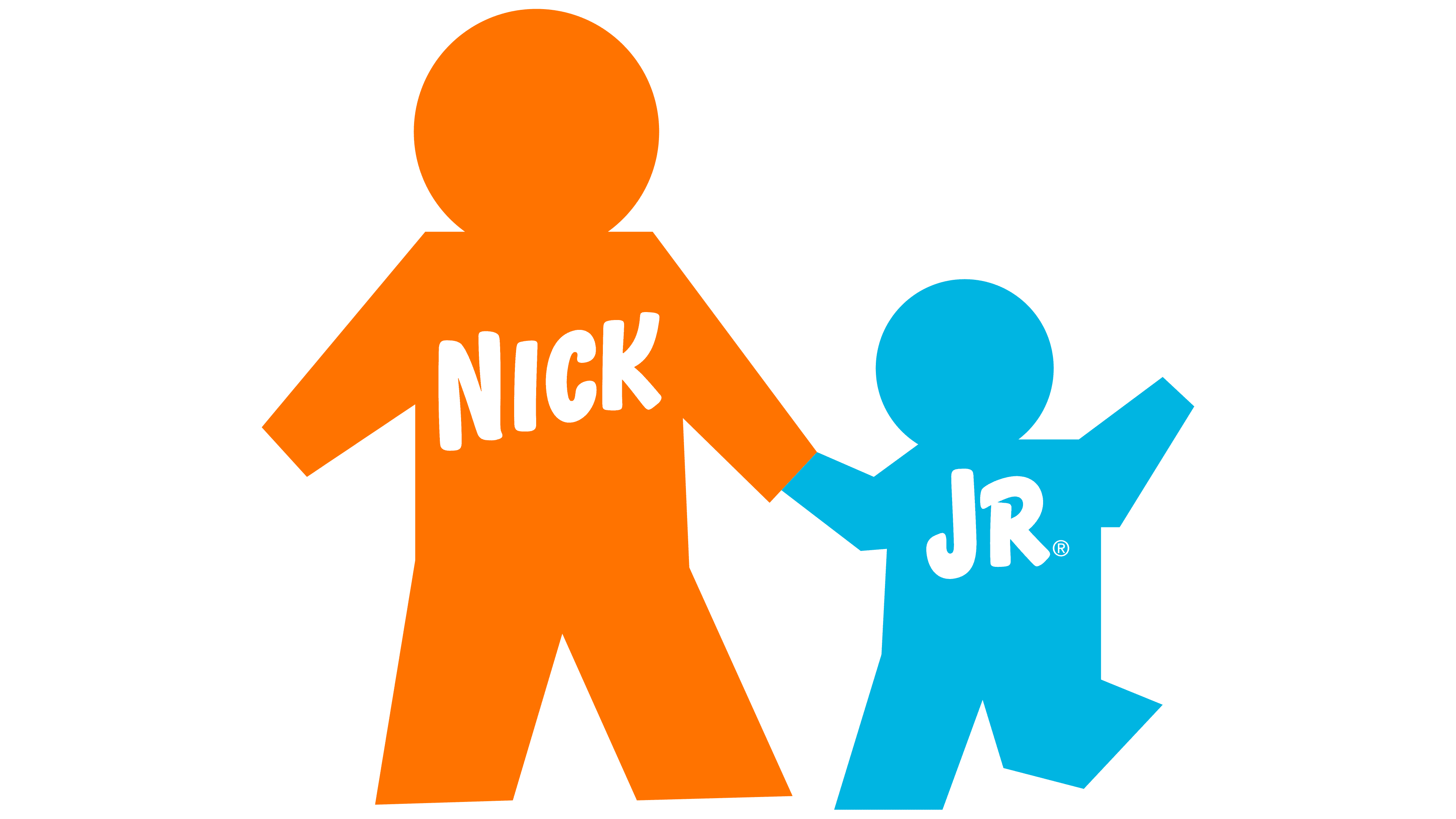
The Nick Jr. Productions logo is graphical. It consists of large and small human silhouettes. The figures immediately recognize an adult (presumably a parent or teacher) and a preschool-age child. The tall person is colored orange. He is holding a child’s hand, leading him, providing necessary support, and instilling confidence. The small figure is made of blue. Both are marked with the words “Nick” and “Jr.” The inscriptions are arranged diagonally, colored white, and are made in the upper-case grotesque font.
1996 – 2004
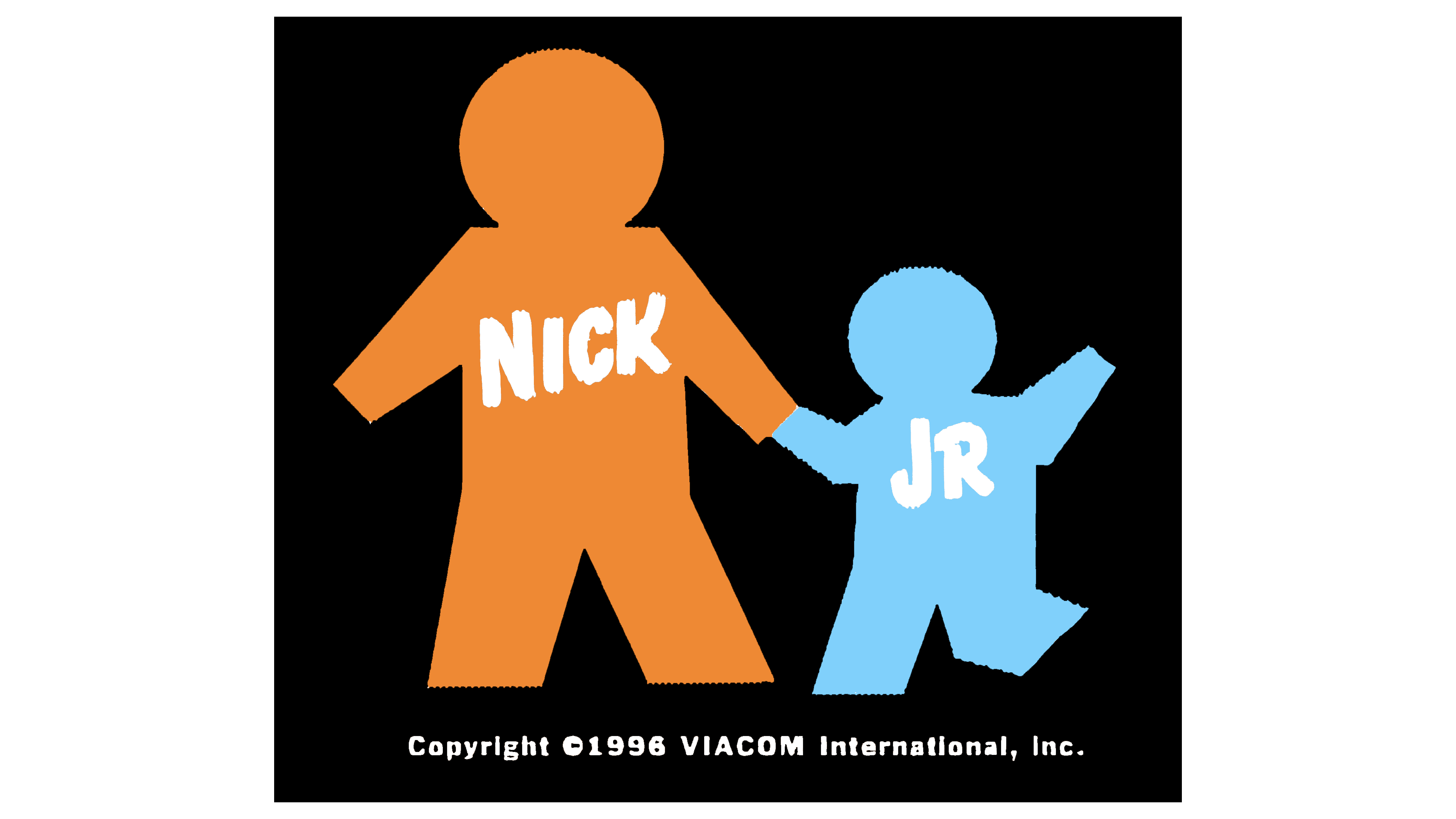
The figures of an adult and a child differ in color: one is dark orange, the other is light blue. This is a parent (teacher, caregiver) leading a child, holding his hand. The movement is indicated by the distinctively bent leg of the small silhouette: the preschooler seems to be stepping. The background turned from neutral white to contrasting black. An animated version of the Nick Jr. Productions emblem appeared during this same period.
1999 – 2009
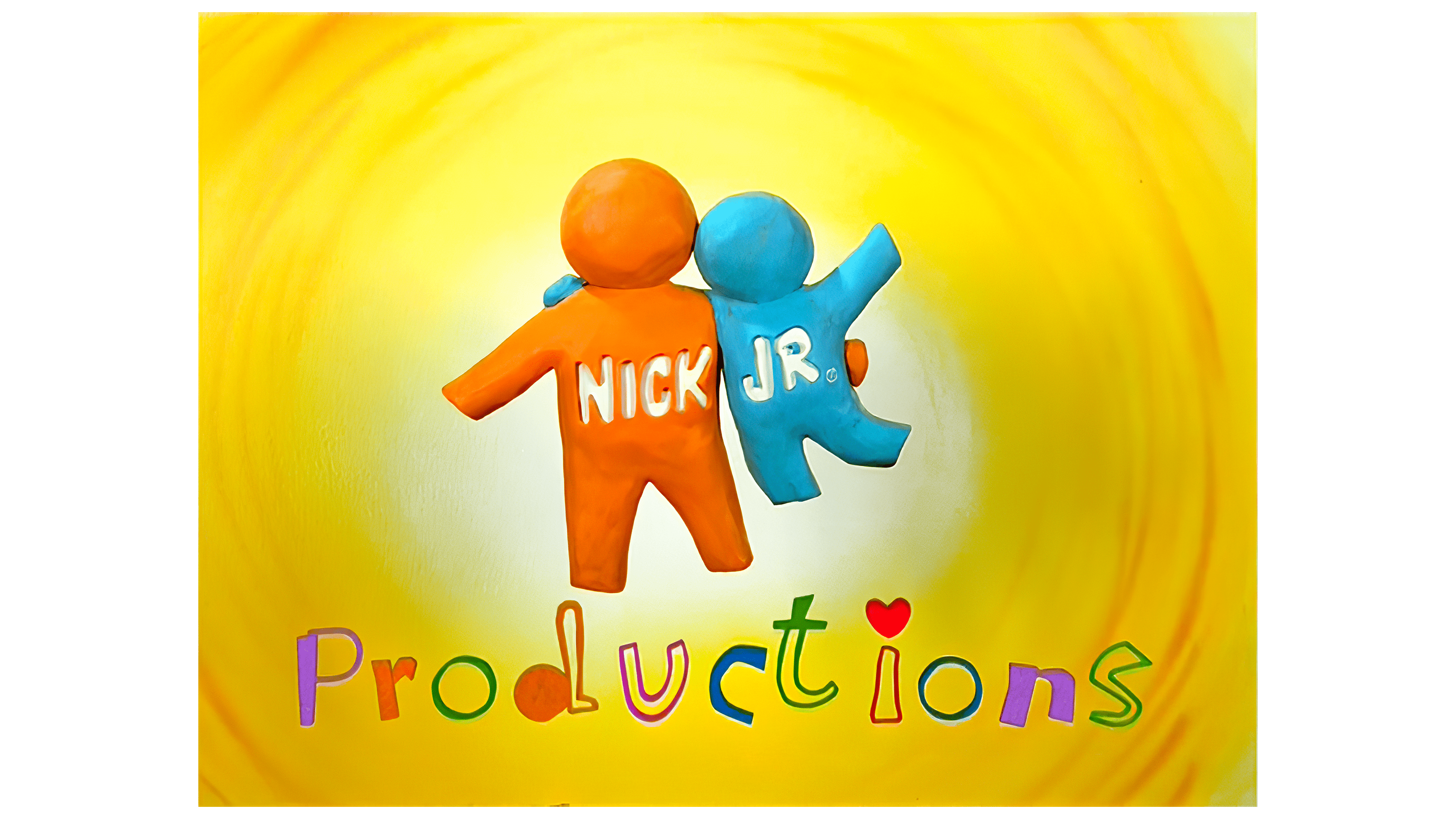
After the redesign, the logo became friendlier, brighter, and more welcoming. It gained color, which made it more attractive to children’s attention. The black background is gone; yellow is used instead, with concentric circles resembling a spiral seen from above. The center is lighter than the edges, indicating a gradient.
In the middle are the figures of an adult and a child, but this time the parent (teacher) does not hold the child’s hand; instead, he seems to be carrying him in his arms. The silhouettes acquired texture and became three-dimensional. Under them appeared the word “Productions,” executed in a playful style with jumping letters, thin contours, and a red heart above “i” instead of the usual dot.
2005 – 2009

Another variant of the Nick Jr. Productions logo is executed in azure color with local admixtures of green. They serve as a background for two silhouettes, a large orange and a small blue. This time, the adult also raises his hand, like a child. Moreover, their hands look almost realistic, with a thumb. The legs look real, too, because the designers made the human figures more believable. The adult and child stand on a pink cloud, with yellow and purple spots reflected in it. Below them is the inscription “Productions,” typed in white lowercase font. All letters are rounded, streamlined, and of the same size.
2010 – today
Font and Colors
One of the latest fonts in the children’s channel’s logo is Oxtail Black with grounded, rounded letters. A typeface reminiscent of Expressway Cd Sb has been chosen for inscriptions on figures. A unique font with bouncing contour glyphs is used in one of the versions.
The emblem palette is characterized by brightness and diversity. Orange and blue are present in all versions. Depending on the period, they are complemented by yellow, azure, green, black, pink, and violet.