


 Oakland Athletics Logo PNG
Although the Oakland Athletics franchise logo resembles a seal, the white elephant that adorned the emblem at its inception is still discernible. Designers retained it in the letter “A” by stretching the right side and curving it into a trunk shape. The double hook shape represents the tusks of the powerful animal.
The Oakland Athletics’ history begins in 1901, when the franchise entered MLB as one of the eight founding teams of the American League as the Philadelphia Athletics. The club remained in Philadelphia until 1954, when it relocated to Kansas City and became the Kansas City Athletics.
In 1967, the American League approved another move, and the team settled in Oakland. Political pressure from Missouri delayed the process, but the franchise remained in California, establishing a long-term base there.
Ownership shifted multiple times. Ben Shibe led the club early, followed by Connie Mack, who managed it for 32 years. Later owners included Arnold Johnson, Charlie Finley, Walter Haas, and, in 2005, a group led by Lewis Wolff, with John J. Fisher as the main stakeholder.
The name “Athletics” remained unchanged through all relocations, with only the city identifier updated. It traces its roots to a 19th-century athletic club and has become one of the brand’s most stable elements.
In 2002, the team recorded 20 consecutive wins, setting an American League record. Across its history, the franchise has won 9 World Series titles and 15 league championships.
Since 1993, the club has used a refined circular logo featuring a central “A,” surrounded by the full team name. The design relies on a balanced layout with gold outlines, maintaining continuity with earlier versions.
Meaning and History
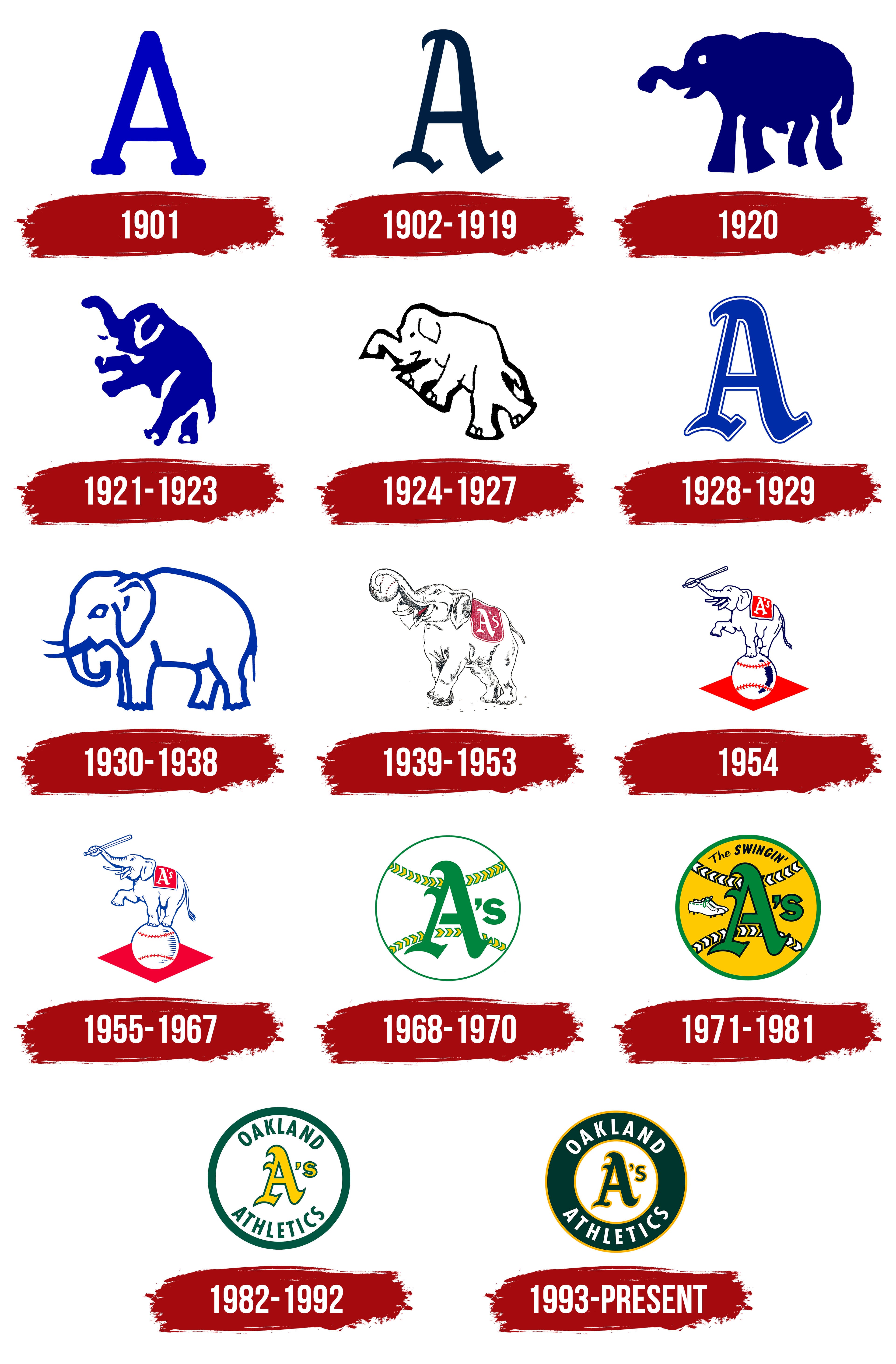
Usually, the letter “A” alternated with an image of a white elephant. The first version of the Oakland Athletics logo is a graphically stylized name. The second version resulted from a disagreement between Connie Mack, owner of the Oakland Athletics, and John McGraw, manager of the New York Giants. In 1902, the latter contemptuously called the team “white elephants,” implying they weren’t playing but were wasting money. Connie Mack accepted the challenge and made the white elephant his club’s emblem.
Fourteen logos, an elephant, and the letter “A” are all part of the Oakland Athletics’ identity. Since 1901, its emblems have changed many times. These changes mostly reflect the franchise’s relocations: it was first based in Philadelphia, then in Kansas City, and finally in Oakland, California. The symbolism is still divided into two major categories: one involving an elephant and one involving a single letter. In the first half of the team’s history, the club added nothing; later, additional elements appeared, more clearly revealing the image.
What is Oakland Athletics?
The Oakland Athletics are a Major League Baseball franchise and a nine-time World Series winner. Previously, it was based in Philadelphia and Kansas City. The team moved to Oakland in 1968 and, a year later, joined the newly formed American League West. Its current home stadium is the RingCentral Coliseum.
1901

The club’s first logo, called “Philadelphia Athletics,” was a classic printed blue letter “A,” meaning “Athletics.”
1902 – 1919

The second club logo lasted for 17 years. It was a dark blue letter “A” printed in an Old English font.
1920

Connie Mack chose a dark blue elephant as the 1920 logo.
1921 – 1923

The new artist who drew the next logo made it more unusual by depicting the animal standing on its hind legs. Additionally, a light blue color replaced the usual one, complemented by white details.
1924 – 1927

During this period, the elephant became more abstract, with a black-and-white theme. The elephant still stood on its hind legs.
1928 – 1929

Athletics again began to use the blue Old English letter “A,” adding a thin white-blue outline.
1930 – 1938

The club’s seventh emblem received a new design: the elephant was depicted as white with a blue outline, shown on all fours.
1939 – 1953

The 1939 logo has a nuanced depiction of a white elephant with a thin black outline. The animal was in motion and held a white baseball in its trunk. Red fabric on its back bore the team’s initials, “A’s.”
1954
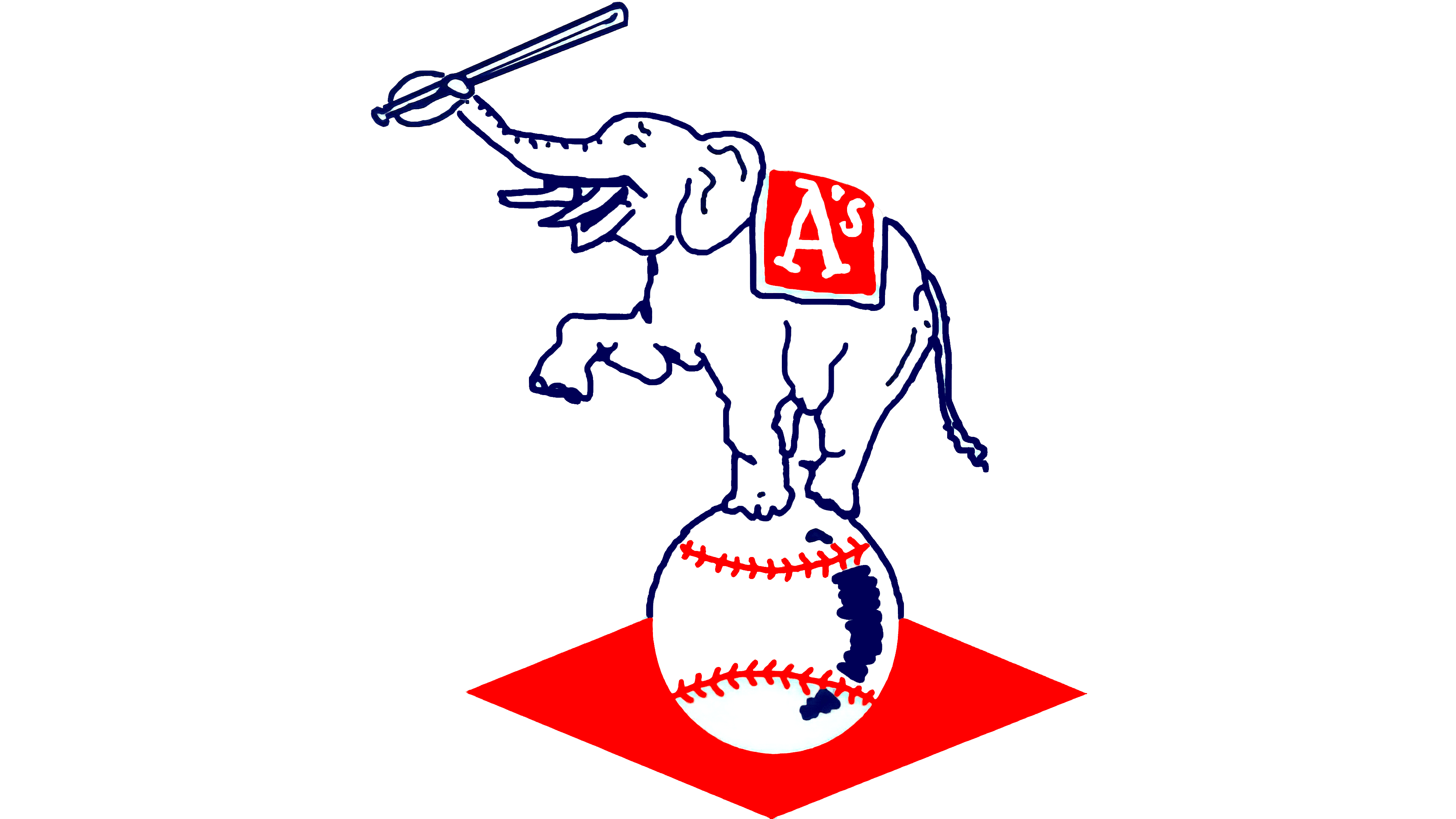
The last Philadelphia Athletics logo featured a white elephant with a blue outline balancing on a red-and-blue baseball. The elephant’s trunk held a bat, and its back bore a piece of red fabric with the letters “A’s,” as before. The baseball featured a black outline of Pennsylvania.
1955 – 1967
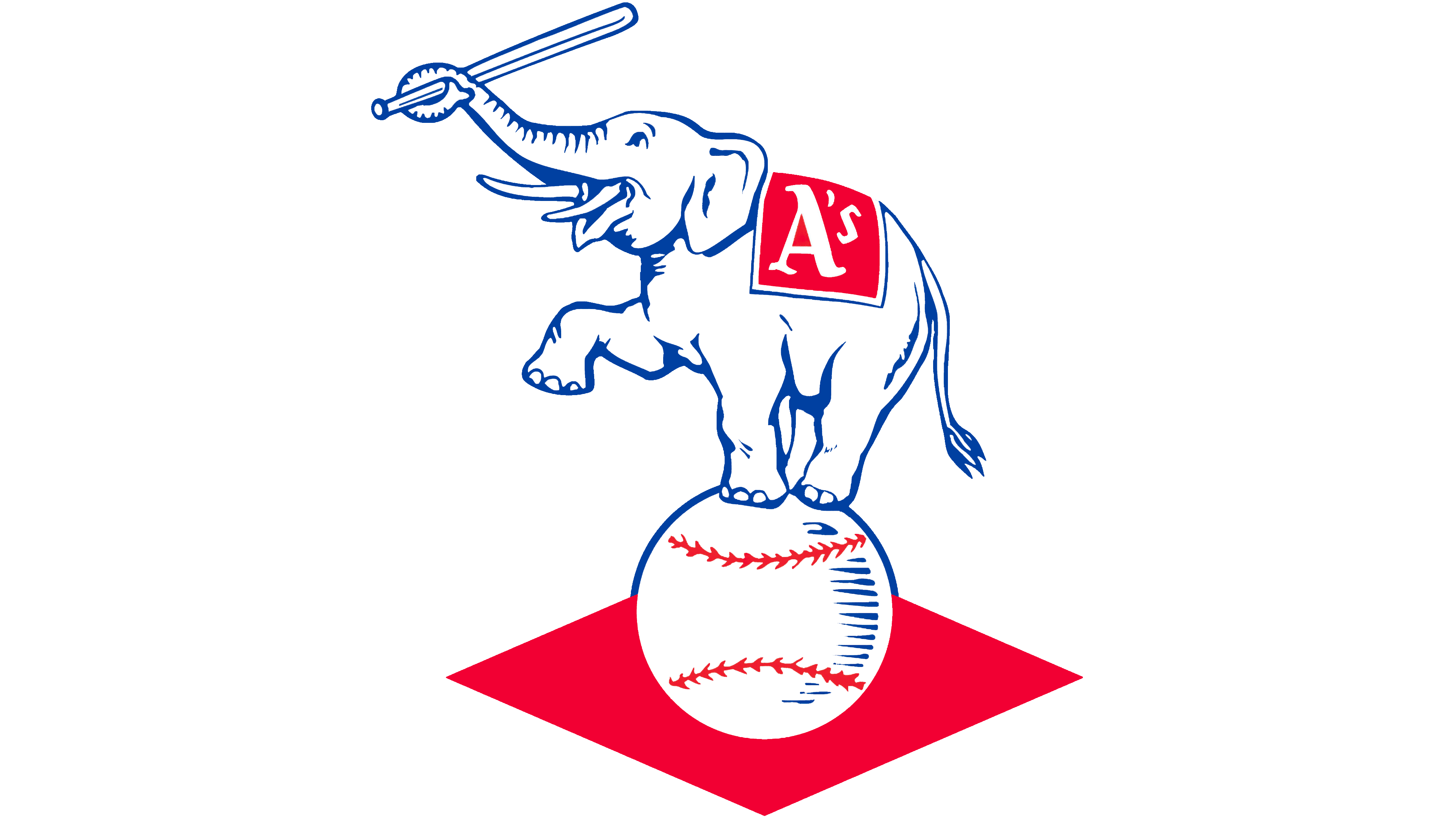
The club moved to Kansas and was renamed the “Kansas City Athletics.” The Kansas City Athletics emblem remained almost the same: an elephant with the letters “A’s” on its back, holding a bat and balancing on a baseball.
1968 – 1970

A large white baseball with two yellow-green seams and a green outline became the logo of the “Oakland Athletics.” It featured green letters “A’s,” meaning “Athletics.”
1971 – 1981
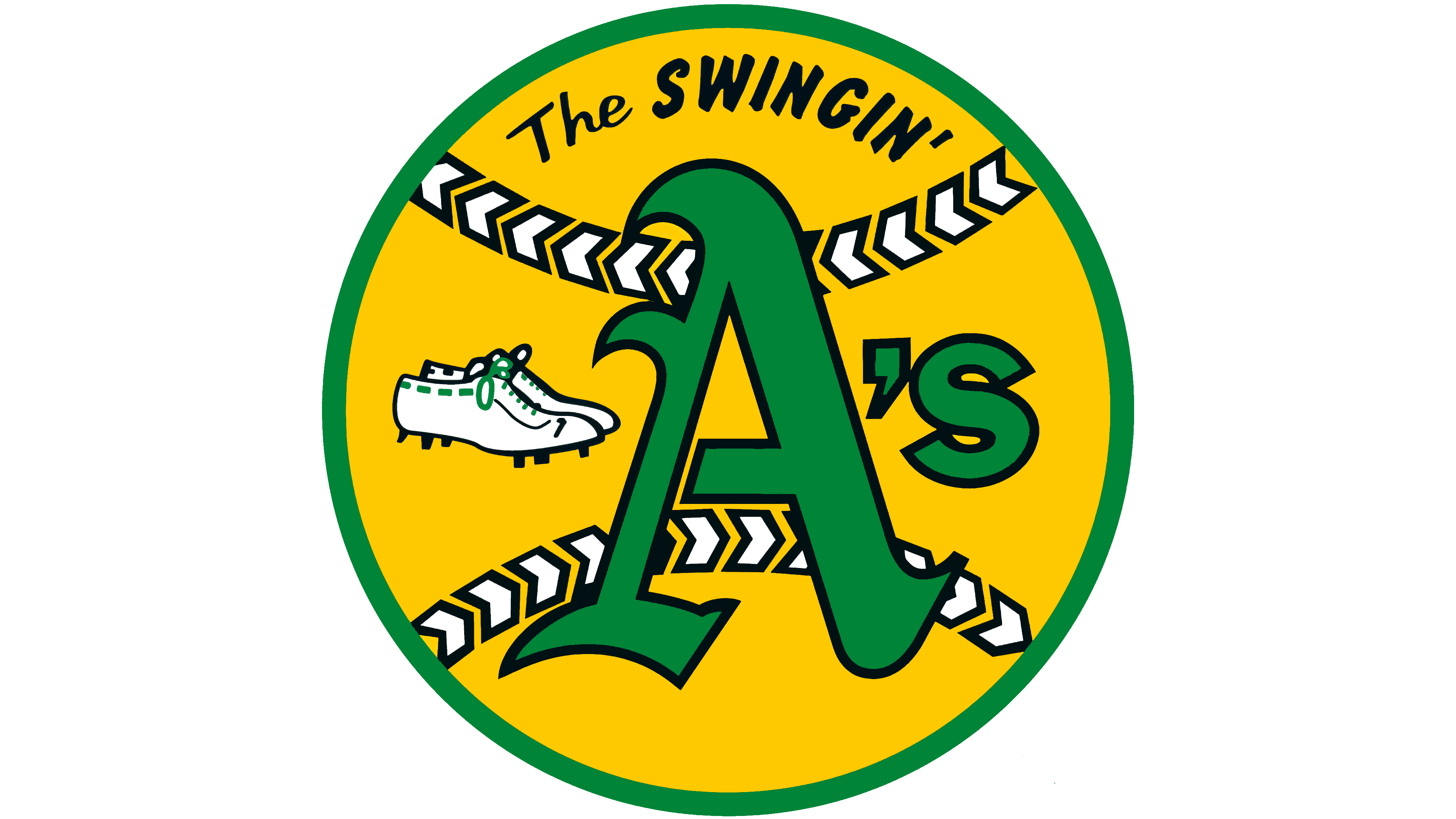
The next “Oakland Athletics” logo was similar to the previous one. It still featured a baseball at the base, but it turned yellow. The letters “A’s” remained in the center, but the logo now featured a pair of white tennis shoes, and “The Swingin'” was printed above the letters.
1982 – 1992

The thirteenth Oakland Athletics logo was a simple white circle with a thick dark green outline. Yellow letters “A’s” were printed in the center, with “Oakland Athletics” in a semicircle above and below.
1993 – 2024

The current version features a large letter in the center of a white circle. In addition to “A,” it also has a miniature s,n with an apostrophe. All central elements are outlined in yellow. Next is a wide dark green stripe with inscriptions. Above is the word “Oakland,” and below is “Athletics.” They are not separated and form an arch. A yellow line also runs along the outer edge.
This version revises the previous one with minor adjustments. The middle has narrowed, while the green field has widened. The outline palette also changed: in the previous version, it was green; in the current one, it is yellow.
Font and Colors

At the beginning of their sports careers, baseball players chose the “A” logo, which, as it does today, conveys part of the name “Athletics.” Then, in 1920, an image of an elephant appeared as a simple outline, as if a child had drawn it. Gradually, its contours changed, improved, and acquired realistic features. Eventually, by 1954, the animal was balancing on the ball and holding a baseball bat in its trunk. This image highlighted the team’s skill level.
The elephant image was used until 1967, when a variation replaced it with the letter “A.” Designers combined it with the ball and added an “s” through an apostrophe. The color and details kept changing until 1993, when the circle became a classic rondel.
The lettering in the Oakland Athletics emblem most closely resembles the condensed Gill Sans Bold font. These are smooth, elongated letters with serifs. The central letter “A” is set in a font developed specifically for the club. It is in an Old English style and has curves.
The emblem features all the corporate colors proposed in 1963 by franchise owner Charlie Finley: white, yellow, and Kelly green.