


 OCBC Bank Logo PNG
The OCBC Bank logo transports clients into the future while honoring the past. It has deep historical roots dating back to the financial institution’s inception. This connection empowers it to strive forward, grow daily, and evolve to meet modern demands. The image in the bank’s emblem is iconic and firmly rooted in its identity.
OCBC Bank traces its roots to Singapore’s early 20th-century Chinese business community. In 1912, Lim Peng Siang and wealthy Hokkien merchants founded the Chinese Commercial Bank, the city’s first Hokkien bank. Ho Hong Bank followed in March 1917, and Oversea-Chinese Bank appeared in 1919. All three served Fujianese diaspora networks built on family and trade ties.
The 1929 financial crisis weakened the three banks and pushed them toward consolidation. On October 31, 1932, they merged into Oversea-Chinese Banking Corporation, with Tan Ean Kiam and Lee Kong Chian playing key roles. Operations began in February 1933, making OCBC one of the largest local banks in the British Straits Settlements. Its predecessor, Oversea-Chinese Bank, had already opened a branch in Xiamen in 1925.
Lee Kong Chian chaired the bank from 1938 to 1964. During the Japanese occupation of Singapore in 1942, local banks briefly suspended operations, and OCBC shifted its head office to Bombay, with Lee Choon Seng serving as acting chairman. After the war, OCBC rebuilt operations, introduced night safe service in 1948, and launched home banking visits in 1958. In 1966, Tan Chin Tuan became chairman.
By 1970, OCBC’s assets had passed one billion Singapore dollars, making it Singapore’s largest financial institution by deposit base. In 1972, it acquired Four Seas Communications Bank, founded in 1906 as Sze Hai Tong Bank. In 1989, the bank adopted the OCBC Bank name and new identity. It acquired Keppel Capital Holdings in 2001 and Wing Hang Bank in 2014 for 6.2 billion Singapore dollars, and later renamed the latter OCBC Wing Hang. Its regional expansion followed a similar path to rivals such as DBS Bank and Maybank.
Meaning and History
The bank’s history is a history of consolidations. It began by combining three structures into one, and it has largely followed this strategy, evolving through mergers. This approach is reflected in the logo: it has often changed, usually coinciding with internal transformations at the financial institution.
What is OCBC Bank?
OCBC Bank is a major financial institution based in Singapore, the second-largest bank in Southeast Asia. Its full name is Oversea-Chinese Banking Corporation. It was formed by merging three banks that emerged in the early 20th century. These are the Oversea-Chinese Bank Limited (1919), Ho Hong Bank Limited (1917), and China Commercial Bank Limited (1912). The new structure was launched in 1932 and was founded by Tan Ean Kiam and Lee Kong Chian.
1932 – late 1960s
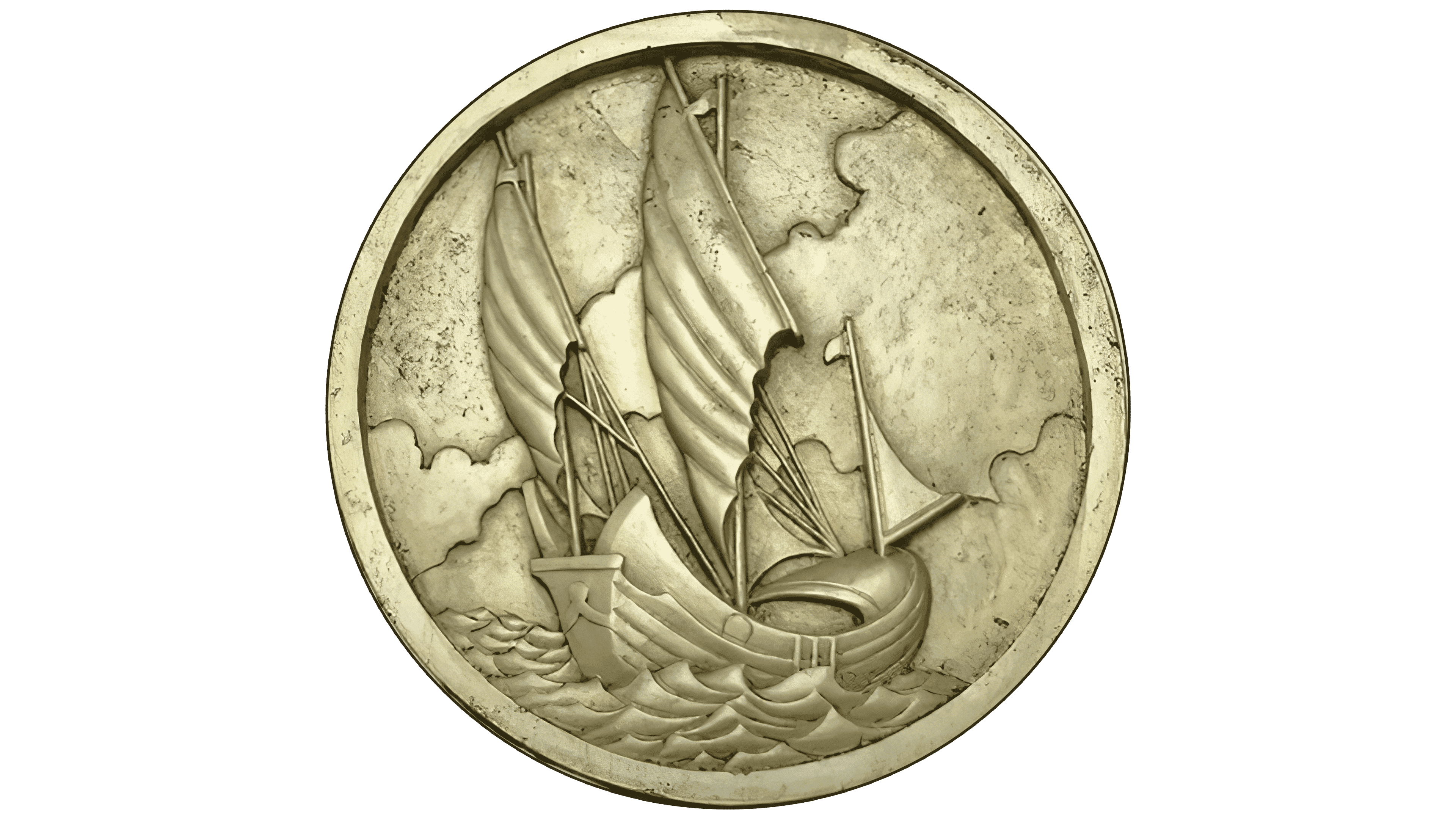
The logo resembles a zinc stamp or an engraving on an iron plate. It is round and depicts a marine landscape, with a large sailing boat rushing forward on the waves against a cloudy sky as the main focus. Each stroke, shadow, and reflection matters because the sign is colorless, and the image emerges from subtle lines.
Late 1960s – 1978
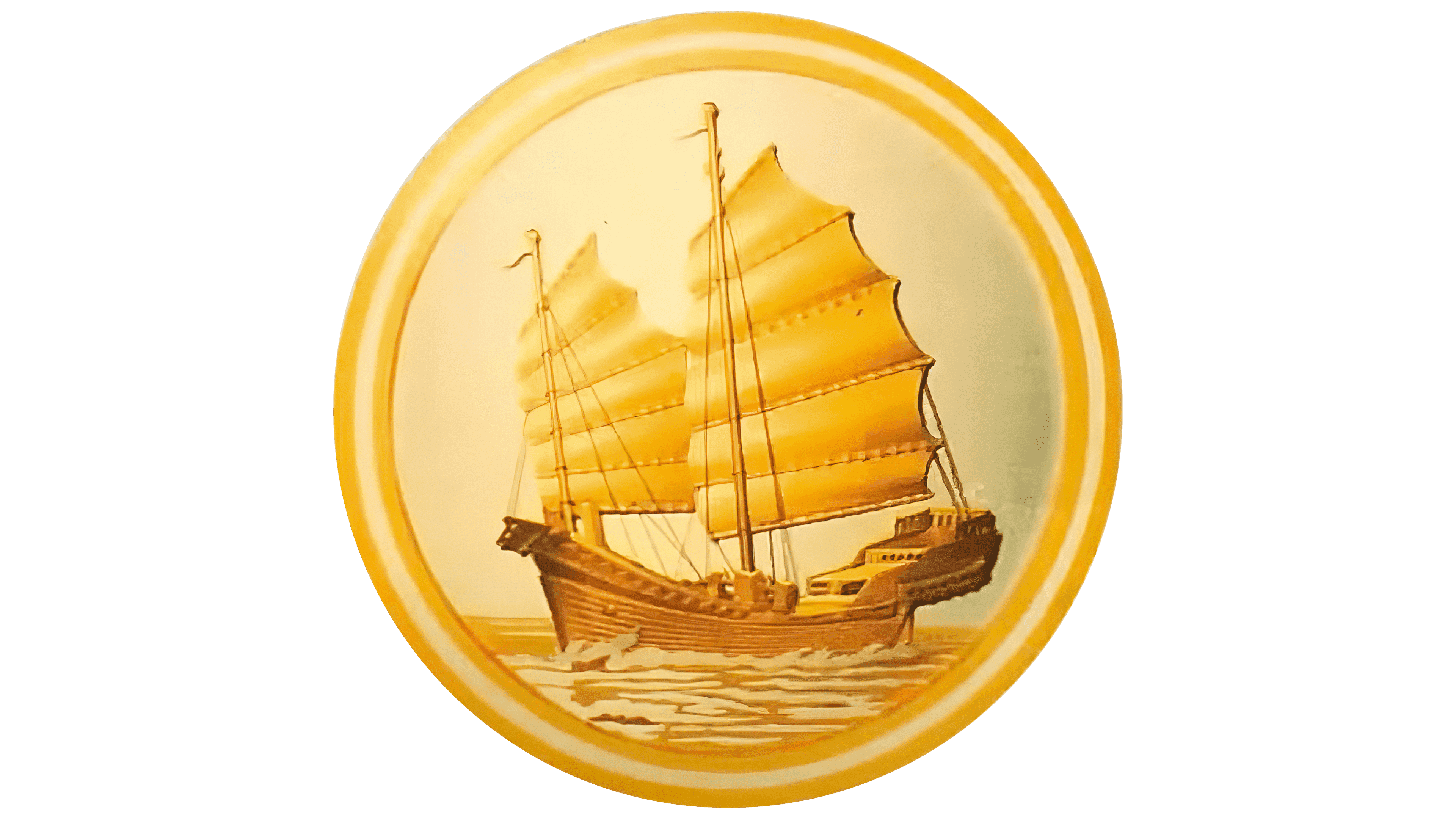
The engraving turned into a work of art. The emblem became juicy, colorful, and convex, and came alive under the artist’s brush. The designer added color, making the image more natural. Now the wooden junk is positioned sideways rather than straight, and placed at the very center of the logo. It has two tall masts with wide sails inflated by the tailwind. The waves are white as if covered with light foam. The surrounding space inspires hope and confidence in a bright future because there is not a single cloud in the sky, only shining sunlight. A light shadow appears only on the right, reminding viewers of the company’s harsh past. All elements are within a circle, captured in a triple-volumetric frame.
1978 – 1989

The OCBC Bank logo became schematic as if it depicted the shadow of a sailing ship. This impression is created by using only two colors, black and beige. The former contains all the emblem’s elements, and the latter serves as its background. As a result, the negative space is used actively. However, the waves are linear rather than volumetric. They form four stripes of different lengths, as the sign has retained its circular shape.
1989 – 1998

The era of the red logo began. It now features two key elements: a unique symbol and an inscription. The circle has a wide ring, harmoniously combined with the image of junk. Like part of the sail, it sits within the frame. Moreover, a piece of the sail sits on a white background at the center of the “O.” On the right is the name, written in one word but separated by color: the abbreviation “OCBC” is painted red, and the word “Bank” is white with a red outline. In the first case, the font is bold and earthy; in the second, it is narrow and high. The only thing that unites them is the absence of serifs.
1998 – 2023

The inscription uses the same font throughout. Although the first part is slightly bolder than the second, they share the same typeface. The letters are smooth, straight, chiseled, and high. This option looks modern and elegant.
2023 – today

In light of the bank’s rapid expansion through branch mergers, the bank adopted a new logo and slogan as part of the rebranding. In line with the motto “For now, and beyond,” the developers cautiously updated the design, leaving the main elements untouched while adding some novelties.
The logo’s central link remains the classic Chinese sailing boat, the bank’s heraldic sign, and its long-term ambitions. This symbol, integral to the bank’s DNA, testifies to its aspiration to pursue prospective deals and investments, paving the way for the future.
The OCBC emblem reflects the founders’ entrepreneurial spirit as they ventured into ASEAN to build businesses and homes that would benefit future generations. In this context, the iconic sailing ship has remained a faithful element of every version of the logo since its creation in 1932.
The current version represents an enlarged image of the stylized ship, topped with a new visual language. A significant change was removing the word “Bank” from the text, which emphasizes the sailing ship and reflects the bank’s resilience and innovation.
Font and Colors
As the OCBC Bank emblem evolved, it shifted from an engraving style to a flat one, which influenced the look of the text outside the logo in its early versions. Designers used several typefaces, similar to Foundation Sans Black Extended and Asimov WidOu. But Geomanist is used most often: a clear, modern font with varying degrees of boldness.
Different shades of red have almost always distinguished the corporate palette. It started as cadmium (code #e11a27), then became a little brighter and lighter, closer to Pantone 485C. Passionate, energetic, and strong, these are the main qualities for which it was chosen, as they are inherent in resourceful, goal-oriented, and enterprising people, such as the employees of this bank.