 Office Depot Logo PNG
The Office Depot logo conveys the company’s professional nature. Although it takes on a familiar shape common to many emblems of similar brands, it has a unique feature that sets it apart from competitors. This is its visual simplicity. It ensures the symbol’s comfortable readability on any display and conveys that its owner is a strict, practical, and reliable business partner.
Office Depot began from the retail experience of F. Patrick Sher, Stephen Dougherty, and Jack Kopkin, who had worked together at Mr. HOW Warehouse. After Sher sold that chain to Service Merchandise in 1983, he applied the warehouse discount model to office supplies. The first Office Depot opened in October 1986 at Lakes Mall in Lauderdale Lakes, Florida, offering direct-from-manufacturer goods at 20 to 75 percent below standard retail prices.
The first store worked, and two more Florida locations opened before the end of 1986. In 1987, seven more stores appeared in Florida and Georgia, while sales passed $33 million. Sher died of leukemia that same year, less than a year after launch. David Fuente, recruited from Sherwin-Williams, became the new leader and took Office Depot public in December 1988.
Expansion accelerated through deals. In April 1991, Office Depot merged with California-based Office Club for $137 million, becoming the largest office-products retailer in North America. In 1992, it bought Canada’s H.Q. Office International. In 1993, it entered the corporate supply market through Wilson Stationery & Printing and Eastman Office Products. By the mid-1990s, it competed with Staples and OfficeMax.
A planned $4 billion merger with Staples was blocked by the FTC in 1997. Office Depot then bought Viking Office Products in 1998. In 2013, it merged with OfficeMax as Amazon reshaped the market, but a second Staples deal was blocked in 2016. The company bought CompuCom Systems in 2017, became The ODP Corporation in 2020, and in September 2025 agreed to an $842.2 million buyout by Atlas Holdings.
Meaning and History
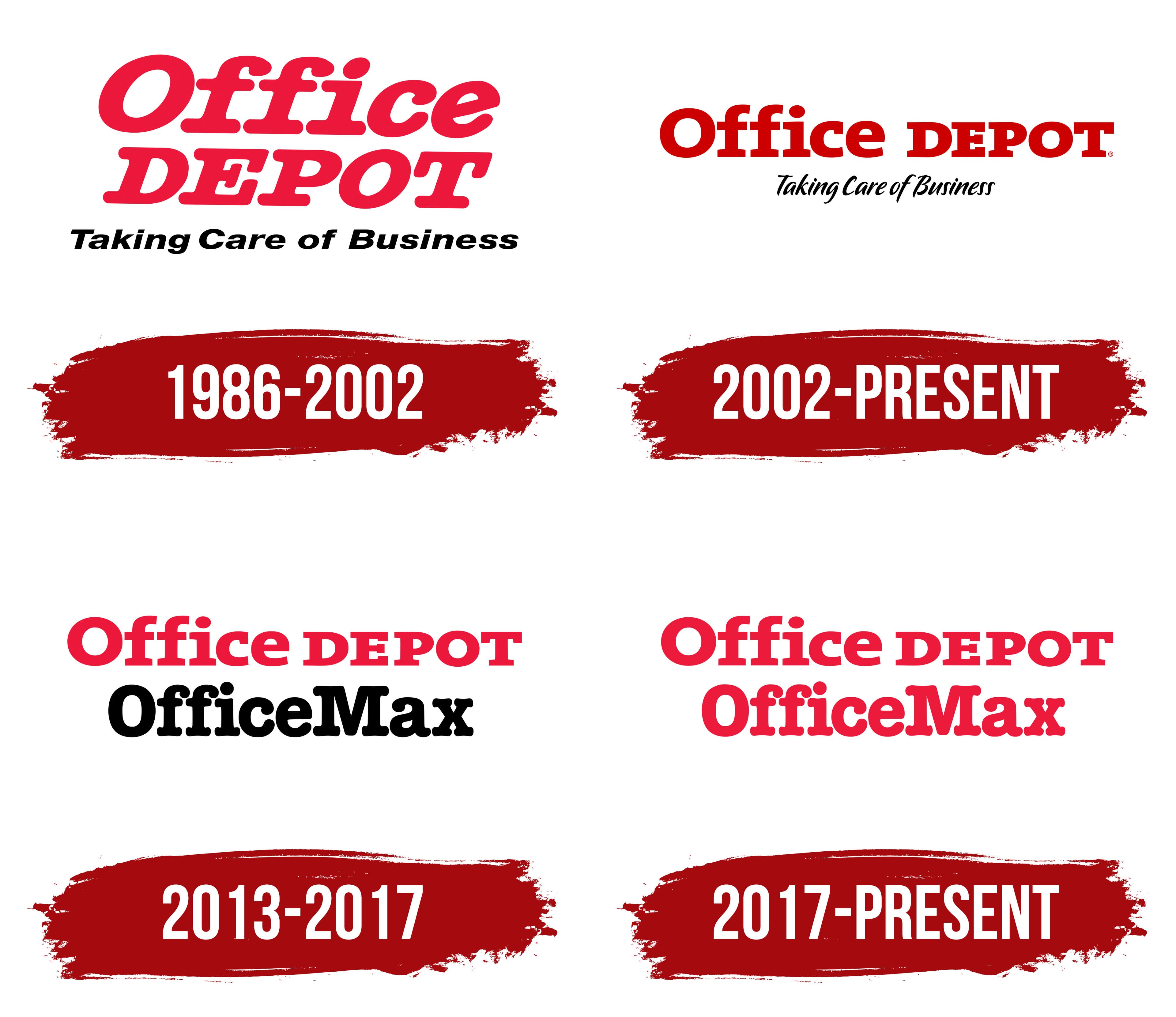
The story of Office Depot began on the sunny coasts of Florida in the resort town of Fort Lauderdale. It was there that the company opened its first store. Gradually, the firm expanded its number of outlets and added various services, leading to the merger of the brands into a holding company managed from the main office in Boca Raton. Its founders immediately assumed key positions and paid close attention to visual identity. Given that it was a store, having a noticeable sign at its entrance became a priority. The emblem is text-based rather than graphic, emphasizing the name.
What is Office Depot?
Office Depot is an American multinational corporation with business centers and retail stores in many countries worldwide. It specializes in office supplies and technical products, leveraging its brands DiVOGA, Realspace, Foray, TUL, Ativa, ODP Business Solutions, Grand & Toy, and OfficeMax. The company also operates e-commerce websites and business support centers. Founded in 1986, Office Depot has become a top industry leader, boasting a network of around 1,400 retail locations managed from its headquarters in Boca Raton, Florida. The company’s founders are Jack Kopkin, Stephen Doughtery, and F. Patrick Sher.
1986 – 2002

The logo features the corporation’s name. It’s set in a rounded font with no sharp angles: both outer and inner edges are smooth and rounded. Such a design leaves a positive impression on customers, as its softness promotes a friendly mood and generates goodwill. The text occupies three lines. The first line is bold and primarily lowercase, while the second is uppercase. Both words are slanted to the right and colored in red. The only difference between them lies in the serifs: “Depot” has them, but “Office” does not. The third line says “Taking Care of Business,” set in black, blocky characters.
2002 – today

The corporation transitioned from a rounded font to a straight and geometric one. This font features even angles, smoothness, and boldness. The top line combines both parts of the name instead of splitting them. The letters are colored a deep red, reminiscent of wine. The italicized style in the first line has disappeared, leaving only the second line italicized. The bottom line has significantly changed: the inscription is now in a proprietary font specifically designed for this project. All glyphs are black, linear, sans-serif, rounded, and slanted, simulating a casual handwriting style.
2013 – 2017

When Office Depot merged with OfficeMax, it adopted a new logo. This two-tiered emblem showcases various font styles: the top glyphs are geometric, angular, flat, and red, while the bottom ones are soft, rounded, tall, and black. What makes them similar is the width of the lines forming the letters; they are all bold. This design exhibits the unique characteristics of both companies, highlighting their individuality.
2017 – today
The designers have unified the inscriptions by color; now, both are light red. At the top is the name “Office Depot,” and at the bottom is “OfficeMax.” The lines are centered. Despite the shared color palette, the first phrase is set in short, somewhat flattened glyphs, with many angles and straight lines. The second line consists of letters with rounded endings, resulting in very smooth strokes. Moreover, the dual-brand name is written as one word.
Font and Colors
Throughout the years, various typefaces, entirely distinct from one another, have been used in Office Depot’s logos. Specifically, among them are unique fonts resembling ITC American Typewriter Bold, TheSerif Black (or possibly Extra Bold), and P22 Pooper Black Regular for the bottom line. On the contrary, the company’s color palette has always been rather limited, consistently featuring shades of black and red, ranging from muted red to wine.