


 Portal Logo PNG
The Portal logo invites the viewer to go through the portal and enter the game. The emblem hints at adventures. It sparks curiosity and a desire to peek into the opened wormhole to explore the unusual phenomena of the future.
Portal began in 2005 at the DigiPen Institute of Technology, where students created Narbacular Drop, a free puzzle platformer about a princess escaping a dungeon through portals. After seeing the project at DigiPen’s career fair, Robin Walker brought it to Gabe Newell’s attention, and Valve Corporation hired the entire student team to turn the idea into a commercial game.
Development lasted about two years and four months, with fewer than ten people working on the project. The fantasy setting was replaced by Aperture Science, a sterile laboratory created by writer Erik Wolpaw and connected to the Half-Life universe. To save resources, the team reused Half-Life 2 assets. GLaDOS, voiced by Ellen McLain, became the facility’s voice, while Jonathan Coulton wrote the ending song “Still Alive.”
Portal was released on October 9, 2007, as part of The Orange Box for Windows and Xbox 360, alongside Half-Life 2: Episode Two and Team Fortress 2. The PlayStation 3 version followed on December 11. The game had been planned as a short experiment inside the bundle. Still, critics treated it as one of 2007’s most original releases, with Metacritic scores around 90 out of 100.
In April 2008, Portal was issued as a standalone retail game. In May 2010, it was given away for two weeks during the launch of Mac OS X support on Steam. In 2011, Learn with Portals used the game as an educational tool. Portal 2 later drew on another DigiPen project, Tag: The Power of Paint, and both games reached Nintendo Switch in June 2022 through Portal: Companion Collection.
Meaning and History
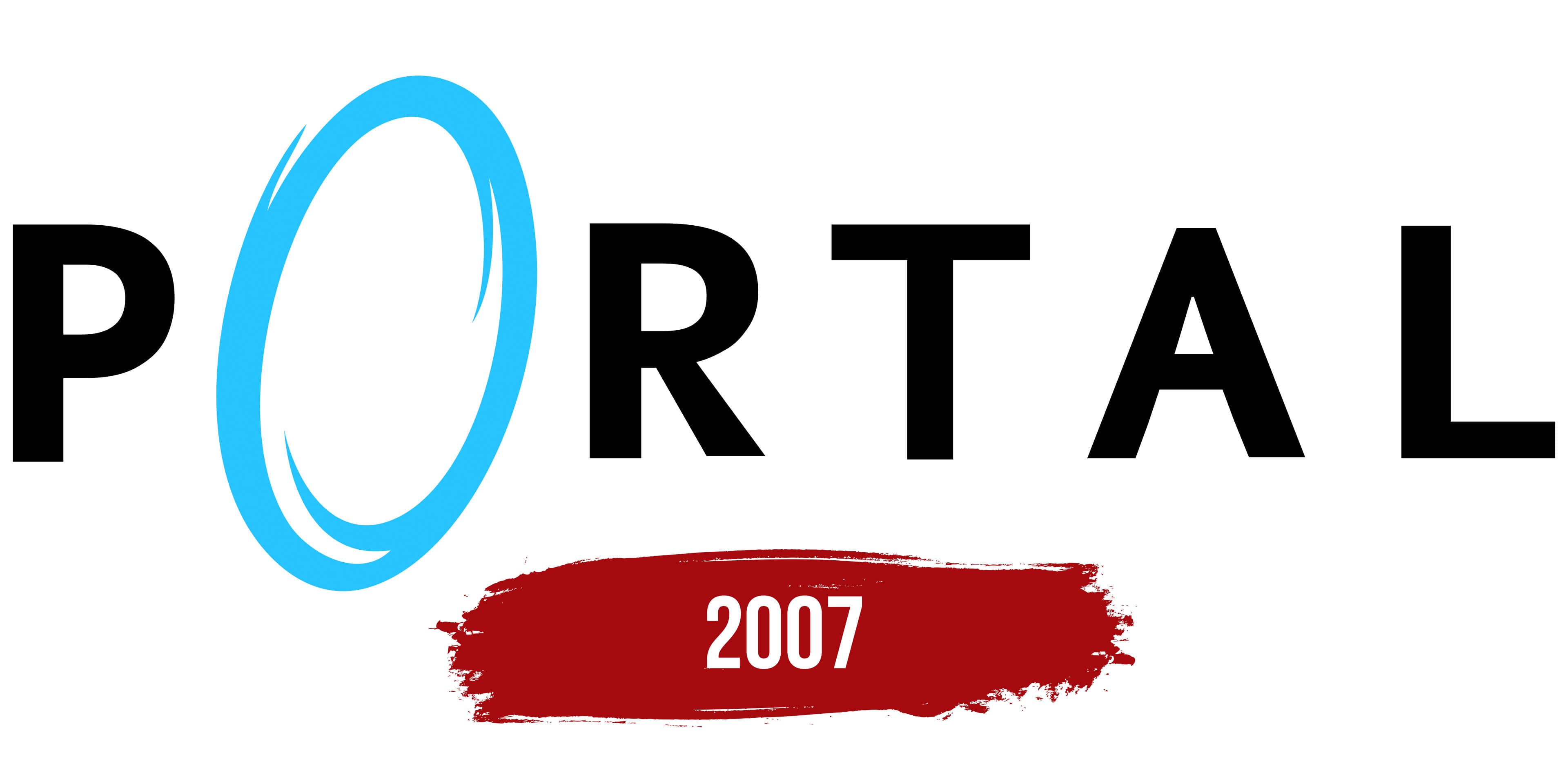
The emblem instantly transports the user into the game’s atmosphere and points to the main object, which plays a central role in the puzzles. The emblem shows futuristic technology. The simplicity and succinctness convey the half-empty rooms of the testing chambers, making the emblem ultra-modern. Each symbol hints at geometric shapes used in the game. The emblem’s minimalism is likely linked to the fact that the game was initially planned not as a standalone project but as part of The Orange Box collection.
What is Portal?
In the role of the main heroine, Chell, the player goes through test chambers at the Aperture Science station, solving various puzzles and completing tasks using a device to open portals connecting rooms. In the end, the heroine learns that the lab was taken over by an operating system responsible for the scientists’ deaths. The struggle against it unfolds in the second part of the game.
2007

The game’s logo is simple and very clear. It’s the title with the letter “O” transformed into a portal. The blue or orange color of the symbol indicates the two types of portals that can be opened with the device. The trim embodies the glowing rim that surrounds the wormhole in the chambers. The open portal seems ready to engulf the other letters and transport them into the laboratory.
The name ‘Portal’ comes from the game’s main element. The participant receives a special device that opens wormholes and connects chambers on any flat surface. Interestingly, the portal concept was taken from a student project: the game Narbacular Drop.
Font and Colors
Blue and black are the game’s main colors. Blue signifies teleportation. All test chambers are designed in a gray-blue color scheme. The color is used for markers in the game: arrows, human figures, and inscriptions. The shade is considered technical. It embodies scientific knowledge, mechanisms, and electronics. The cool tone suggests seriousness and focus. The emphasis on the technical side stems from the fact that the process is managed by the special operating system GLaDOS rather than a human. The light blue shade hints at lightness, the process of teleportation.
If blue conveys the theme of movement, then black embodies the stability and immobility of the main structures. It describes the laboratory’s system of rooms and corridors.
The font of the inscription is unique because of the unusual letter O. The symbol is slightly tilted sideways, as if it’s against an invisible wall. A vortex can be seen inside the portal, capturing and moving bodies and objects. The other letters are wide and sturdy, like the test chambers. Each symbol embodies a separate puzzle. Their font resembles Mahsuri Sans Pro Bold.