 PUBG Logo (PUBG Studios Logo) PNG
The PUBG logo is businesslike and practical, which is unusual for an online computer game. Its identity is based on block letters, an abbreviation of the phrase “PlayerUnknown’s BattleGrounds.” Monolithic design and massive glyphs convey power, confidence, and strength.
PUBG’s origins trace back to Brendan Greene, an Irish photographer, designer, and web developer who became interested in game mods. Inspired by the 2000 Japanese film Battle Royale, he created DayZ: Battle Royale for Arma 2 in the early 2010s. The mod led Sony Online Entertainment to hire him as a consultant on H1Z1.
After Sony split H1Z1 into two games in 2016, Greene left the title. That year, South Korean studio Bluehole, founded in 2007 by Chang Byung-gyu, invited him to become the creative director of a full-fledged battle royale game. PlayerUnknown’s Battlegrounds launched in Steam Early Access on March 23, 2017. In six months, it sold more than 10 million copies.
The format was simple: 100 players dropped onto an island, searched for weapons and gear, and fought as the safe zone kept shrinking. The final survivor saw “Winner Winner Chicken Dinner,” a phrase that became part of gaming culture. The full PC release arrived on December 20, 2017, alongside the Xbox Game Preview for Xbox One. In January 2018, PUBG reached 3.24 million concurrent players on Steam.
PUBG won Best Multiplayer Game at The Game Awards 2017, while Epic Games‘ Fortnite became its main rival after Epic launched Battle Royale in July 2017. PUBG Mobile followed in March 2018 with Tencent Games, and PlayStation 4 in September. Bluehole became Krafton Game Union in 2018. India banned PUBG Mobile in 2020, and Krafton relaunched it as Battlegrounds Mobile India in July 2021. Krafton held its Seoul IPO in 2021; PUBG became PUBG: Battlegrounds; Greene left; and the game went free-to-play on January 12, 2022.
Meaning and History
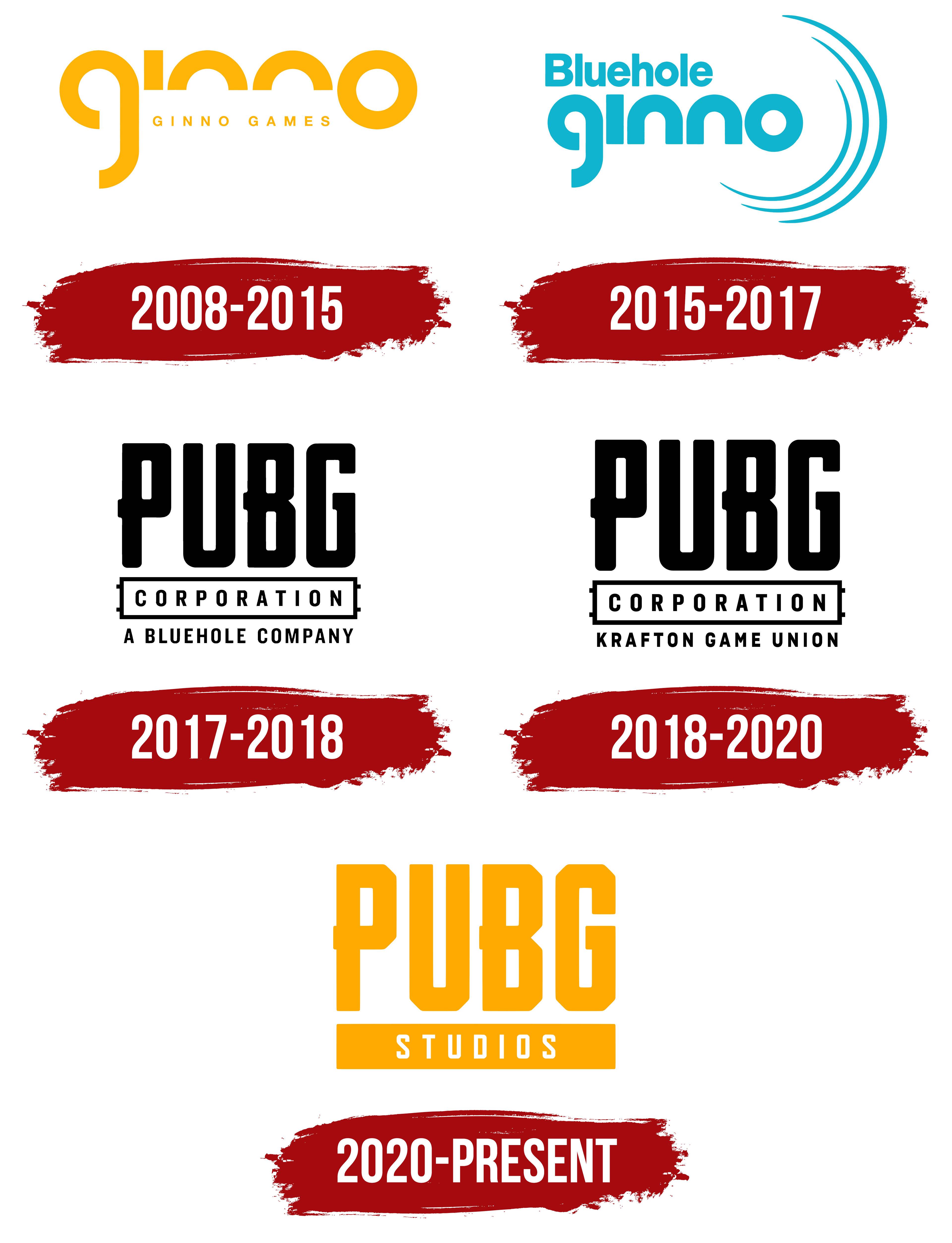
The South Korean company’s visual identity is consistent. Her emblem still consists of three lines. Even the rebranding, which completely replaced the bottom row, did not affect the PUBG icon. After all, despite the update, the phrase retains the same design style, typeface, and look as before. In PUBG Corporation’s history, two main emblems have become symbols of the online game.
What is PUBG?
PUBG is a South Korean company that develops multiplayer games of the same name. It has existed since 2008, when Chang Byung-gyu founded it. Today, the studio is part of Bluehole Corporation.
2008 – 2015
Before the PUBG name emerged, the developer began as Ginno Games. Its early logo consisted of yellow-orange Ginno lettering. Thick vertical strokes, circles, and semicircles formed the lowercase letters.
The long descender of the “g” extended below the baseline, while the final “o” formed a closed ring. A horizontal white band crossed the middle of the wordmark, carrying small GINNO GAMES lettering. The widely spaced uppercase letters repeated the studio’s name within the larger design.
The PUBG name later grew out of Brendan Greene’s online alias. The Irish developer described replacing the default PLAYER 1 name in Arma 2 with PLAYERUNKNOWN. The username then became his creator credit in PlayerUnknown’s Battlegrounds. PUBG’s support team compared the naming convention to Sid Meier’s Civilization and Tom Clancy’s The Division. Over time, PUBG became the name of the franchise and part of the studio’s name.
2015 – 2017
After Bluehole acquired the studio in 2015, it was renamed Bluehole Ginno Games. Bluehole lettering above the beginning of the large ginno wordmark identified the parent group. The upper line used a tightly spaced sans-serif typeface.
The rounded ginno lettering remained, but turquoise replaced yellow-orange. The horizontal white band and its small lettering were removed, leaving solid letterforms. Three thin arcs with pointed ends appeared on the right. They curved around the name to form an open circle.
2017 – 2018

The success of PlayerUnknown’s Battlegrounds led to Ginno being renamed PUBG Corporation. On September 29, 2017, Bluehole announced the formation of a division dedicated to developing the game and expanding the franchise. The rounded turquoise lettering and arcs were removed. The studio’s first official logo under its new name consisted of black-and-white text.
Three tiers of lettering identified the game brand, the corporation, and the parent group. Large PUBG lettering occupied the top. The tall, narrow sans-serif letters had heavy vertical strokes, small interior openings, and rounded corners. Short projections on the “P” and “B” extended left from their vertical stems, interrupting the otherwise straight edges.
The second line placed CORPORATION in bold sans-serif lettering inside a horizontal rectangular frame. Two small solid black squares flanked the frame. A BLUEHOLE COMPANY appeared below, outside the frame, in the same typeface. The large abbreviation established the logo’s scale, while the two lower lines identified its corporate affiliations.
The corporate emblem represented the developer, while the full PLAYERUNKNOWN’S BATTLEGROUNDS title identified the game. In the game logo, the creator’s alias appeared in a small upper line above large BATTLEGROUNDS lettering. A rough texture resembling a worn surface covered the narrow, heavy letters. Yellow-orange versions appeared alongside black-and-white versions. Later designs maintained the connection between the game and corporate logos through the PUBG letterforms and rectangular frames.
2018 – 2020
The introduction of KRAFTON changed the affiliation line in the PUBG Corporation logo while preserving its overall arrangement. On November 5, 2018, Bluehole established Krafton Game Union to bring the group’s brands together. KRAFTON GAME UNION replaced A BLUEHOLE COMPANY on the bottom line. The large PUBG abbreviation and the frame around CORPORATION remained unchanged.
The KRAFTON name drew on the craft guilds of medieval Europe and the skill of their members. The naming process took five months. Employees and outside specialists considered about 900 options before approving the name for the shared brand.
The update affected the affiliated studios’ logos, although PUBG retained its existing design. The new bottom line used the same typeface and alignment at the left and right edges. The monochrome logo preserved its text arrangement, with the revised line identifying its affiliation with Krafton Game Union.
PUBG’s September 2019 brand guide specified PUBG Orange, black, and white. The orange was defined as Pantone 130 C, with the hex code #F2A900. Brand wordmarks were reproduced from their respective approved artwork.
2020 – today
The success of PlayerUnknown’s Battlegrounds led to Ginno being renamed PUBG Corporation. On September 29, 2017, Bluehole announced the formation of a division dedicated to developing the game and expanding the franchise. The rounded turquoise lettering and arcs were removed. The studio’s first official logo under its new name consisted of black-and-white text.
Three tiers of lettering identified the game brand, the corporation, and the parent group. Large PUBG lettering occupied the top. The tall, narrow sans-serif letters had heavy vertical strokes, small interior openings, and rounded corners. Short projections on the “P” and “B” extended left from their vertical stems, interrupting the otherwise straight edges.
The second line placed CORPORATION in bold sans-serif lettering inside a horizontal rectangular frame. Two small solid black squares flanked the frame. A BLUEHOLE COMPANY appeared below, outside the frame, in the same typeface. The large abbreviation established the logo’s scale, while the two lower lines identified its corporate affiliations.
The corporate emblem represented the developer, while the full PLAYERUNKNOWN’S BATTLEGROUNDS title identified the game. In the game logo, the creator’s alias appeared in a small upper line above large BATTLEGROUNDS lettering. A rough texture resembling a worn surface covered the narrow, heavy letters. Yellow-orange versions appeared alongside black-and-white versions. Later designs maintained the connection between the game and corporate logos through the PUBG letterforms and rectangular frames.
Font and Colors
The developers chose typefaces for the game creator’s visual identity that, with slight changes, resemble Flywheel Condensed Fat, Vintage Fonts Collection VFC Fantomen, and Bricked Bold. Despite the gaming theme, PUBG’s corporate palette uses a classic combination of black (inscriptions, frame) and white (background).