


 Regular Show Logo PNG
The simple, unpretentious Regular Show logo reflects the characters’ simplicity and lack of pretension, from their character designs and drawing style to their attitude, lifestyle, and other nuances. At the same time, it hints at the show’s humor and the unseriousness of what’s happening. The sign suggests people appreciate humor in all its forms!
Regular Show began at California Institute of the Arts in Santa Clarita, where J. G. Quintel studied character animation from about 2002. The school also shaped Pendleton Ward, later creator of Adventure Time, and Thurop Van Orman, creator of The Marvelous Misadventures of Flapjack. Quintel’s student “48-hour films” turned random words into finished shorts over one weekend.
In spring 2005, one exercise led to The Naive Man from Lolliland, where a lollipop-headed diplomat became the early form of Pops. The film won the Producers’ Choice Award and the Student Animator Award at the Nextoons Nicktoons Film Festival. Quintel’s next short, 2 in the AM PM, introduced early versions of Benson and Mordecai and was selected for Spike and Mike’s Sick and Twisted Animation Festival in 2007.
After CalArts, Quintel worked at Cartoon Network on Star Wars: Clone Wars, Camp Lazlo, and Flapjack. In 2008, Cartoon Network launched Cartoonstitute, a pilot program for independent animators. Quintel pitched Regular Show with a finished storyboard rather than a verbal outline. In 2009, the network approved it as a full series.
Regular Show premiered on Cartoon Network on September 6, 2010. The series followed Mordecai and Rigby, two 23-year-old park workers whose attempts to avoid work led to surreal disasters. Quintel voiced Mordecai and Hi-Five Ghost, Sam Marin voiced Benson, Pops, and Muscle Man, and Mark Hamill voiced Skips. The show won an Emmy in 2012 for “Eggscelent,” received six Emmy nominations, released Regular Show: The Movie in 2015, and ended on January 16, 2017, after 244 episodes.
Meaning and History
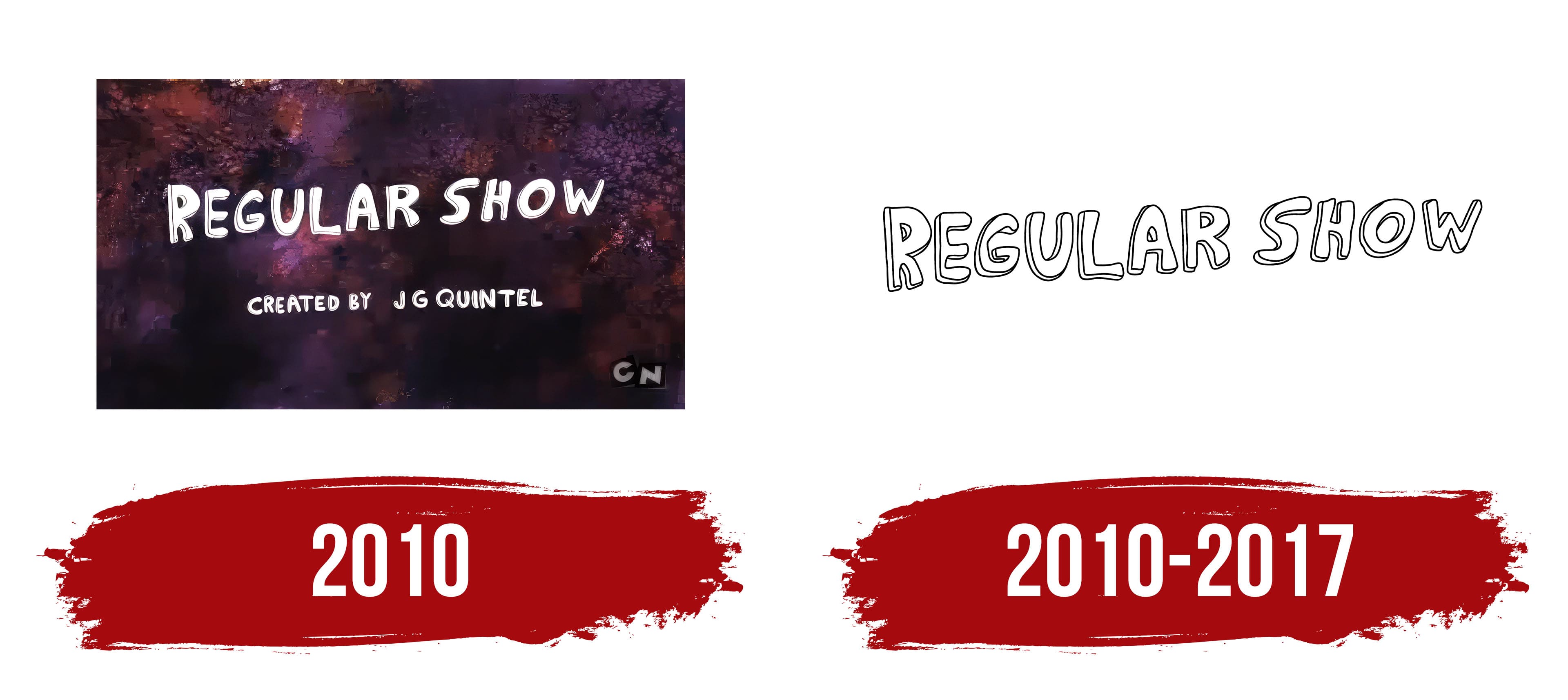
Critics have called this show crazy but fun. It’s quirky, absurd, vivacious, fresh, and full of unusual humor, cheekiness, and even stupidity. The animated comedy’s logo captures all of this at once. Like the sitcom, it shows that even a small incident can spark a great adventure and immense joy. The emblem’s style is shocking yet cute, with a personal note of humor. Even though time has passed (the series ended in 2017), it still looks interesting and relevant, just like the cartoon itself.
What is a Regular Show?
This creative franchise is based on an American sitcom that ran for 8 seasons and 261 episodes. The animated comedy inspired video games, a movie, a card game, comics, and two types of children’s toys (plush and set). J. G. Quintel produced the cartoon, which aired on Cartoon Network from 2010 to 2017.
2010
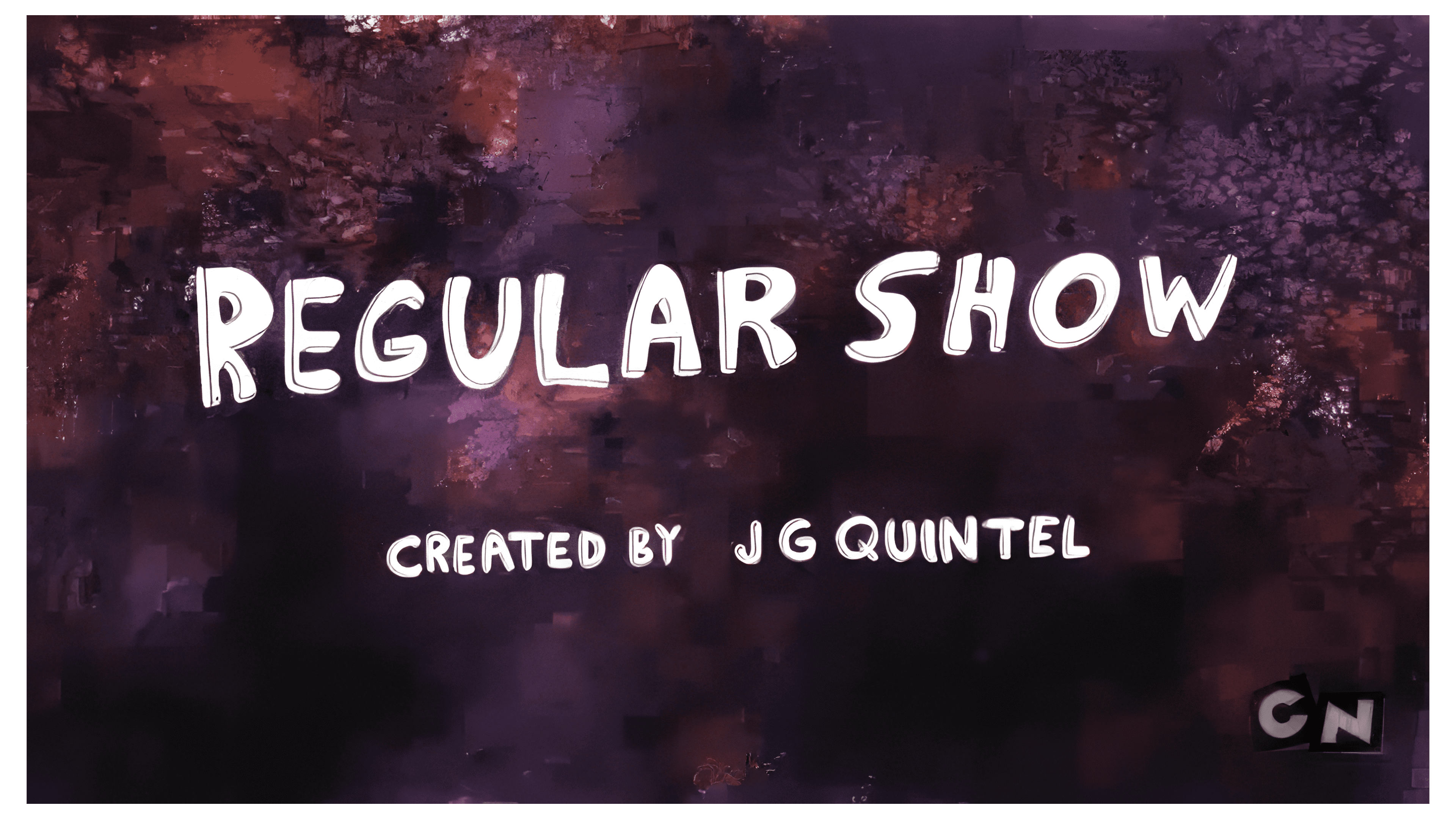
The “Regular Show” logo perfectly captures the series’ essence. It’s a bit weird and simple, yet undeniably captivating.
The text is rendered in a deliberately rough, hand-drawn font, making it feel like we’re entering a world where anything is possible, and normality has no place. Each letter appears slightly tilted or warped, emphasizing the show’s chaotic, absurd nature.
The background’s color palette is dark, with shades of purple and maroon, reminiscent of a twilight sky or a mysterious space where something unexpected is always around the corner. This aligns with the series itself; you never know where the characters will end up in the next episode.
The emblem’s lack of bright, cheerful colors underscores that, despite its comedic tone, the show often explores absurdity and surrealism. It’s a cartoon for entertainment, but there’s depth and even a hint of darkness lurking behind the seemingly simple imagery.
The series title is set in large letters, and that choice is intentional. The word “Regular” suggests something ordinary, though the show is anything but. This play on expectations is one of the show’s trademarks, and the logo underscores this beautifully.
The lower part of the emblem, where the creator’s name, JG Quintel, appears, uses the same style as the main title but in a slightly smaller size. This adds to the logo’s uniqueness, making it recognizable and personal, as if we were watching something truly auteur rather than mass-produced.
2010 – 2017

J. G. Quintel chose an unconventional visual identity style for his show to stand out among numerous similar projects. In particular, he focused on the cartoon’s key feature: its zaniness. Designers implemented this in the form of:
- Wavy letter edges, making them appear trembling, even somewhat whimsical;
- The blurry inscription, which looks unclear because of mismatched outlines and a lack of a unified boundary.
- Weightless text, executed with “empty” glyphs, with only thin black lines realistically outlining the boundaries of the characters;
- The smooth inscription, as if sliding from top to bottom and from right to left with a gradual (almost invisible) enlargement of symbols;
- A double edge gives the three-dimensional text expressiveness, as if it comprises geometric elements.
Overall, the mood the Regular Show logo conveys depends on the background against which it is set. In a dark space, it feels ephemeral and cosmic; in a light one, it feels carefree and easy. All letters are in uppercase and have broad outlines.
Font and Colors
Naturally, the typeface chosen for the inscription in this emblem is unique and custom-made for this project. However, the font visually resembles a bold style, with rounded glyphs and a slight tilt. It gives the logo a carefree feel and reflects the animated sitcom’s relaxed spirit. This is Ice Cream Party by Xenographer. The logo’s palette is restrained; it’s monochrome, so it adapts to any background.