


 Safran Logo PNG
Safran is a French conglomerate operating in the aerospace, defense, and security industries, resulting from the 2005 merger of Snecma and Sagem. The company, listed on the Euronext Paris stock exchange, plays a significant role in the global aviation industry.
Thanks to CFM International’s collaboration with General Electric (GE) in developing commercial jet engines, the company has a significant presence in the aircraft propulsion sector. Safran’s diverse product line extends beyond propulsion systems to encompass aircraft equipment for the defense industry, such as landing gear, wheels, brakes, nacelles, avionics, and rocket engines.
The company’s broad product portfolio includes solutions for cockpits, electrical equipment, passenger equipment, identification, and security systems. Under Safran’s wing are major subsidiaries, including Morpho, Zodiac Aerospace, Snecma, and Safran Electronics & Defense.
Safran’s main customers are renowned aircraft manufacturers such as Airbus, Boeing, and Bombardier, as well as armed forces and aviation authorities. With over 90,000 employees working in more than 30 countries, Safran’s revenues totaled €15.3 billion in 2021.
Safran prides itself on its significant investment in research and development. The company holds an impressive portfolio of 30,000 patents and relies on a staff of more than 20,000 engineers to continue its innovation journey. Safran traces its roots to several French industrial groups that worked on jet engines and aerospace equipment as early as the 1930s. It has a rich history of contributing to the development of the aerospace industry.
Meaning and History
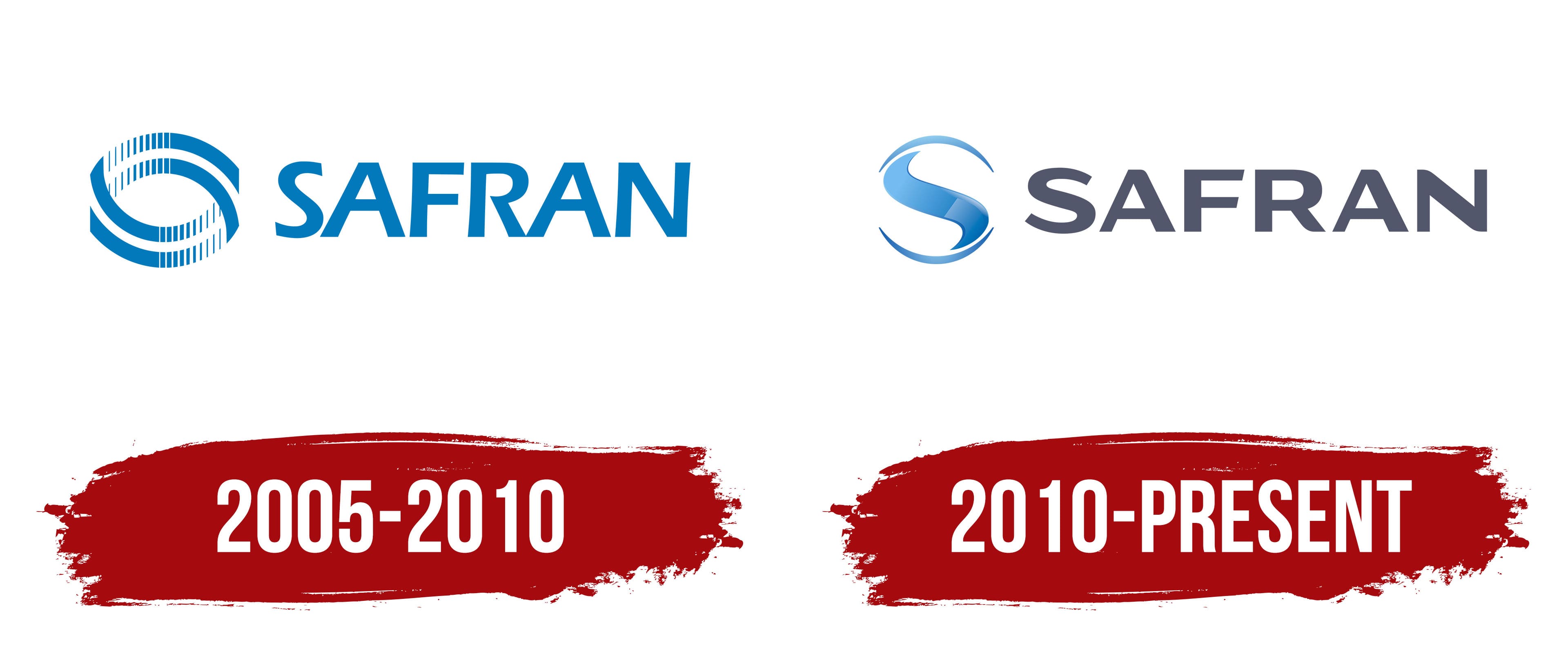
What is Safran?
It is an industrial group specializing in the development and production of aviation, space, and defense technologies. The company manufactures aircraft turbojet and turboprop engines, avionics, flight control systems, braking and landing gear systems, and components for satellites and navigation equipment. The products are used in civil, military, and space applications.
2005 – 2010

2010 – today
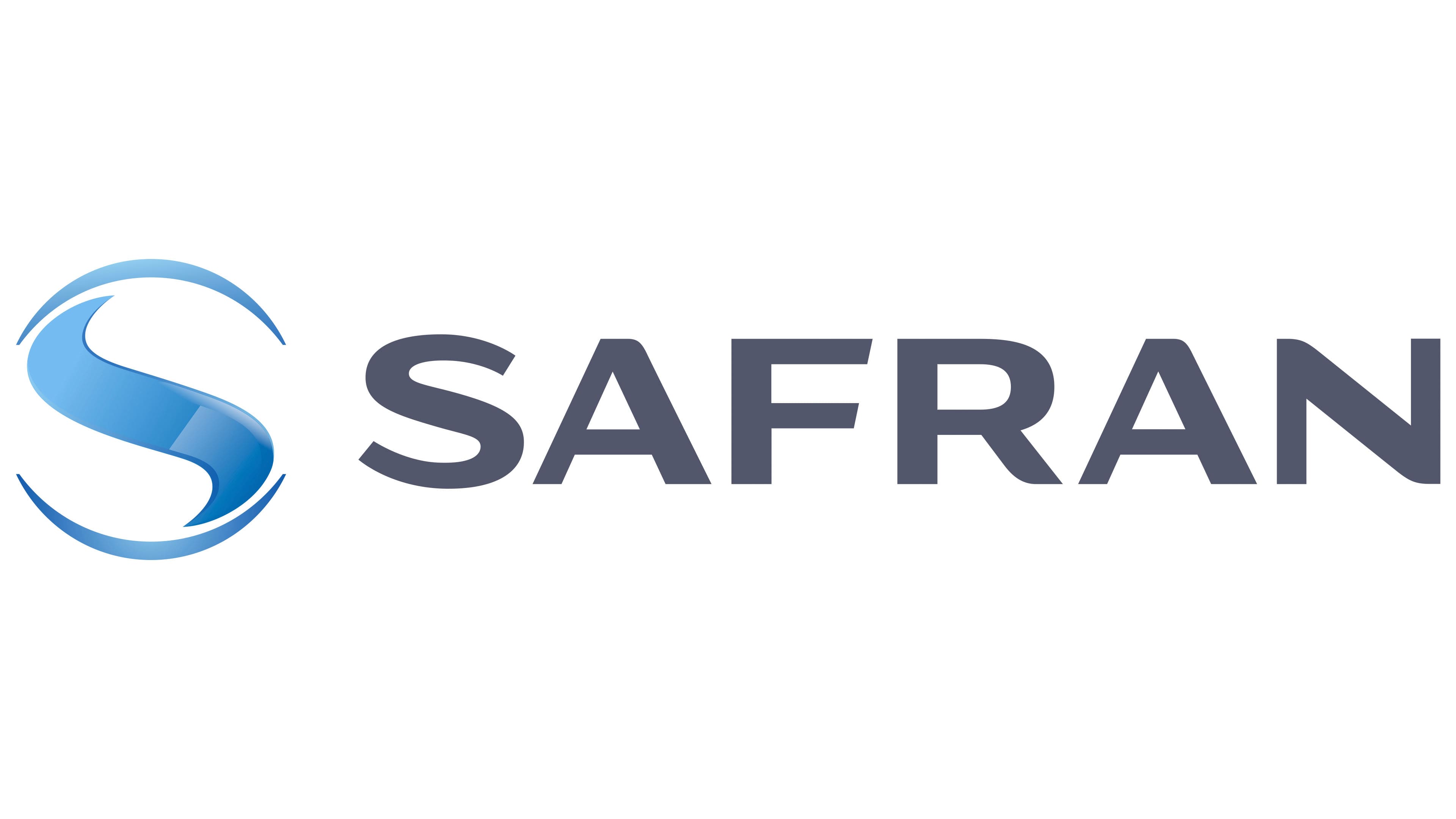
The Safran logo features a stylized letter “S” and the company name. The symbol is defined by smooth curves surrounded by two thin lines. These lines create the impression of a circle, within which the letter “S” resembles an aircraft propeller in motion. The symbol’s light blue color is presented as a gradient that transitions smoothly from a pale shade to a deeper one. The tilted orientation of the image enhances the sense of flight and movement, evoking the rotation of blades.
The company name is written in a slightly slanted typeface with smooth lines and gently rounded letter corners. The text color is dark gray, strongly contrasting with the symbol. The horizontal alignment of the letters maintains the strict proportions characteristic of a modern style. The slight tilt of the letter cuts aligns visually with the symbol’s angled position.
The Safran logo conveys the idea of constant motion, reflecting the company’s activities in aviation, space, and high-precision technologies. The blue shade of the symbol evokes the vast expanse of the sky, while the gray text color conveys a business-oriented, serious character. Visually, the logo resembles a brief story of an airliner flying high above the clouds, emphasizing a sense of freedom and scale. The “S” symbol appears ascending, resembling an aircraft during takeoff. All elements of the composition convey confidence in Safran’s specialists’ knowledge and expertise.