


 Sailor Moon Logo PNG
The designers proposed a mystical yet calm Sailor Moon logo for the English version. It reflects the plot’s spirit, the fairy-tale nature of the events, the magic, and the extraordinary occurrences. These elements are conveyed through a slightly tilted crescent moon that seems to sway in the sky, a wavy font with bouncing letters, and pastel shades.
Naoko Takeuchi was born on March 15, 1967, in Kofu, Japan. She studied chemistry at Kyoritsu University and became a licensed pharmacist. Before becoming a manga artist, she worked as a miko at Shiba Daijingu shrine near her university, an experience later reflected in Rei Hino. In 1991, Kodansha’s RunRun published Codename: Sailor V, the first work connected to the future Sailor Moon universe.
Toei Animation became interested after Sailor V and wanted a sentai-style story with a wider group of heroines. On December 28, 1991, the first chapter of Sailor Moon appeared in Kodansha’s Nakayoshi. The manga followed Usagi Tsukino, a schoolgirl who becomes a warrior. It ran from 1991 to 1997, with 52 chapters collected in 18 volumes, and won the Kodansha Manga Award for shōjo in 1993.
On March 7, 1992, Toei Animation launched the anime on TV Asahi. The series ran for five seasons: Sailor Moon, R, S, SuperS, and Sailor Stars, totaling 200 episodes. In the magical-girl market, Madhouse’s Cardcaptor Sakura later became a major title. Meanwhile, Toei’s Dragon Ball Z reached a different audience.
By 1995, the manga had sold over one million volumes in Japan. By 2012, sales passed 35 million copies in more than 50 countries, with licensed merchandise revenue reaching $13 billion by 2014. Toei produced the live-action Pretty Guardian Sailor Moon in 2003. Sailor Moon Crystal began in 2014, followed by Sailor Moon Eternal in 2021 and Sailor Moon Cosmos in 2023.
Meaning and History

The franchise’s main heroine is Usagi Tsukino, a Tokyo schoolgirl. She befriended a talking black cat named Luna, who gave her a magical brooch. This artifact allowed her to transform into Sailor Moon. At first, the adventures were only covered in the manga. Then, three feature-length cartoons, three short films, and one television movie were launched as anime. In North America, the manga series was published through a license obtained by Kodansha Comics.
The Japanese manga Sailor Moon is well recognized and very popular; it has sold millions of copies. In total, it has sold more than 35 million copies. In the emblem, as in the franchise itself, the main character’s magic, lightness, and light character, along with high artistic skill, are clearly evident. The humor is also evident, which earned the comic an international award. To date, three “reincarnations” of its logo are known.
What is Sailor Moon?
Sailor Moon is a Japanese manga about a schoolgirl named Usagi Tsukino and her talking black cat, Luna. Thanks to a magical artifact, the girl can transform, which is depicted in her adventures. The comic’s author and artist is Naoko Takeuchi, who began working on it in 1991. It was first published in a magazine by publisher Kodansha of the Nakayoshi company. The manga has since become a franchise.
1994

In the pilot project, the emblem was indeed filled with magic. It felt like the night sky: scattered bright stars, a large crescent moon, distant planets, delicate gradients, wavy inscriptions, and letters of different shapes and heights. The moon remained the main element, though waning. It sat in the center of a dark rectangle, a fragment of the night sky. The cosmic landscape optimally balanced the purely earthly object, the inscription stretching across the crescent.
However, the manga’s title was uneven, like a tidal wave washing ashore. The glyphs were elongated, thin, and tall. Small serifs complemented them. Moreover, the double “OO” looked like eyes looking left. This impression was created by the narrow, dark inner letter space, which contrasted with the light circle.
1995 – 2003

For this variant, designers borrowed some details from the previous Sailor Moon emblem. For example, they retained the crescent, tilted it slightly, and doubled it. One crescent was inside the other, as if it surrounded it. This was made possible by shifting the moon: the upper part was vertical, while the lower part was almost horizontal. Both were painted silver-gray and complemented by shadows. The inscription also came from the pilot logo. The letters were tall, bold, uppercase (except for “i”), and golden with a glint in the middle. Meanwhile, the “S” and “M” at the beginning of the words exceeded the size of the other glyphs. The crescent’s duality conveyed the heroine’s dual nature and her magical transformation from a real schoolgirl into a magical character.
2011 – today

The modern logo is cheerier and more feminine than the first two. Bright colors, abundant light, a pink border, and a lot of gold characterize it. The inscription is written in a smooth, slightly italic calligraphic font. Most letters have curves and swirls. The designers replaced the dot over the “i” with a small star to remind readers of the magic and the night sky. At the beginning of the manga’s title, a thin golden crescent appears, with horns stretched forward. One of them (the lower one) is so large it reaches the penultimate letter in “Sailor.”
Despite the modernization, the Sailor Moon logo has not lost its magic. It remains magical, cute, and charming. While the shining stars in the night sky and the silvery moon used to create such an atmosphere, it is now maintained by the pink color, the rounded style of letter writing, and the golden crescent.
Font and Colors
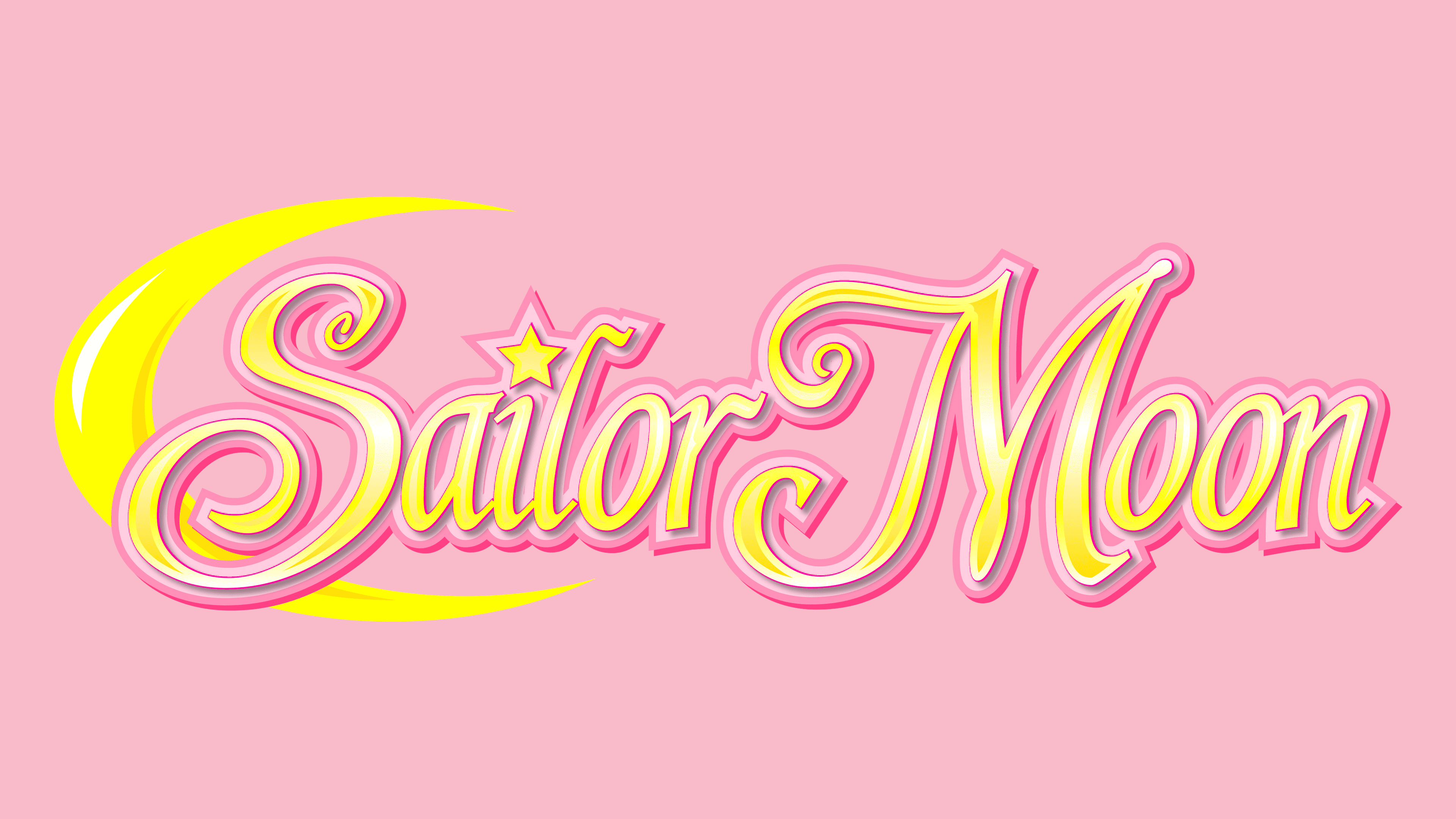
An elegant, charming typeface was chosen for the modern “Sailor Moon” inscription. Each line features intricate, airy, light, soaring strokes. This font closely resembles Shardee by Bright Ideas Studio. The logo’s color palette varies. Sometimes it is dark, while at other times it is bright. The pilot emblem features deep blue-black hues evoking outer space or the night sky. It also features various shades of yellow, white, and silver.