 Science Logo PNG
The Science logo is related to the theme of television. Several emblems fit this description, but all include at least one element indicating they represent a scientific film studio. In modern identity, their similarity to periodic-table symbols signals this.
Science Channel began in the early 1990s, as Discovery Communications expanded its television portfolio. Discovery Channel, founded by John Hendricks in 1985, had already established itself in cable television documentaries with programs on nature, science, and technology. At the same time, the National Geographic Channel and the History Channel were growing in the same factual TV market.
In November 1994, Discovery Networks announced plans to launch several specialized digital channels in 1996. The future science channel was first developed under the working title Quark!, named after the subatomic particle. Before launch, the name changed, and on October 7, 1996, it went on air as Discovery Science Network alongside Animal Planet, Discovery Kids, and Discovery Civilization.
In 1998, the network became Discovery Science Channel, with programming focused on natural science, space, technology, engineering, physics, chemistry, and Earth studies. In April 2002, it was renamed The Science Channel, becoming the first Discovery digital network in the United States to remove “Discovery” from its domestic name. Concrete Pictures created the updated visual identity, while international versions kept Discovery Science.
On December 22, 2007, the channel adopted the name Science Channel. Thornberg & Forester developed the new identity with “Sc,” the chemical symbol for scandium, and typography based on ITC Avant Garde Gothic. The Wormhole with Morgan Freeman premiered on June 9, 2010, and ran for eight seasons, ending in May 2017. By February 2015, the channel reached about 75.5 million U.S. pay-TV households. After Discovery’s merger with WarnerMedia closed on April 8, 2022, Science Channel joined Warner Bros. Discovery Global Linear Networks.
Meaning and History
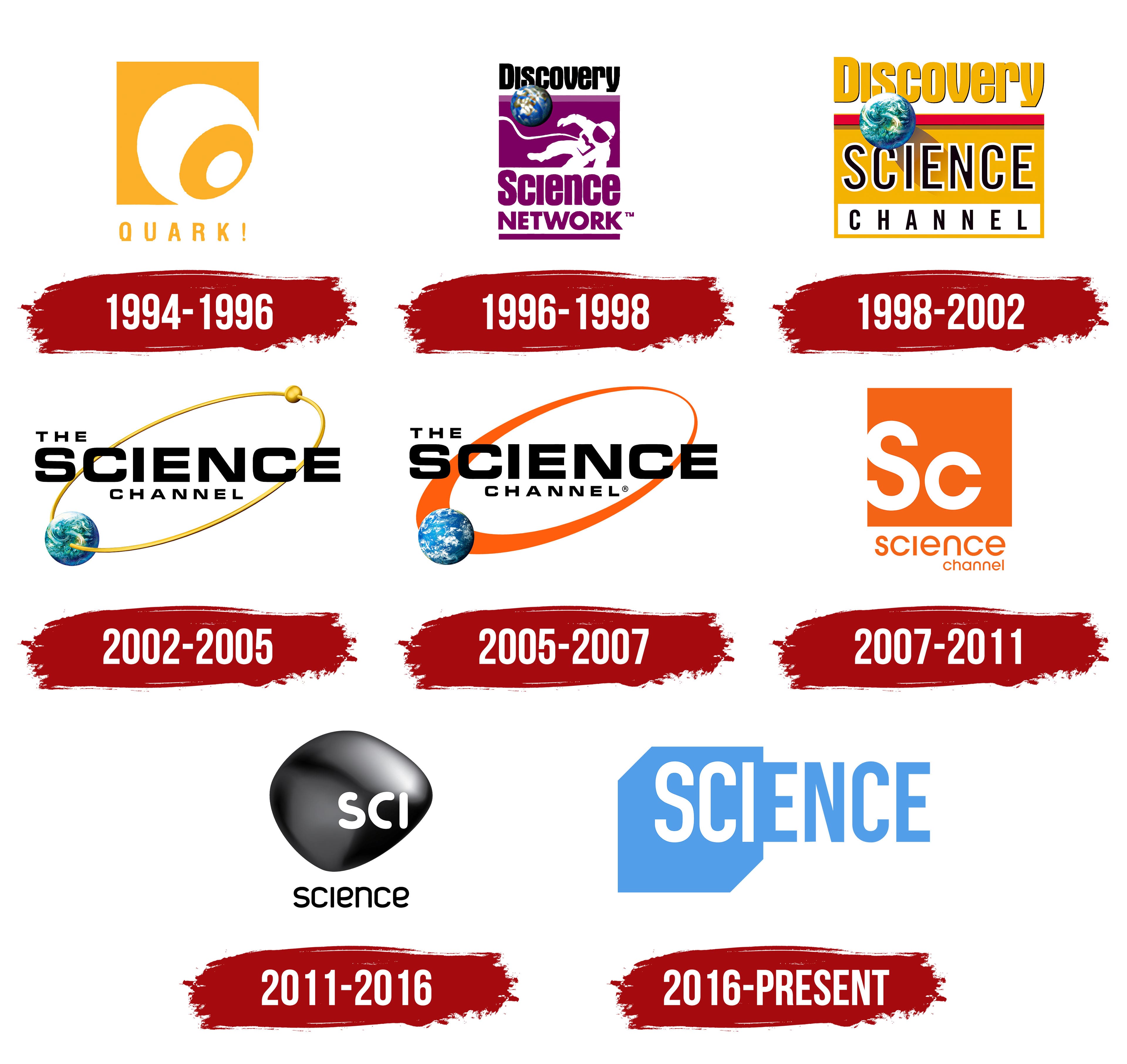
Since its inception, this channel has undergone several rebrandings. For example, when Discovery Networks announced it in 1994, it called it Quark! In 1996, when the project was launched, it was renamed Discovery Science. It was included in the novelties package along with Discovery Civilization, Discovery Kids, and Discovery Home & Leisure. In 1998, the channel was renamed Discovery Science Channel, and in 2002, it became The Science Channel. Since 2007, it has been operating under the name Science Channel. Now, the shortest possible version, consisting of a single word, is in use.
Each option is directly reflected in the TV project’s visual identity. Several logos, including the current one, fully align with their concepts, as the creators based them on the periodic table of chemical elements. They sought to reflect the show’s scientific orientation in the emblem. They achieved this by placing the abbreviated name in a square. In total, Science has eight emblems in eight different formats.
What is Science?
Science is a television channel from the Warner Bros. Discovery portfolio. It was launched in 1996, and before that time, it existed as a pilot project (since 1994). It features shows about space achievements, scientific research, technical progress, innovations, engineering, ufology, and more. Its headquarters are concentrated in Silver Spring, Maryland.
1994 – 1996

Before the TV project launched, its logo featured an improvised “Q,” with the name “Quark!” starting with it. It was a short word ending in an exclamation mark, emphasizing the channel’s scientific nature. The concept is simple: the basis of matter, everything that exists in the world. Quarks (elementary particles) combine into more complex structures. The inscription is made in uppercase sans-serif. At the top is an orange square with several concentric circles of different sizes.
1996 – 1998
When Quark! was relaunched as Discovery Science Network, it adopted a new emblem. However, it wasn’t a partial redesign; it was a complete identity replacement. The symbol was a vertical rectangle with a white astronaut, a blue globe, and a purple name. The inscriptions occupied three lines, one word per row.
1998 – 2002
The next rebranding brought a different identity style. The logo was horizontal, with a three-level name and without an astronaut. A red stripe separated the word “Discovery” from the rest of the first-line text. A wide sandy-yellow rectangle contained the large inscription “Science,” and a narrow white rectangle housed the word “Channel.” The designers retained the blue-green planet as a symbol of the channel, which discussed various scientific aspects of life on Earth.
2002 – 2005
This Science emblem resembled a model of Earth in orbit. Opposite the blue-green planet, a small golden dot rotated. The channel’s latest name was placed over the graphic elements. It was entirely black. Concrete Pictures worked on this symbol.
2005 – 2007
Designers removed the green from the Earth, leaving it blue and adding white, as if it were a view of the Earth through a spaceship’s porthole. They replaced the golden oval with an orange one. As it moved away from the planet, the stripe narrowed, shrinking. The inscription remained three-level and black, with the middle word in the name highlighted in large font.
2007 – 2011

Design studio Thornberg & Forester modernized the Science logo. As a result, the article “The” disappeared from the name. This was the first innovation. The second concerned implementing the periodic table of chemical elements, as if the channel were also on that list. As a result, an orange square labeled “Sc,” reminiscent of the real element scandium, appeared in the emblem. The full name appeared below in two rows, set in a grotesque font.
2011 – 2016
Agency Imaginary Forces proposed a droplet-shaped logo variant. However, the improvised “drop” didn’t hang downward; it was horizontal. Designers colored the background dark gray with reflections and placed the first three letters of the word “Science” on it. They were uppercase. The lower inscription used thin, rounded glyphs.
2016 – today

Specialists from Sibling Rivalry Studio, commissioned by Discovery Communications, created a new logo for Science. It is also oriented towards the theme of the periodic table of chemical elements, consisting of a square with an inscription inside. However, the designers went a little further, turning the square into a cube, visible only in outline. Instead of the first two letters of the channel’s name, they used three. At the same time, the developers didn’t remove the other glyphs; instead, they widened them and converted them to uppercase. The emblem’s color palette was updated to sky blue.
The Science logo’s transformation reflects the brand’s regular name changes and periodic image updates. Therefore, whenever a new name emerged, the channel’s management changed its visual identity.
Font and Colors

All Science emblems contain text. In the latest versions, they use the fonts ITC Avant Garde Gothic (a modified version) and DIN Condensed. The only thing that unites these and other typefaces is the absence of serifs. The palette varies little because each logo predominantly uses a single color. Orange, purple, dark gray, sandy yellow, black, and blue are used. They are usually complemented by white.