Sears Logo PNG
The logo of the American retail chain Sears is simple. It contains only the company name in various forms. The modern emblem includes a graphic icon of a miniature house, drawn with a single continuous line. It conveys the principle of uniting all points of sale.
Sears began in 1886, when Minnesota railroad station agent Richard Warren Sears received a shipment of pocket watches that a local jeweler had refused. He sold them to other agents along the route, earned $5,000 in six months, and left the railroad. In Minneapolis, he founded R.W. Sears Watch Company. In 1887, Sears moved to Chicago, hired watchmaker Alvah Roebuck, and issued the first catalog with watches and jewelry.
By 1888, the catalog had 80 pages; by 1890, it had expanded to 322 pages, adding clothing, sewing machines, bicycles, and musical instruments. On September 16, 1893, the company became Sears, Roebuck and Co. In 1895, Roebuck sold his stake, while Aaron Nusbaum and Julius Rosenwald bought half the company for $75,000. In 1906, Sears became the first major retailer to go public, raising $40 million.
Retail stores changed the company again. Robert Wood joined in the early 1920s, and Sears used rising car ownership to reach suburban and rural customers. Sears opened its first store in Chicago in 1925. By 1929, Sears had 300 stores, and in 1931, store revenue passed catalog revenue. The company later built private labels such as Craftsman tools and Kenmore appliances. In 1973, it completed the Sears Tower in Chicago.
In the 1980s, Sears bought Dean Witter Reynolds and Coldwell Banker, then launched Discover Card in 1985. Sears’ retail focus weakened as Walmart overtook it in sales in October 1989. Sears sold non-core assets in the 1990s. In 2004, Eddie Lampert merged Kmart and Sears for $11 billion to form Sears Holdings. Lands’ End was sold in 2014. Sears Holdings filed for Chapter 11 on October 15, 2018, and Transformco was formed after ESL bought the assets in 2019.
Meaning and History
Initially, Sears, founded by two entrepreneurs, handled mail orders and delivered goods. To do this, they printed catalogs listing available products and prices. The catalogs then went to the countryside, where anyone could get everything they wanted. However, rural hardships reduced consumer purchasing power and left many products unsold.
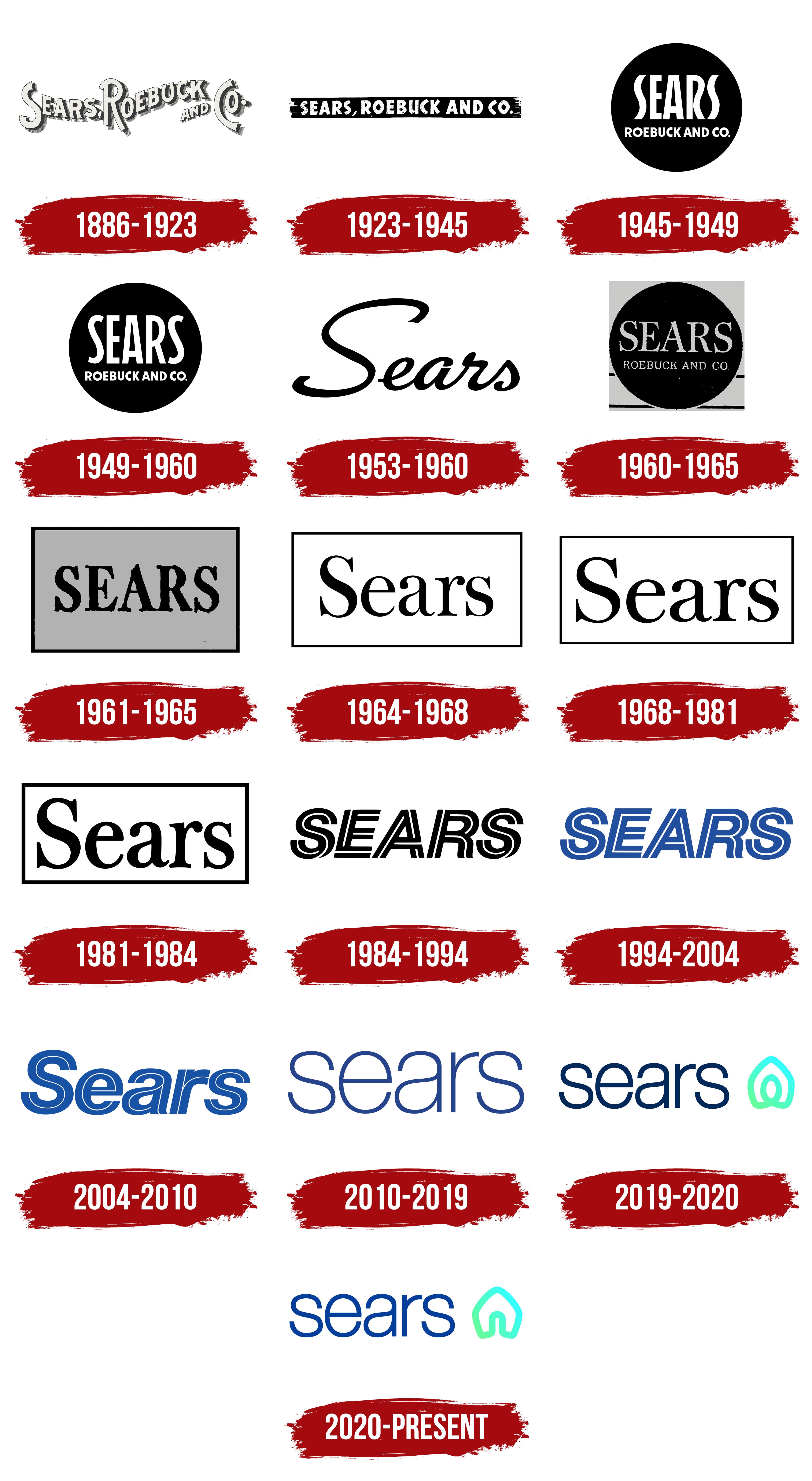
In the end, Alvah C. Roebuck sold his share to Richard W. Sears and left the business. Later, Julius Rosenwald joined him, and the company had to be registered again. Despite Roebuck’s departure, the entrepreneurs initially kept his last name in the title because it was already well-known and recognizable. Over the years, the stores’ visual identity changed 15 times.
What is Sears?
Sears is an American department store chain. It has been operating since 1892, starting with catalog orders and mail delivery. Two entrepreneurs founded it: Richard Sears and Alvah Roebuck. Later, Roebuck left the business, and his place was taken by Julius Rosenwald. The new partners re-registered the company in 1906. The department store’s main management was based in Hoffman Estates, Illinois.
1886 – 1923

The first official Sears logo read “Sears, Roebuck, and Co.” The inscription was made as a wavy line, so its parts did not align in height. The letters were uppercase and outlined, with a monochrome shadow on the right side. The connecting union was the smallest, while the other words remained large.
1923 – 1945

The second version of the inscription became the new logo in 1923. It kept the same phrase but used a different design style. It had a black background in the form of a wide horizontal stripe, in which white words of equal size were placed. The font was bold and bubble-like.
1945 – 1949

The next redesign brought a round emblem. The spherical space was colored black, with the text visible, typed in white letters. The word “Sears” was set in a large font, while the phrase “Roebuck and Co.” appeared in a smaller, centered font. The text occupied two lines.
1949 – 1960

Designers kept the logo structure but changed the font in the first word of the store chain’s name. They removed the wavy “S” and replaced it with a standard one.
1953 – 1960
From 1953, a parallel emblem with italic, handwriting-style text was used. It adorned the signs in front of the department stores. The first “S” was uppercase, while the other glyphs were lowercase. The letters were executed in smooth, semi-bold lines.
1960 – 1965

Sears management returned to the circle, so the emblem became a black disk with the name inside. However, the inscription was now set in a serif font rather than sans serif. Moreover, the serifs were thin and sharp. The two-level text arrangement was preserved.
1961 – 1965
After rebranding and shortening the store names to a single word, the chain received an updated logo. It featured an inscription outlined in rectangular frames. Both the border and the letters were black. The simplified adaptation was used in newspaper advertisements.
1964 – 1968
The logo became simpler and cleaner. To this end, the developers made the frame even thinner and replaced the uppercase font with lowercase (except for the first letter). The serifs were preserved.
1968 – 1981
The emblem was changed again, but this time the designers only corrected the font. They increased the letter size and added width.
1981 – 1984
To make the inscription on the logo more visible, the developers bolded the letters.
1984 – 1994

The design studio Bob Girsen & Associates helped create this emblem. They removed the frame that enclosed the inscription. First, the frame was removed. Second, they added another stripe to the letters, doubling them. The uppercase font was brought back.
1994 – 2004
The department store name’s black color was replaced with blue.
2004 – 2010
The identity update affected the font. Developers changed the letters to lowercase, leaving only the “S” uppercase. The glyphs’ double lines were preserved. The redesign coincided with the formation of Sears Holdings.
2010 – 2019

The Sears wordmark received another font, a thin, rounded, smooth, sans-serif. All letters were converted to lowercase and enlarged.
2019 – 2020

The department store chain updated its visual identity after emerging from bankruptcy proceedings caused by declining sales at its parent company, Transformco. However, the logo resembled the Airbnb emblem, a platform for searching for and renting accommodations. Therefore, the new identity was criticized. The emblem featured a neon-green house with the department store name beside it. The inscription was in dark blue lowercase letters.
2020 – today

The modern version keeps the same house but removes the central loop. The developers removed it to reduce the symbol’s similarity to the Airbnb emblem. Now nothing fills the space. The bright building with a gable roof is drawn with a single closed line. The inscription has a light blue color palette.
When Sears updated its logo in 2019, it sought an identity filled with home warmth and cordiality. However, the opposite proved true: it was accused of plagiarism because the online accommodation platform Airbnb had long used a similar symbol. It has the same house with a heart in the center and a similar concept.
Font and Colors

Over the years, this store chain has used 16 emblems, each with a different version of the name inscription. Some typefaces were bold and wide, others narrow and tall. In particular, some resembled fonts like Neue Helvetica 96 Black Italic, Helvetica 35 Thin, and Nimbus Sans Black Italic.
The corporate palette is less diverse than the typography. It is mainly built on monochrome black or blue. Now, a light green neon spectrum color has appeared.