


 Sony Pictures Logo PNG
A staircase to fame- that’s what the Sony Pictures logo is. It signals high aspirations for success and popularity, so its owner can reach the parent company’s level. A half-baked success doesn’t satisfy the film studio: it longs to capture everything within reach of its bright personality’s rays. We observe this aspiration in its visual identity.
Sony Pictures traces its roots to CBC Film Sales Corporation, founded in New York in 1918 by Harry Cohn, Jack Cohn, and Joe Brandt. On January 10, 1924, the company became Columbia Pictures. In the 1930s, director Frank Capra helped lift the studio’s profile, and It Happened One Night won five Oscars in 1935, the first major “Big Five” sweep in American film.
In June 1982, The Coca-Cola Company bought Columbia Pictures for about $750 million. That same year, Columbia joined HBO and CBS to create TriStar Pictures. By 1985 and 1986, CBS and HBO had left the venture, giving Columbia control of TriStar. In December 1987, Coca-Cola combined Columbia and TriStar into Columbia Pictures Entertainment.
Sony Corporation announced its purchase of Columbia Pictures Entertainment on September 28, 1989. The deal cost about $4.9 billion, including debt. Sony wanted film content to support its consumer electronics and home-video ambitions. It also hired Peter Guber and Jon Peters, which led to a costly conflict with Warner Bros. The settlement gave Sony the historic Culver City studio lot once tied to Metro-Goldwyn-Mayer. On August 7, 1991, the company became Sony Pictures Entertainment.
The first years were difficult, with heavy losses and failed projects before Guber and Peters left in 1994. Sony Pictures Classics launched in 1992, Men in Black became a major hit in 1997, and Spider-Man earned over $820 million worldwide in 2002. In 2005, a Sony-led group bought MGM for $4.8 billion, adding more than 4,000 films and James Bond rights. In November 2014, Sony Pictures suffered a major corporate hack by Guardians of Peace.
Meaning and History
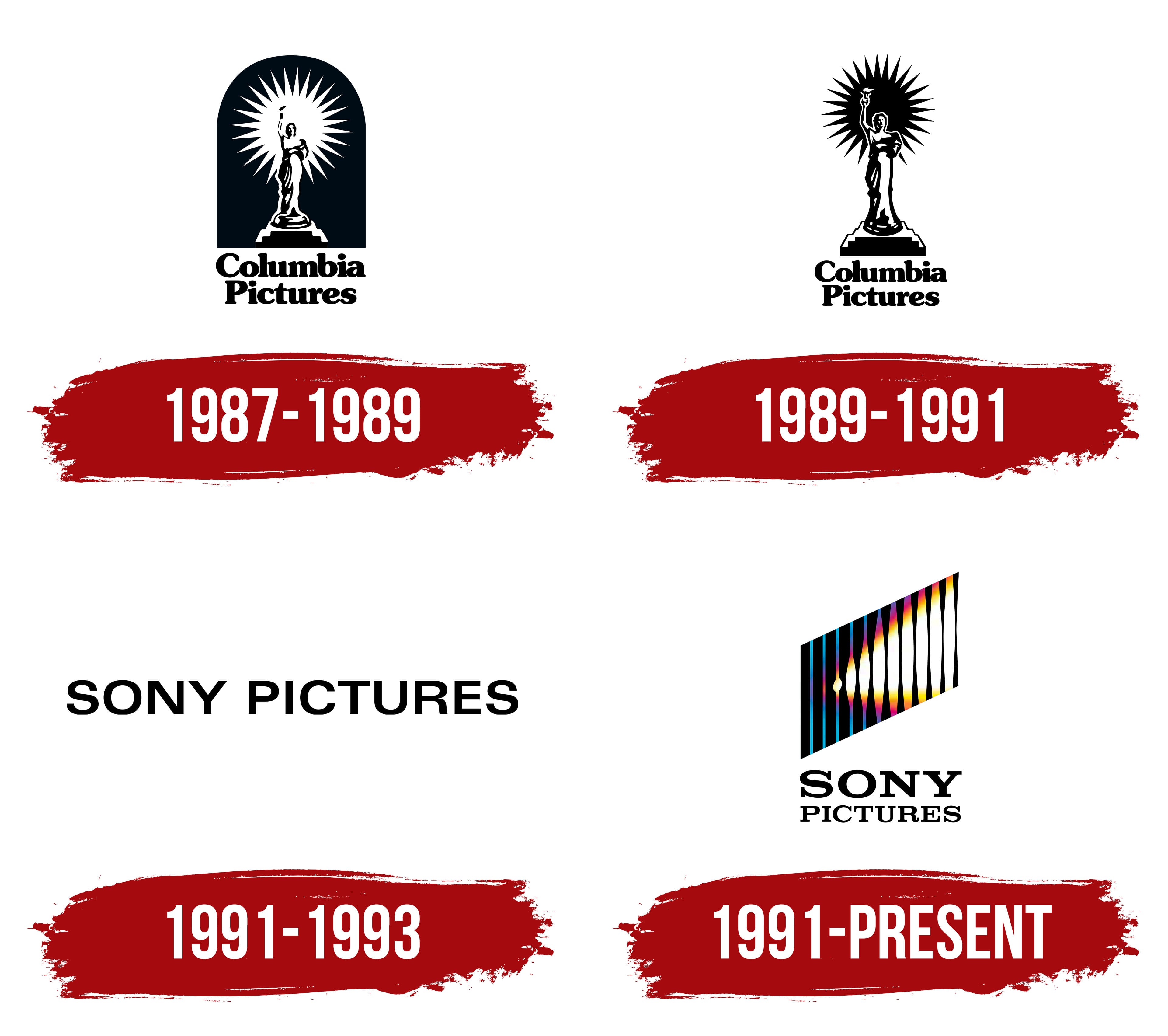
Sony Pictures’ visual identity reflects its origins, rebranding, and connection to the television entertainment industry. The logo vividly conveys key stages of the studio’s development and its approach to adapting what’s happening in the world for the screen. No wonder it remains a leader in the film industry, offering a diverse range of high-quality content, from feature films to game shows.
For a long time, its emblem was a symbolic figure representing the United States: Columbia, a girl. She debuted on the screensaver in 1924. The image’s prototype was actress Evelyn Venable, depicted with an olive branch and a shield. In 1928, the logo incorporated the torch, held high. This was followed by a series of identity experiments that culminated in a concise image of the famous Torch Lady. The modernized version was launched in 1981. Later, the picture was digitized. Columbia Pictures graphic editor Jenny Joseph then posed as the cinema goddess.
What is Sony Pictures?
Sony Pictures (also known as Sony Pictures Entertainment or SPE) is a globally renowned film company and one of the top 5 producers and distributors of films, shows, television programs, and online games. It is part of the Sony Group Corporation, a global technology and media conglomerate. It was founded in 1987, when the Coca-Cola brand decided to separate its entertainment-industry assets. The studio was initially called Columbia Pictures Entertainment and took its current name in 1991. Its headquarters are located in the California city of Culver City.
1987 – 1989

The logo depicts a slender young girl standing on a high pedestal with a torch in her right hand. She wears a flowing tunic; behind her, light appears as the sun, with many sharp rays. The torch flame illuminates the figure and everything around her. The background for Columbia (the character’s name) is a half-cut oval that resembles an entrance. Below it is the film studio’s name, set in bold letters with miniature serifs. The font is lowercase, except for the first glyphs, which are in uppercase. The inscription is centered.
1989 – 1991

After years of experimenting with its visual identity, the film company settled on a “negative” logo. In this case, the concept is not associated with negative impressions but with the effect of a photonegative, where light objects appear black and dark ones appear white. Therefore, on the emblem, the girl with a torch, the fire, and part of the clothes became black. Designers completely removed the background but kept the two-level name.
1991 – 1993

After rebranding, the film company got a different name and a refreshed logo. This is a text sign with nothing superfluous. The inscription occupies one line and is characterized by narrow inter-character spacing. All letters are in uppercase, grotesque, wide, and flattened.
1991 – today

This logo symbolizes Sony Pictures’ progress and development. It’s like a staircase leading upward, reflecting the film company’s evolution. A series of parallel vertical lines evidences this. Each has its own thickness. But this is not the only interpretation of the emblem. It also has another concept, inspired by creative flight, professionalism, and even the torch held by the girl depicted in the ancestor company’s screensaver, Columbia Pictures.
At the center of the third vertical line, a bright light is drawn, like a flame, a movie projector, or a film camera. It actively expands to the right, capturing more and more space until it reaches a global scale. The beam of light is powerful and cone-shaped. Its middle is white, and the edges are yellow-red, like a real flame. The black-blue stripes are diagonally positioned: the lower-left corner is lower, and the upper-right corner is raised. The studio’s name is under the rhomboid figure. It is divided into two lines and typed in capital Roman font.
Font and Colors
Depending on when the Sony Pictures logos appear, different writing styles are used. In early versions, the bold font prevails; later, semi-bold and even thin fonts appear, demonstrating the studio’s sophisticated taste. In particular, the serif typeface is Clarendon Bold Expanded, designed by Robert Besley. The humanistic sans-serif font is called SST.
The sign’s palette has varied over time, each time gaining more color. As a result, it has grown from monochrome to a combination of several colors: black, white, blue, red, and yellow.