


 Star Wars Logo PNG
The Star Wars logo demonstrates the franchise’s global reach. The symbols let imagination soar. The emblem reminds us that, despite their importance, these events are just a flash in the universe’s endless journey.
Star Wars emerged in the early 1970s, when George Lucas developed a large-scale space story after “American Graffiti.” Studios rejected early 1973 drafts, calling the project risky. 20th Century Fox agreed to finance it with caution. In 1976, a novel by Alan Dean Foster, published under Lucas’s name, tested audience interest.
On May 25, 1977, the film premiered and became a major box-office success, surpassing Steven Spielberg’s “Jaws”. Marvel Comics adaptations supported the publisher financially from 1977 to 1978. Merchandise generated about $500 million over three years. Lucas secured merchandising rights and sequels through an earlier contract.
In 1975, Lucas founded Industrial Light & Magic to handle effects after Fox ran out of capacity. The studio developed new techniques and later hired Ed Catmull, who brought in John Lasseter, which led to the creation of Pixar.
In 1980, Irvin Kershner directed “The Empire Strikes Back,” followed by “Return of the Jedi” in 1983. The original trilogy grossed over $2 billion. In 1982, LucasArts was founded and later produced games such as X-Wing and TIE Fighter.
Lucas returned with the prequels in 1999, 2002, and 2005, which earned over $2 billion and expanded ILM’s use of digital effects.
On October 30, 2012, Disney acquired Lucasfilm for 4.05 billion dollars after talks with CEO Bob Iger. Kathleen Kennedy became president. In 2015, “The Force Awakens” set North American box-office records, followed by subsequent films and the 2019 series “The Mandalorian” on Disney+.
Meaning and History
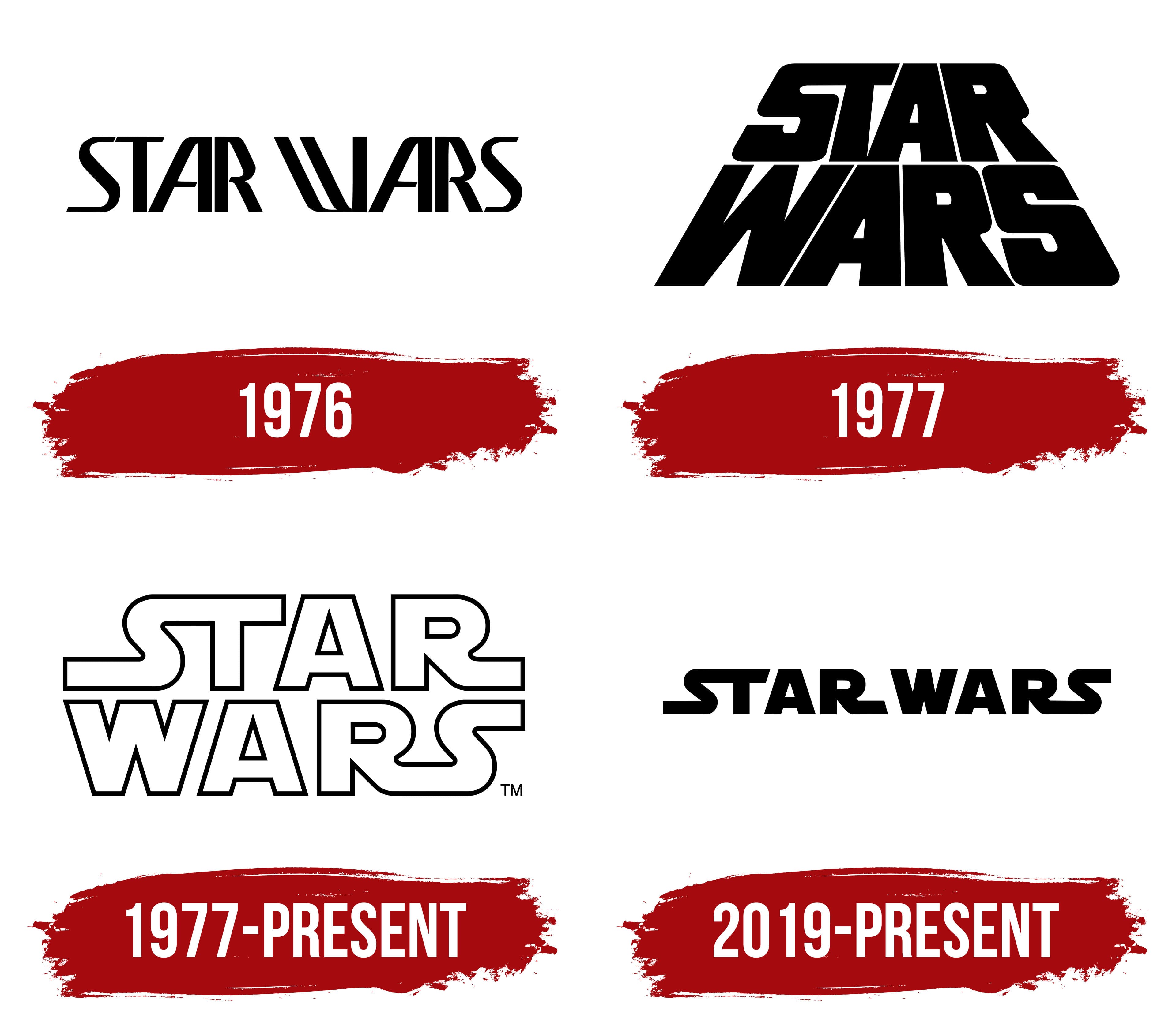
The “Star Wars” media franchise has existed for several decades. It has evolved with the new era, and the logo has changed. What was in demand in the mid-20th century is no longer relevant. At the same time, designers tried to preserve the iconic style associated with the space opera.
What is Star Wars?
Star Wars is an American media franchise that began in 1977 with a film of the same name and has since grown into a space epic. Its creator is director George Lucas. It quickly became one of the highest-grossing works ever. Currently, it includes films, comics, novels, video games, TV series, theme park attractions, and much more.
1976 (pre-release)

The title The Star Wars appeared in working materials for George Lucas’ space saga before it reached theaters. “The” was later dropped, and the shorter title became the basis for several wordmark designs. The words “star” and “wars” referred to armed conflicts in a distant galaxy. The first film opened in U.S. theaters on May 25, 1977, beginning Star Wars’s screen history. The saga eventually grew into a Lucasfilm media franchise.
An early emblem was created for use during production. In June 1975, artist Ralph McQuarrie designed a logo for film cans, scripts, and internal materials. A figure holding a raised lightsaber stood against a red planet and a shining star, with “The Star Wars” below. McQuarrie associated the character with an early version of Han Solo developed during costume design.
After the title was shortened, Charles Lippincott commissioned designer John Van Hamersveld to create new lettering. In 1976, the wordmark and illustration appeared together on T-shirts worn by participants in the Star Wars presentation at San Diego Comic-Con.
One early version featured Star Wars on a single line in narrow, angular, solid black letters. The letters within each word sat close together, with a gap between words. A flattened “R” stood out on the right, and the “W” had an unusual shape. The design used only flat letter silhouettes. This version served as a prototype for the main logo.
1977

While working on the opening titles for Star Wars, Dan Perri created a logo in perspective. He drew inspiration from the opening titles of the 1939 film Union Pacific. In 1977, he proposed an animation in which the title receded into space toward the horizon.
He stacked STAR above WARS. The upper line was narrower than the lower one, and the sides widened toward the bottom, giving the wordmark a trapezoidal silhouette. Heavy, bold letters appeared in bright yellow against a black, star-filled background. In some versions, the star field filled the letters’ interiors.
A different design appeared as the on-screen title, while Perri’s work appeared in promotional materials for the 1977 premiere. It featured on early posters, including Tom Jung’s first poster for the film later titled Star Wars: Episode IV – A New Hope.
1977 – today

The two-line Star Wars logo emerged during work on a Fox brochure for theater owners. Seiniger Advertising was commissioned to design the cover, with art director Suzy Rice developing the lettering. The logo was initially intended for print materials, packaging, and advertising. Gary Kurtz participated in its development. George Lucas wanted an intimidating look, describing the desired result as “very fascist.”
Rice started with Helvetica Black. She reworked the letters by hand, drawing in pencil at a large drafting table. The cover’s proportions reminded her of a movie screen, so she imagined the lettering in a theater even though the commission was for a brochure. STAR and WARS were stacked to form a nearly rectangular silhouette. Heavy strokes, rounded outer corners, and long horizontal terminals distinguished the design from the original typeface.
Lucas pointed out that the title might be read as “Tar Wars.” In response, Rice adjusted the opening and closing “S” letters. In the outlined version, the background remained visible inside the letters. The team chose Rice’s work for the on-screen title because Dan Perri’s version was hard to read in animation.
The lettering was refined for the film. Joe Johnston reworked the “W” and widened the other letters. Perri then adapted the logo for the widescreen frame and optical printing. He adjusted the outline thickness to account for the title gradually shrinking on screen. Color tests explored yellow, white, orange, blue, and gray. The film used a yellow outline against a black star field John Dykstra prepared.
The logo debuted on screen on May 25, 1977. At the beginning of the film, the title fills the frame before receding into space. The logo appeared in all 9 films of the saga. Black-and-white outline versions were produced for print.
2019 – today (secondary)
The Mandalorian’s 2019 Disney+ debut introduced a new Star Wars opening sequence with the title on a single line. STAR and WARS appeared side by side, retaining the heavy lettering and the joined “ST” and “RS” pairs. In the monochrome version, solid letters replaced the hollow outlines. This horizontal version was used alongside the two-line logo from the films.
Devastudios created the sequence with Lucasfilm. Character masks and helmets emerge one after another from darkness, catching red and blue reflections. The colors reference lightsabers and the conflict between the Force’s two sides. ILM supplied the 3D models, and Devastudios developed their surfaces, combining shine with signs of wear. The Mandalorian’s helmet appears last, followed by a glowing, multicolored Star Wars wordmark.
The single-line logo appeared in opening sequences for Disney+ series and specials set in the Star Wars universe, as well as in the service’s main hub. It also appeared in the on-screen branding for Star Wars: Skeleton Crew.
Font and Colors
Suzy Rice’s meticulous work created the current logo. To create it, the artist studied reproductions of political works from the 1930s, when fascism became a form of state structure. She also focused on the Art Deco style and used the enlarged Helvetica Black font as a reference.
Thus, the first version appeared: a two-line inscription, “STAR WARS,” outlined in white lines. Later, director Joe Johnston slightly altered the emblem, brightening the contours.