


 Terraria Logo PNG
The Terraria logo is fabulous and magical. Transfers to the arcade world, demonstrating its nature and the type of game and graphics to the user. The emblem invites you to become an explorer and gatherer, trying your hand at the role of Robinson Crusoe.
Terraria began in January 2011, when programmer and game designer Andrew “Redigit” Spinks started building a two-dimensional sandbox from his home in Floyds Knobs, Indiana. Before that, he was known in a small circle as the lead developer of Super Mario Bros. X. He was joined by artist Finn Brice, assistant Jeremy Gerrett, composer Scott Lloyd Shelly, and Whitney “Cenx” Spinks, who worked on design and community relations.
The game was made with Microsoft XNA and C#. After a beta version leaked online, Re-Logic released Terraria ahead of schedule. It appeared on Steam for Windows on May 16, 2011, and sold 200,000 copies in its first week. Mojang Studios’ Minecraft followed, though Terraria placed more weight on combat, progression, bosses, and item systems.
Update 1.1 arrived in December 2011, adding monsters, bosses, companions, items, lighting changes, and world-generation improvements. In February 2012, Spinks announced the end of active development, but Engine Software and 505 Games handled console ports. The Xbox 360 and PlayStation 3 versions were released in 2013, while Codeglue handled the iOS and Android ports.
Spinks returned to PC development in 2013, and update 1.3, released in July 2015, added enough content to renew Steam’s interest. Terraria: Otherworld was later canceled in 2018. Journey’s End, update 1.4, launched on May 16, 2020, when sales had passed 30 million copies. In 2021, Google blocked Spinks’ account, leading them to cancel the Stadia port. By October 2024, Terraria had sold over 60 million copies, including about 33 million on PC, with no paid expansions or microtransactions.
Meaning and History

The game’s logos are very consistent. Even as the version changes, the old emblem remains alongside the new one. It’s a good idea for a sign that doesn’t make sense to change radically.
What is Terraria?
A super-popular survival-arcade game developed by the private American studio Re-Logic. Over 50 million copies have been sold in nine years. Allows the player to create their world from scratch.
2011 – today

The emblem is part of the playing field: the name sits on a green-grass background, with a tree in front of it. The image conveys the device of the world. Terraria has a lot of greenery. The player walks on a green surface. This reflects the logo’s background. For greater realism, blades of grass and flowers have been added to the upper surface. The background repeats the outlines of the inscription surrounding it.
Tunnels form all the name letters dug into the ground. Most of the playing field is occupied by soil extending down from the top green cover. It contains stones, ore, and other “treasures” that the player can dig up using a hoe. In doing so, he creates underground tunnels. The letters represent these passages. For greater similarity, some of them include stone elements.
The tree before the name is a maple. It fully reflects the trees in the game world. The participant can use it to extract timber. It symbolizes good luck, prosperity, growth, and development. Two additional lower branches seem to invite you to climb up.
Depending on the world and weather the user has chosen, the logo’s color and details change. For example, a tree loses its leaves in winter, and in the desert, they are replaced by cacti, etc.
2020 – today

By the game’s ninth anniversary, the developers released a major update, 1.4, titled Terraria Journey’s End. The developers said this is the final version and that no further updates will follow. Along with rewriting many details and adding golf mode, they also slightly tweaked the logo.
The update is minor and preserves the previous version’s image. The main difference is in size. The emblem brightened, grew larger, and increased in contrast, while the grass cover became fluffier.
Font and Colors

The logo’s main colors are green and brown. They represent grass and earth.
- Green is pleasing and soothing. Shows that life is flourishing in the arcade. It predicts a long future with many new versions.
- Brown conveys the program’s and code’s stability and reliability. It represents the wealth the game brings to its creators and users.
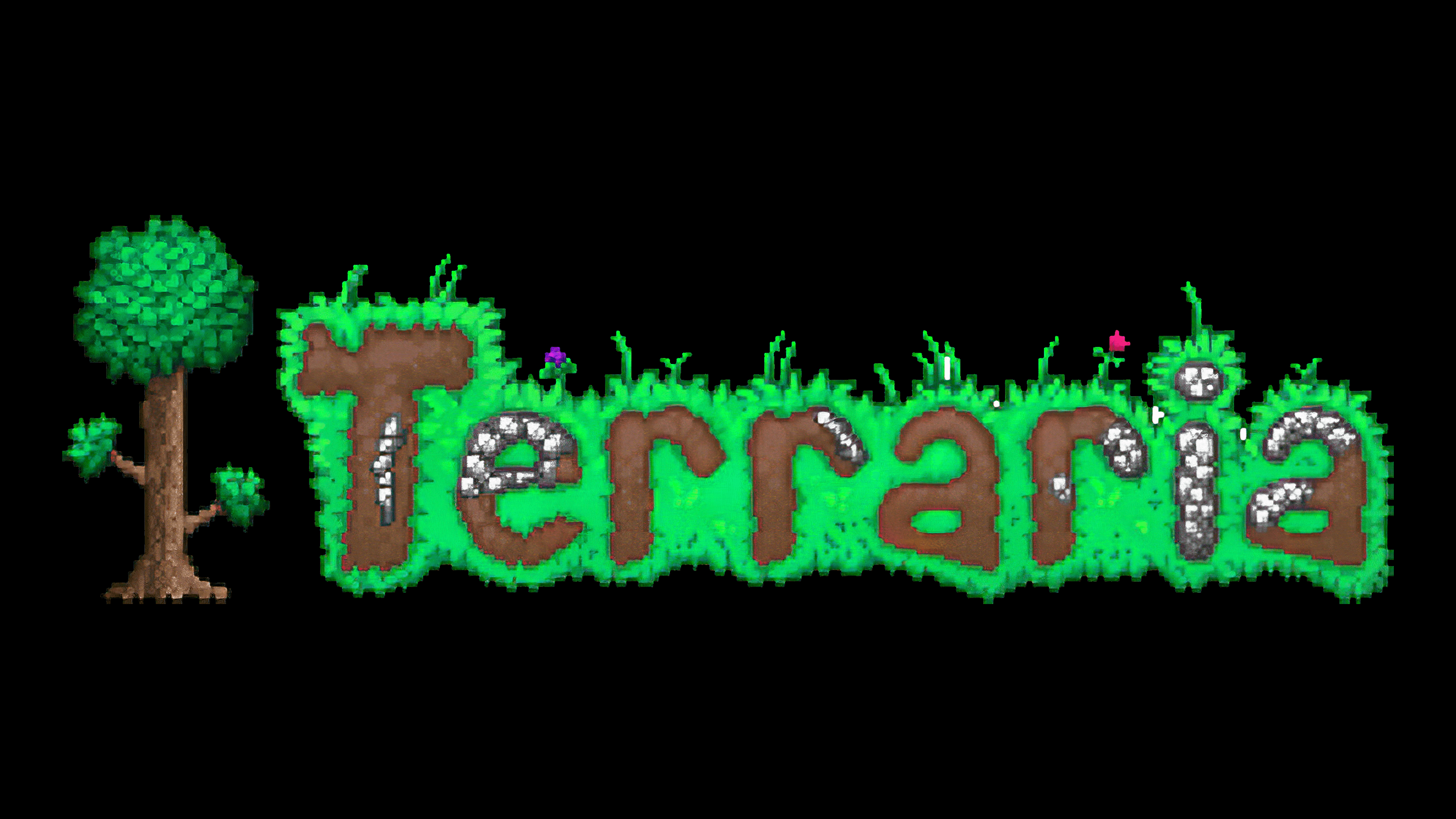
The font is authentic and bold with jagged edges. The letters resemble the player’s basic tools. Rs look like hoes, and Ts look like axes or pickaxes.