


 Texas Rangers Logo PNG
The entire identity, including the Texas Rangers logo, reflects the team’s professional affiliation and philosophy. The emblem highlights the brand name, hometown, and commitment to tradition.
The Texas Rangers’ history begins in 1961, when the franchise debuted as the Senators after the previous club became the Minnesota Twins. Early seasons were poor, with multiple 100-loss years, until 1969, when manager Ted Williams led the team to an 86–76 record.
In 1972, the franchise moved to Arlington and became the Rangers. Results in the 1970s remained inconsistent, with a brief rise in 1974 under Billy Martin. A key figure arrived in 1989, when Nolan Ryan joined the team, recording his sixth and seventh no-hitters and reaching 5,000 strikeouts before retiring in 1993.
The 1990s marked the first competitive phase. With Juan González and Iván Rodríguez, the Rangers won the AL West in 1996, 1998, and 1999, but lost each time in the playoffs to the New York Yankees.
In 2001, Alex Rodríguez signed a record $252 million contract but was traded in 2004. In 2010, the team returned to the postseason and, led by Josh Hamilton, defeated the Yankees to win the AL pennant before losing the World Series to the San Francisco Giants.
In 2011, the Rangers returned to the World Series but lost to the St. Louis Cardinals after leading late in Game 6.
In 2023, under Bruce Bochy, the team won its first title, defeating the Houston Astros and then the Arizona Diamondbacks in the World Series.

On September 21, 1971, almost all AL members voted for the relocation. Initially, the franchise was planned to stay in its new location only for the 1972 season, but things turned out differently. In 1980, oil magnate Eddie Chiles bought it from Brad Corbett and, nine years later, sold it to an investment group led by George Bush and Richard Rainwater. The deal cost $89 million. From 1998 to 2010, Tom Hicks owned the club, and then the baseball company Rangers Baseball Express, which still owns the team today.
The team’s debut name wasn’t associated with the Rangers. Robert Short named the team the Texas Rangers in 1971. The new name was given in honor of the famous Texas agency, created in 1823 by Stephen F. Austin.
The franchise’s branding went through several stages before reaching its current form. The earliest version dates back to 1961. Even then, it was done in primary colors – red, blue, and white. Other elements either disappeared or were reworked over time.
Meaning and History
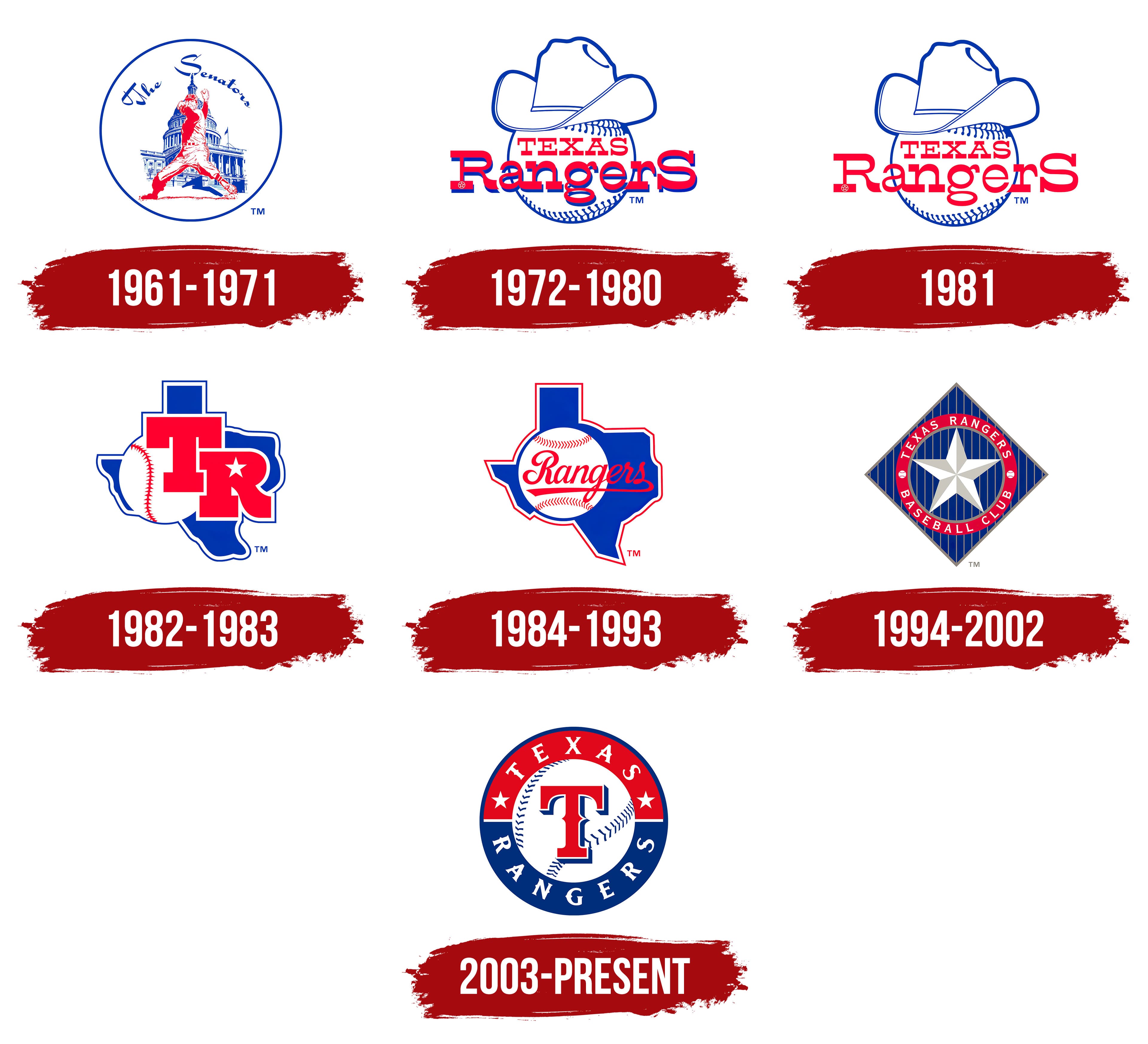
The baseball team has come a long way from “Washington Senators” to “Texas Rangers,” and it associated its visual image with the name in both cases. The debut logo featured an athlete pitching a ball in front of the Capitol in Washington, D.C., where senators convene. After the rebranding, versions featured a cowboy hat and the Texas administrative map. The only constant was the palette: the blue-and-red combination was approved when the original emblem was released.
What are the Texas Rangers?
In baseball, the “Texas Rangers” are a professional baseball team based in the economic center of North Texas. It has been based in the Dallas-Fort Worth-Arlington area since 1972 and previously played in Washington, D.C. Its previous name was “Washington Senators.” The club was created to replace the previous “Washington Senators” team, which moved to Minnesota.
1961 – 1971
The first logo in the expansion history of “Washington,” which lasted ten years until the team moved to Texas in 1972, featured a white circle with the White House and a baseball player throwing a ball. The White House outline was in blue ink, and the player’s outline was in red. Above the building was the inscription “The Senators.”
1972 – 1980
With the move to Texas, the club changed its name to “Texas Rangers” and, accordingly, the logo concept. The new logo depicted a white ball with a cowboy hat. Above the drawing, the team’s name was written in red. The outline of the drawing itself became completely blue.
1981

A slightly modified version of the previous logo appeared in 1981. Artists improved the drawing, depicting a baseball and a cowboy hat to symbolize the cowboy state of Texas. The inscription “Texas Rangers” remained in the same place, with only a slight font change.
1982 – 1983
The shape of Texas naturally became the basis for the new “Rangers” logo. On the state’s blue background, two huge red “TR” letters were placed, with a small white star inside one. A white ball also appears on the logo as a symbol.
1984 – 1993
The 1984 logo resembles the previous one, depicting a blue drawing of the state of Texas, now with a red-and-white outline. The letters “TR” were replaced with the word “Rangers,” highlighted in italics in the center of the drawing. As with the previous logo, a ball is also present on the emblem of these years.
1994 – 2002
The new logo received a diamond-shaped base with additional thin vertical stripes. The focus is on the silver five-pointed star, around which a dark red ring is placed. The phrases “Texas Rangers” and “Baseball Club,” placed on the red ring, separate two small baseballs.
2003 – today
New York designer Skilo Brands created the modern version in agreement with the Rangers Baseball Express and with Major League Baseball approval. It was adopted in 2003 and is based on the previous version. The logo’s shape is a round seal, or classic rondel, with an emphasized center and a round inscription on a wide band.
At the center is a baseball with two “Christmas tree” stitches. It serves as a background for the letter “T,” rendered in Old English style with spikes. Next is a two-tone ribbon, divided by a thin line into red and blue zones. At the top are two stars, and at the bottom is the inscription “Texas Rangers.” A thin border runs along the edge.
Font and Colors
Seven different logos for the “Texas Rangers.” The images don’t group them: the first with the Capitol, the next two with a cowboy hat, the next two with the map of Texas, and the last pair with a rondel. This evolution reflects the club management’s quest for the most successful form: simple, understandable, meaningful, and conveying all necessary information. In the 1972-1993 emblems and the current version, baseball is depicted realistically. In the 1961-1971 and 1994-2002 versions, it is played in the logo’s round shape.
Two emblems use the handwritten font. In 1972, a version with a streamlined print font appeared – without sharp transitions and corners, with smooth lines and serifs. Now, one of the Old English lettering versions is used, with horizontal spikes in the middle part.
The official palette was approved immediately and has remained unchanged ever since. It consists of white, red, and dark blue.
FAQ
What does the “Texas Rangers” logo represent?
The “Texas Rangers” logo looks like a peculiar rondel with a baseball in the center. In the center is a stylized red letter T. The ball sits in a round frame with two joined half-rings: red (above) and blue (below). The team’s name is written on it, and two five-pointed stars separate the words. The letters are white, with triangular crests in the middle.
Is George Bush the owner of the “Texas Rangers” team?
George Bush, along with a group of investors, bought a portion of the “Texas Rangers'” shares. He acquired 2% for over $600,000. The politician sold his stake in 1998 before becoming president. As a result, he no longer owns the team.
What color is the “Texas Rangers'” jersey?
The “Texas Rangers'” home jersey is white with red sleeves. During away games, players wear gray jerseys with blue sleeves. In ALT 1, the top of the uniform is light blue; in ALT 2, it is dark blue; and in ALT 3, it is red.
Where are the “Texas Rangers” located?
The Texas Rangers moved from Washington to Dallas-Fort Worth-Arlington in 1971. Since 2020, their home stadium has been Globe Life Field.