


 Thule Logo PNG
Thule is a well-known Swedish company specializing in sports and cargo equipment for cars. The company was founded in 1942 in Malmö, Sweden, and its initial product range included kayak paddles and fishing nets.
Over the years, Thule has built a strong reputation for its diverse product range, including roof racks, roof boxes, bike racks, cargo carriers, strollers, and various accessories for cars and outdoor sports. The company’s significant achievements in this field include the first roof box in 1960, a roof rack system with retractable rails in 1978, and the first bicycle rack in 1981.
Thule products are available worldwide and sold under well-known brands such as Thule, Case Logic, SportRack, and Yakima, which came under Thule’s control after their acquisition. The company operates factories around the world, in Connecticut (USA), Shanghai (China), and Beloit (Canada), to meet its customers’ needs.
One of Thule’s core competencies is product testing, including rigorous crash and climate-chamber testing to ensure products meet the highest safety and durability standards. Thule also sponsors numerous sports partnerships and professional athletes, reinforcing its image as an active-lifestyle brand.
As of 2021, Thule has more than 2,600 employees worldwide and sales of SEK 8.5 billion. Thule has played a key role in shaping the mainstream automotive accessories industry from its humble beginnings, particularly through its revolutionary luggage racks and boxes.
Meaning and History
What is Thule?
It is a Swedish manufacturer of gear for transportation and storage, designed for an active lifestyle. The company produces car roof racks, bike carriers, roof boxes, backpacks, strollers, and related items for recreation and travel. It is known for its wide range of mobility and sports solutions.
1996 – today

1996 – today
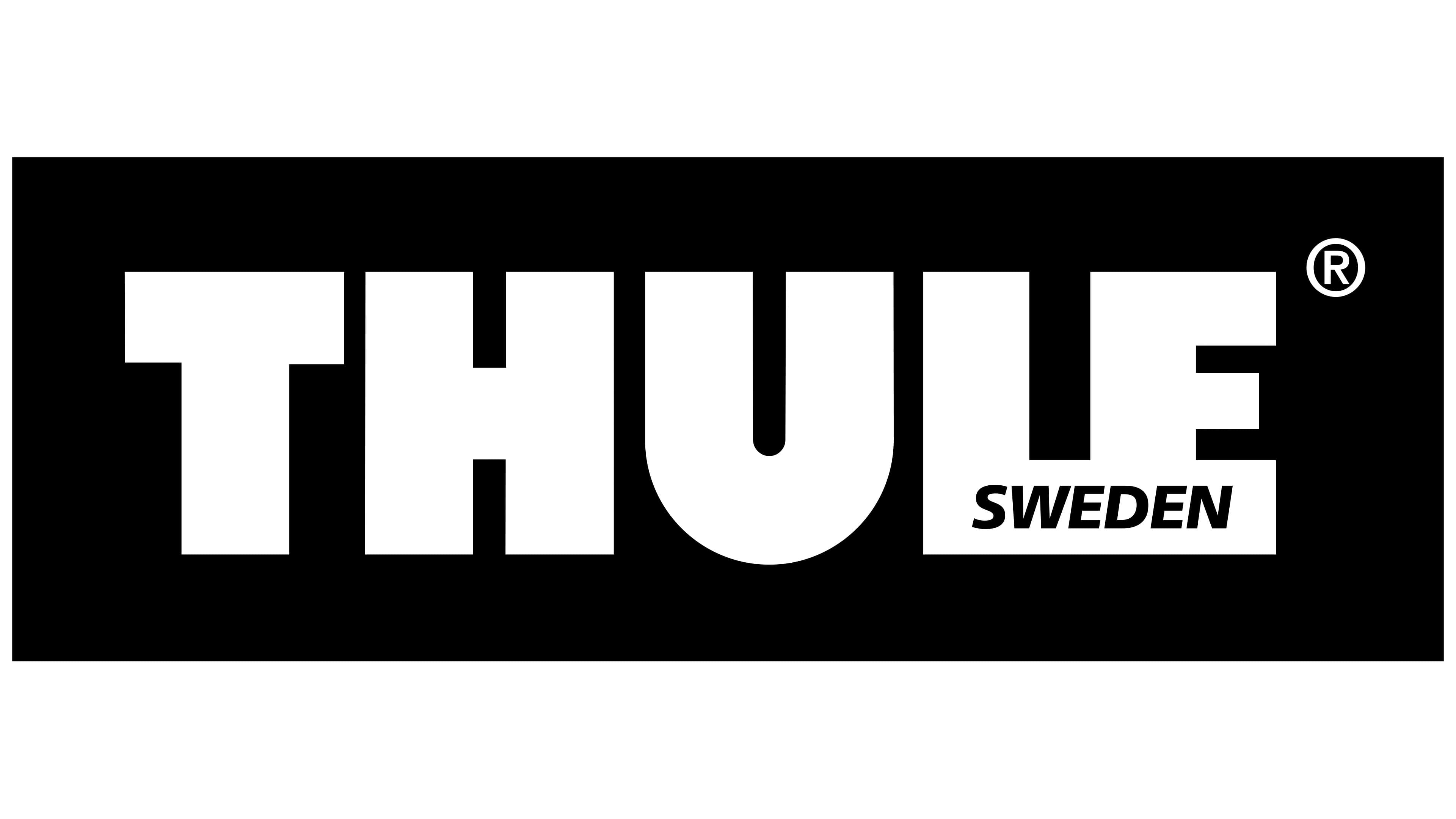
The Thule logo features a white wordmark placed on a black rectangular background. The brand name is written in bold, sans-serif typeface with uniform line thickness. The letter style is minimalist and strict, with no decorative elements.
The main feature of the logo is the connection between the last two letters of the name: a horizontal line links the lower parts of the “L” and “E,” forming a unified shape. This connection resembles a handshake, emphasizing unity and mutual support.
A small italicized inscription, “SWEDEN,” appears on the bridge between the “L” and “E.” Unlike the white main wordmark, the word “SWEDEN” is rendered in black, giving it a restrained appearance that subtly conveys the company’s origin.
The color scheme consists of only black and white, creating a strong, memorable contrast. This choice evokes associations with classic black-and-white films: simple yet expressive.
The typeface does not attempt to mimic Scandinavian motifs, runes, or national symbols; instead, it uses a traditional style that emphasizes the universality and reliability of the company’s products. The horizontal line connecting the letters visually conveys the strength and durability of Thule’s bags, backpacks, and automotive carriers.
The logo’s integrity and the subtle reference to Sweden create the image of a company that knows how to produce high-quality, durable products without drawing unnecessary attention to its origins.