


 Ticketmaster Logo PNG
The Ticketmaster logo is associated with small pieces of paper. This is a prototype of the tickets that users buy on the platform. The emblem demonstrates advanced online technologies that provide convenience and ease of use.
Ticketmaster began in Phoenix on October 2, 1976, when box-office specialist Albert Leffler, programmer Peter Gadwa, and entrepreneur Gordon Gunn III registered the company. Its first model was not direct ticket sales, but software and terminals for venues, with royalties from each ticket sold through the system.
In 1977, Ticketmaster handled its first concert, Electric Light Orchestra at the University of New Mexico. A year later, it signed an international deal in Oslo and a sports contract with the NBA’s New Orleans Jazz.
The turning point came in 1982, when the Pritzker family, owners of Hyatt Hotels, bought Ticketmaster for about $4 million and brought in Fred Rosen as CEO. He moved the company to Los Angeles and shifted from equipment sales to exclusive service contracts with venues.
Ticketron remained the main rival until Rosen bought it in 1990-1991 for about $265 million. Ticketmaster then controlled around 90% of computerized ticketing in North America. In 1993, Microsoft co-founder Paul Allen bought 80% of the company for $80 million. Ticketmaster.com launched in 1995, the first electronic ticket was sold in 1996, and the company was listed on Nasdaq that same year.
Pearl Jam challenged Ticketmaster in 1993 over service fees and exclusivity. The Justice Department investigated, but closed the case in 1995 without charges.
In 2010, Ticketmaster merged with Live Nation to form Live Nation Entertainment, despite criticism from Bruce Springsteen and others. In 2019, Canadian regulators fined Ticketmaster over pricing practices. In May 2024, the U.S. Justice Department and 29 states sued Live Nation Entertainment, seeking to break up Ticketmaster from its concert promotion business.
Meaning and History
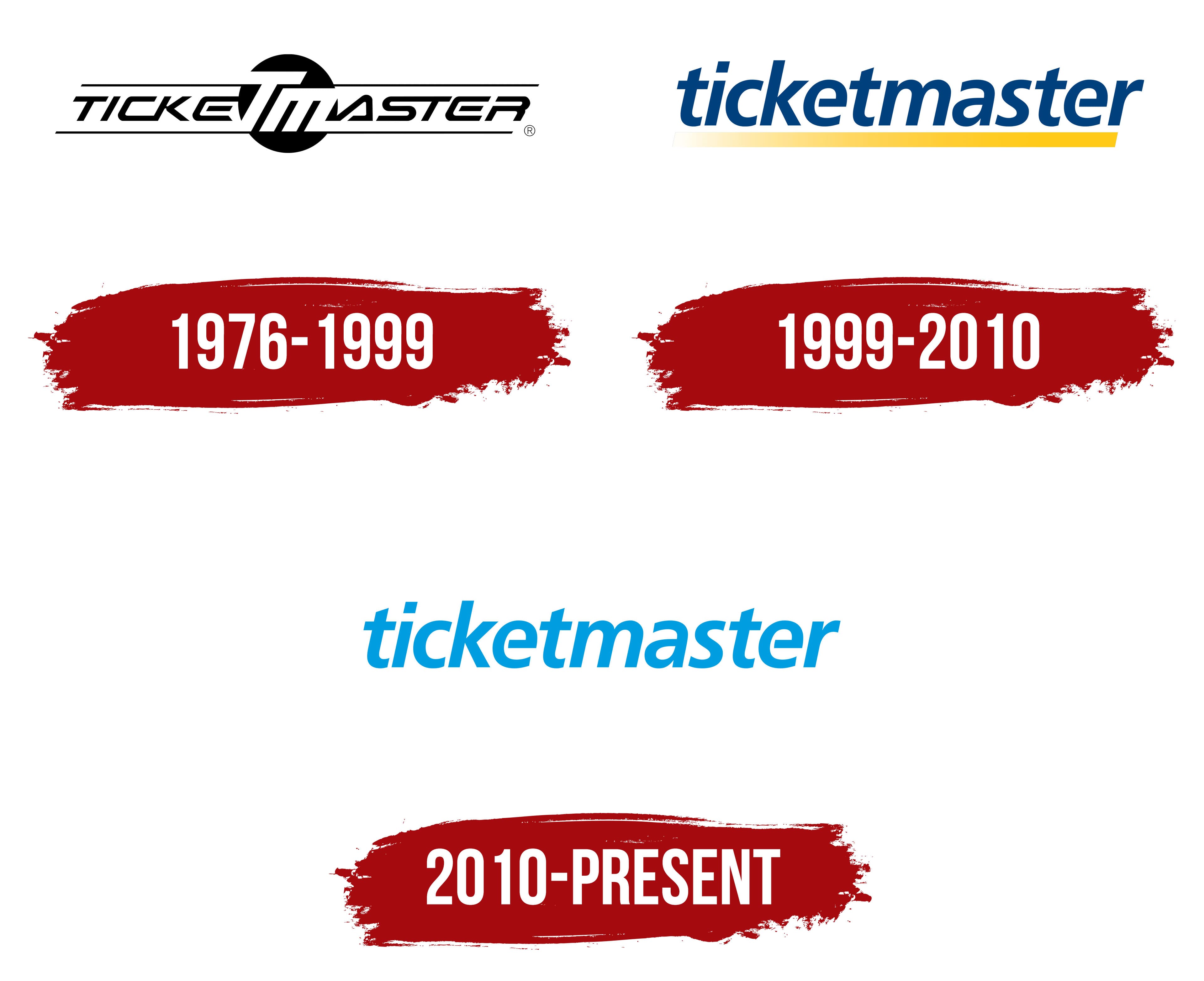
The company was founded in 1976 and, until 1982, specialized in selling equipment for ticket machines. Then it began distributing tickets, opened a travel agency, and acquired a platform where fans could buy souvenirs. Whatever it did, the organization always used a logo with its name. Over time, it has changed: at first, it was a black-and-white inscription with additional decorative elements, and now it uses a colored, minimalist wordmark.
What is Ticketmaster?
Ticketmaster sells electronic and paper tickets for various events. This company is part of Live Nation Entertainment and is based in the USA but provides services worldwide. It has operated in the entertainment industry since 1976, popularizing theater performances, concerts, musicals, sports events, and more.
1976 – 1999

The early Ticketmaster logo contained the company’s name in two typefaces. “TICKE” and “ASTER” were written in black italics with unusual styling. The letters “CK” were connected at the bottom with an elongated line, and “ST” were merged at the top. The “A” looked like a triangle, the middle “E” stroke hung in the air, and a portion of the vertical line was missing in the upper-left corner of the “R.”
The TMs in the center were large and white. From them, two black lines extended to outline a line. The designers have drawn a dark circle behind the “T” and “M” to make these letters distinct.
1999 – 2010

In 1998, USA Networks acquired a controlling stake in Ticketmaster, and a year later, the brand adopted a new logo. It kept the same inscription but in a different design. The developers removed the old graphic elements, including the circle, and set all the letters to italic, lowercase, and dark blue. Instead of a thin black line, a wide yellow stripe appeared at the bottom, indistinct on the left side.
2010 – today

The wordmark’s creators felt it was not minimal enough, so they removed the stripe, leaving only the company’s name. To compensate for the lack of light shades, the designers repainted the word in aquamarine.
Font and Colors

The stylized “ticketmaster” lettering is not just a registered trademark. A logo is an integral part of a brand, an important expression of identity. It has an animated version that focuses attention on the first “t,” and only then do the other letters appear. Such dynamism is evident in the entertainment industry, as Ticketmaster sells tickets to exciting, long-awaited events.
The company has its own official font, TM Sans. It features minimal stroke contrast, open apertures, and geometric roundness. Still, the logo uses a completely different typeface, similar to the modified Usual Medium Italic. The tops of both ts are angled like in Artica Bold Italic. The horizontal strokes of the letter “e” do not even reach the baseline.

Ticketmaster has always leaned toward blues, and it continued this tradition with an azure hue. This rich tone is central to the brand’s visual identity. It symbolizes wisdom, loyalty, and energy; therefore, it perfectly complements the lettering design.