


 TJ Maxx Logo PNG
The TJ Maxx logo is designed to be striking and attract customers’ attention. It is used as signage above store entrances. It’s a universal symbol that characterizes the company as ambitious, creative, and resourceful in retail.
TJ Maxx grew out of Zayre Corp., a discount retailer based in Framingham, Massachusetts, following its failed attempt to buy Marshalls in the 1970s. In 1976, Zayre hired Bernard “Ben” Cammarata, Marshalls’ former head of buying, to build a rival chain from the ground up. The extra “x” was added because similar TJ’s names already existed in some markets.
On May 19, 1977, the first two T.J. Maxx stores opened in Auburn and Worcester, Massachusetts. A third followed four days later in Charlotte, North Carolina. The format relied on opportunistic buying, including excess stock, factory leftovers, canceled orders, and unsold seasonal goods. During the inflationary late 1970s, the model gave shoppers access to branded merchandise at lower prices than traditional department stores.
While Zayre’s main business weakened, T.J. Maxx remained profitable. In June 1987, Zayre spun off T.J. Maxx, Hit or Miss, and Chadwick’s of Boston as TJX Companies, led by Cammarata. In 1988 and 1989, the struggling Zayre chain was sold to Ames Department Stores, while the remaining company took the name The TJX Companies, Inc.
Expansion continued through the 1990s. Winners Apparel was acquired in Canada in 1990, HomeGoods launched in 1992, and T.K. Maxx entered the United Kingdom in 1994 under a changed name to avoid confusion with an existing British retailer. In 1995, the company acquired Marshalls, its original rival. HomeSense launched in Canada in 2001. In 2008, the company faced a major payment card data breach, yet the off-price format retained its customer base.
Meaning and History
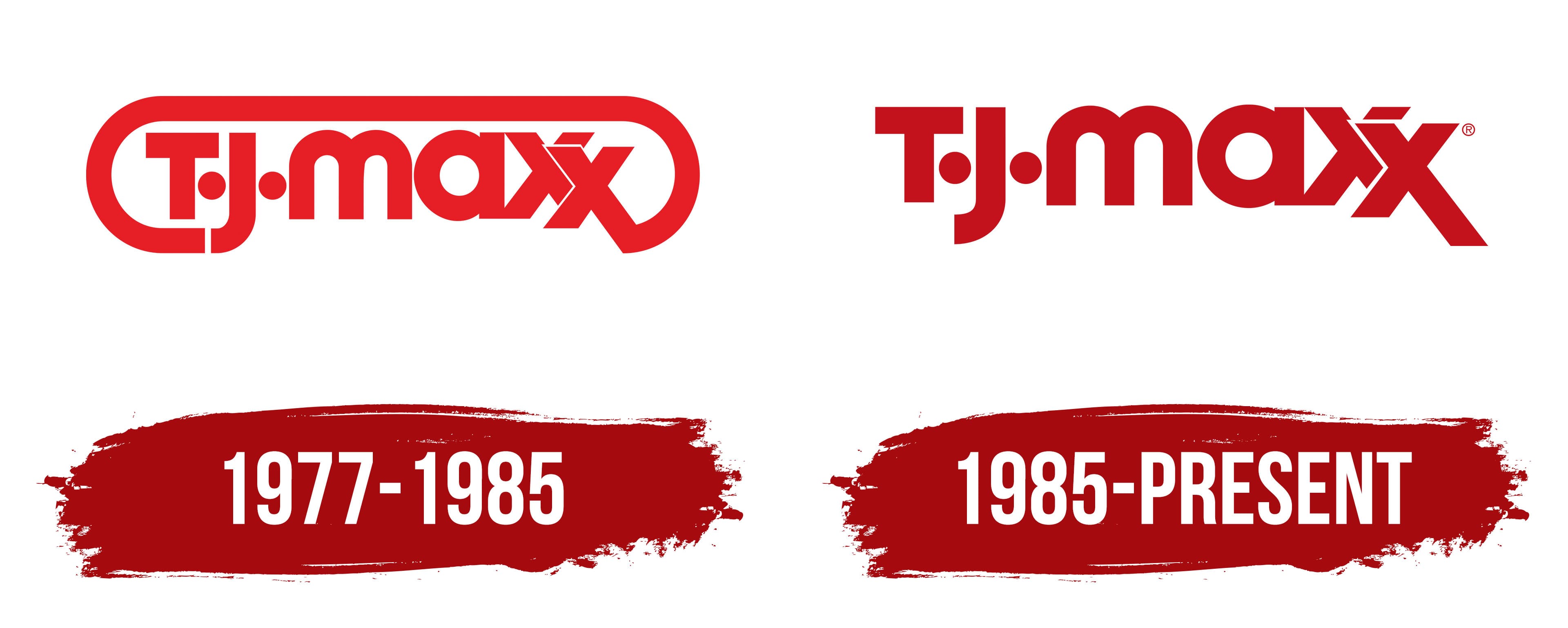
Being a part of TJX, TJ Maxx inherits its style. Hence, the brand’s logo is as dark red as the parent company’s and contains an inscription. This version was introduced in 1985, replacing a similar wordmark that was brighter and adorned with a long curving stripe. Designers emphasized the double “X” to highlight the store chain’s uniqueness. For the same reason, they depicted two small circles to the right and left of the “J.” These stylized dots should be placed after the letters “T” and “J.”
What is TJ Maxx?
TJ Maxx is a department store chain owned by TJX Companies. It was launched in the U.S. in 1976 and has since expanded to over 1,200 locations, making it one of the largest in the country. In Europe and Australia, it’s known as TK Maxx. The stores offer a variety of products at discounted prices, including dishes, furniture, cosmetics, toys, and clothing.
1977 – 1985
The logo features a red inscription, “TJ Maxx,” with the first two letters uppercase and the rest lowercase. Despite the differences in the cases, the size of the glyphs is consistent. From the bottom of the “J” to the lower-right corner of the final “X,” a stripe extends across the top, forming an incomplete frame for the emblem. To ensure the stripe began at the same level on both sides, designers had to lower the “X.” For visual balance, it overlaps the preceding letter. Flanking the “J” are bold dots reminiscent of eyes, making the glyph look like a quirky hooked nose.
1985 – today
After the redesign, the decorative stripe was removed, but the letters’ positioning remained unchanged. The brand’s management kept both “X”s connected, one in line and the other slightly below, creating an elongated diagonal. This memorable detail makes the TJ Maxx logo instantly recognizable. The same goes for the signature dark red color.
Font and Colors
The inscription font is reminiscent of Gordon Regular, designed by Francis X Mahoney. It features both straight strokes and rounded edges. However, the emblem’s creators modified the “x” letters to align with the department store chain’s concept.
The color scheme traditionally incorporates dark red and white. One is used for the text, and the other for the background, and they can be alternated.