


 Tumblr Logo PNG
The Tumblr logo looks as if it came straight off the pages of a newspaper. The emblem attracts masters of words who can articulate thoughts clearly and tastefully. The blog service aims to offer a space; what goes on these pages is up to the writer.
Tumblr started in a New York apartment where David Karp lived with his mother. Raised on the Upper West Side, he learned HTML at 11, left school at 15 for an internship at Frederator, and by 20 ran Davidville with Marco Arment.
In 2006, Karp discovered early Tumblr blogs and focused on short mixed posts. He aimed to build a platform unlike Facebook and YouTube. Tumblr launched on February 19, 2007, and gained 75,000 users in two weeks.
The service used seven post types and one-click publishing. Reblogs spread content, themes could be customized, and anonymity shaped communities of artists, writers, and fan groups.
In October 2007, Karp closed Davidville to focus on Tumblr. Funding followed: $750,000 from Spark Capital and Union Square Ventures, then $4.5M in 2008, $5M in 2010, and $30M in Series D. By 2011, the valuation reached $800M with over 30M blogs. Arment left in 2010 to build Instapaper.
Revenue lagged. The first ad deal with Adidas appeared in May 2012. That year brought in $13M in revenue against $25M in costs. By 2013, Tumblr hosted 87M blogs and ranked 11th by traffic.
On May 20, 2013, Yahoo acquired Tumblr for $1.1B. Marissa Mayer kept Karp as CEO, but integration into Yahoo’s ad system caused friction. In 2017, Verizon bought Yahoo, moved Tumblr under Oath, and Karp resigned.
In December 2018, Tumblr banned adult content, effective December 17. Traffic fell by about a third over the next three months. In August 2019, Verizon sold Tumblr to Automattic, owner of WordPress.com, for under $3M.
Meaning and History
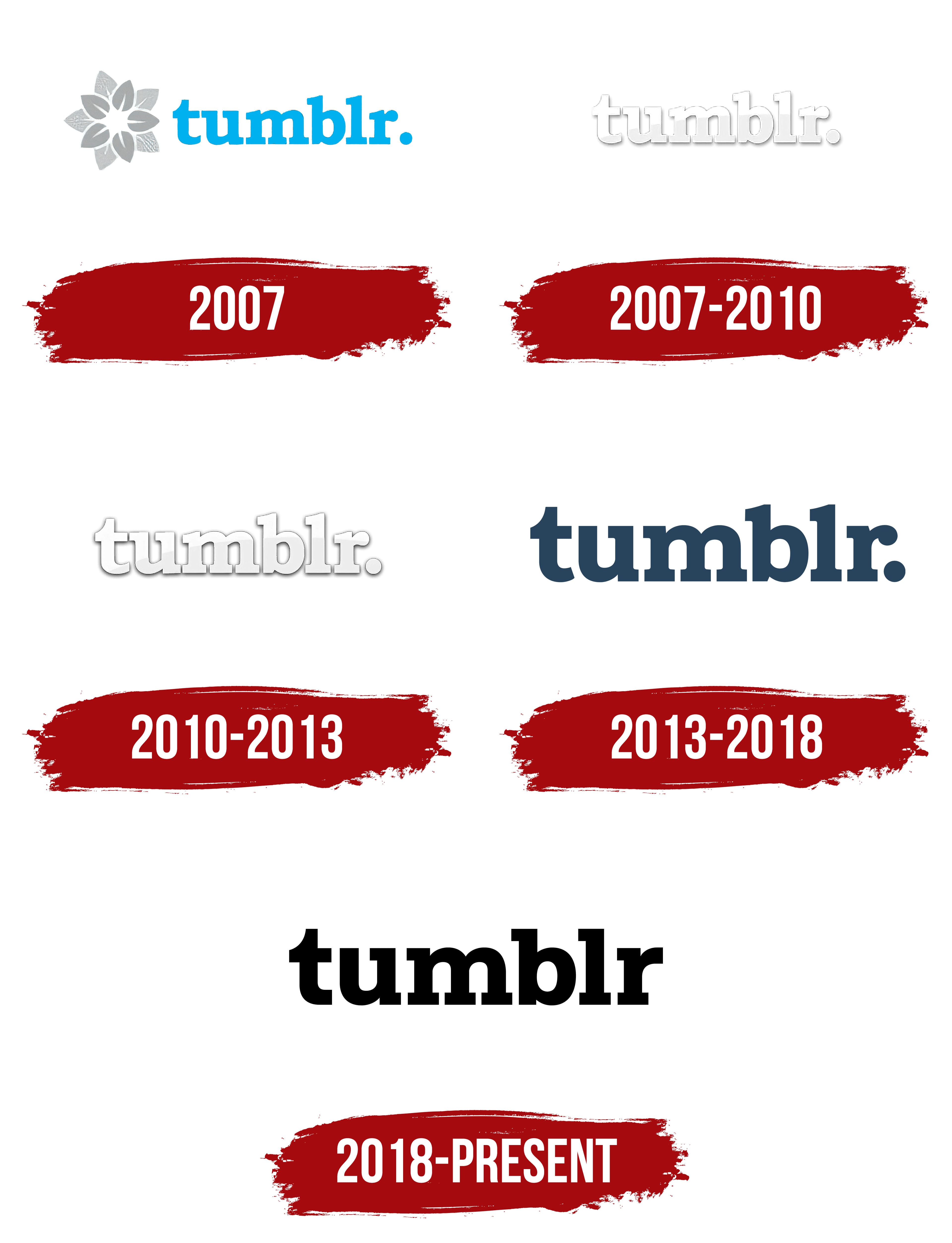
The social network’s original logo appeared in 2007, the year it launched. It consisted of two elements: a graphic (a flower) and text (the name). In this form (except for color), the logo remained until mid-2013, when Yahoo acquired the microblogging platform and left it unchanged.
The changes were so minor that people saw them as an adjustment rather than a redesign. The new owner entrusted the logo redesign to its design team. They made interesting changes: the word seems to remain the same, but if you look at each letter separately, the changes are noticeable.
Thus, the symbols became wider, so the name took up more space on the logo. The most radical transformation occurred with the letter “u”; its left serif was removed. It, along with “m,” received smooth, streamlined bends. As a result, the logo became more visually appealing. Over the years, the logo has undergone four changes.
What is Tumblr?
It is an American social network that functions as a personal microblog, where users publish articles, videos, GIFs, photos, etc. After subscribing to other users, their content appears in your feed.
2007 – 2010


The debut version featured a flower with 10 petals and an inscription bearing the social network’s name. Initially, it was blue, but then it became gray, combining light and dark. The gradient transition is uneven: “t” is whiter, while “r” is ashy. This technique creates the impression of sunlight’s close presence, as if rays pass through the window and unevenly illuminate the word “Tumblr.” By the way, it is written in lowercase and ends with a large dot.
2010 – 2013

The play of shadows and sun remained in the name, but it took on a lighter, muted tone, as if it became pastel and less bright. No other changes followed.
2013 – 2018

In 2013, Yahoo! acquired the blogging platform and decided not to change the logo significantly. The main reason was that it had already become familiar and traditionally associated with the social network, so changes could lead to a sharp outflow of users.
The developers changed the logo’s color to blue and added a couple of proprietary icons. They represent a modern resource on the Internet, advertising, and digital media. This was the initial letter “t,” played in dark blue and white: dark on light (2015-2016) and light on dark (2016-2018). In the first case, shadows appear on the letter, giving it a 3D effect.
2018 – today
In the modern version, the serifs of the “b” and “l” align, and the upper-right part of the “r” is cut off. The dot at the end of the word disappeared, and the word itself became black. The icons have been redesigned and adapted for iOS and Android. All of them contain one letter “t”:
- Dark on a light background
- Light on a square with rounded corners
- Light in a circle
Font and Colors

Initially, next to Tumblr was a ten-petaled flower. They borrowed it from the Davidville project. However, when the company designed v3, it removed it to shorten the brand name. Now, the Tumblr logo only has an inscription that repeats the original version.

The logo’s text is based on a very old font that appeared in 1860. It is called Bookman Old Style and was created by Alexander Phemister for the Miller & Richard foundry. This variety is reminiscent of the Caslon font, but differs in its even, regular structure. The emblem’s colors are white, blue, and gray.
FAQ
Why Did Tumblr Change Its Logo?
Tumblr changed its logo in 2018 as part of an update after Automattic purchased the service. Its new design is the strictest of all: the dot was removed from the emblem, and the name was repainted in black.
How to Register on Tumblr?
Open the site, click the “Register” button, and enter your email and password. Then, specify the desired nickname. If it is already in use, choose another name from the list. After filling in all the fields, click on the “Register” button again.
Why is the Tumblr Logo Black?
The logo uses black to emphasize the service’s simplicity and seriousness, as it unites people in large communities by interests and allows creative self-expression.
How to Log in to Tumblr?
To do this, open the site, click the “Login” link, enter your email address and password, then click the “Login” button again.