


 Ubisoft Logo PNG
In the company’s history, the Ubisoft logo changed quite often until it became a whirlwind. Now it’s a black-and-white spiral with a minimalist, monochrome look that fits flat-design traditions. It symbolizes curiosity, enthusiasm, and madness, of course, in a good way.
Ubisoft traces its roots to the Guillemot family business in Brittany, where five brothers, Christian, Claude, Gérard, Michel, and Yves, worked in sales, distribution, accounting, and management. In 1984, they founded Guillemot Informatique, a mail-order software company. A year later, Guillemot Corporation was founded to trade in computer hardware.
On March 28, 1986, Ubi Soft Entertainment S.A. was registered in Carentoir. The name came from “ubiquitous,” reflecting the company’s international ambitions. The company opened its first office in Paris and, in June 1986, moved to Créteil. The family developed early games at their château in Brittany, where they recruited young creators, including 17-year-old animator Michel Ancel.
Ubisoft released its first internally developed game, Zombi for Amstrad CPC, in 1989. In 1994, Ancel created Rayman, and in 1995, the platformer Rayman launched on PlayStation. By 1997, it had sold 900,000 copies worldwide and topped UK PlayStation sales. In 1996, Ubisoft went public on the Paris Stock Exchange, raising about $80 million for expansion.
The company opened studios in Shanghai and Montreal, with Ubisoft Montreal starting on April 25, 1997. In 2000, Ubisoft bought Red Storm Entertainment, gaining access to the Tom Clancy brand and later developing Rainbow Six, Ghost Recon, and Splinter Cell. In 2003, Ubi Soft became Ubisoft and released Prince of Persia: The Sands of Time. Electronic Arts bought almost 20% of Ubisoft in 2004, then sold its stake in 2010. Vivendi’s 2015 takeover attempt ended in 2018 with support from Tencent and the Ontario Teachers’ Pension Plan.
Meaning and History

The Guillemot family named the company Ubi Soft, taking the first three letters from the word “ubiquity.” The term refers to the ability to be everywhere at once, which accurately describes a game developer that has succeeded not only in France but worldwide. What is the adventure platformer Rayman Legends, famous in Japan and the USA? So all attempts by fans to associate the Ubisoft name with the Union of Independent Bretons were unsuccessful.
The company logo has long been bright and colorful, but in 2017, everything changed. The spiral, previously a blue gradient, was stripped of color and turned black and white. This sharp transition to flat design coincided with minimalism’s rise as a trend. It didn’t become popular until top tech companies adopted it: first Microsoft with Windows Mobile, then Apple with iOS. The monochrome Ubisoft logo looks elegant, and its negative space makes it stand out.
What is Ubisoft?
Ubisoft Entertainment SA develops iconic video games such as Rayman, Prince of Persia, Far Cry, and Assassin’s Creed. This French company was founded in 1986 as Ubi Soft Entertainment SA. It changed its name in 2003 as part of a global rebrand.
1986 – 1989

The first logo of a video game developer impressed with its retro style. The letters “U,” “B,” and “I” were large and pink, with wide blue edges. To dilute the bright color scheme, the designers made the word “Soft” white and outlined it with a thin black line. It sat diagonally opposite the “I.” The first part of the name used a large, three-dimensional sans-serif font, and the second part was handwritten with elongated horizontal strokes. The cartoonish inscription suggested Ubisoft specialized in entertainment.
1989 – 1993

In 1989, the logo’s relaxed style gave way to a conservative, strict design. The developers placed the phrase “UBI SOFT” at the top in ITC Lubalin Graph bold, and at the bottom, in the same font but in italics, they wrote “Entertainment Software.” The text was black and center-aligned.
1993 – 1994

During this period, the company was represented by an emblem of many geometric shapes. The basis was a red square with a black inscription “SOFT.” It was executed in a vertically elongated serif font. The upper half featured two small squares (green and blue), with a yellow rhombus between them. These three figures had lowercase but large “u”, “b”, and “i” in black.
1994 – 2003

When the company released the game Rayman, it marked the occasion by updating its identity. So the name “Ubi Soft” returned to the same line. It was black, so the pale green ENTERTAINMENT at the bottom was lost against it. On top was a thin arch with an iridescent gradient.
2003 – 2017
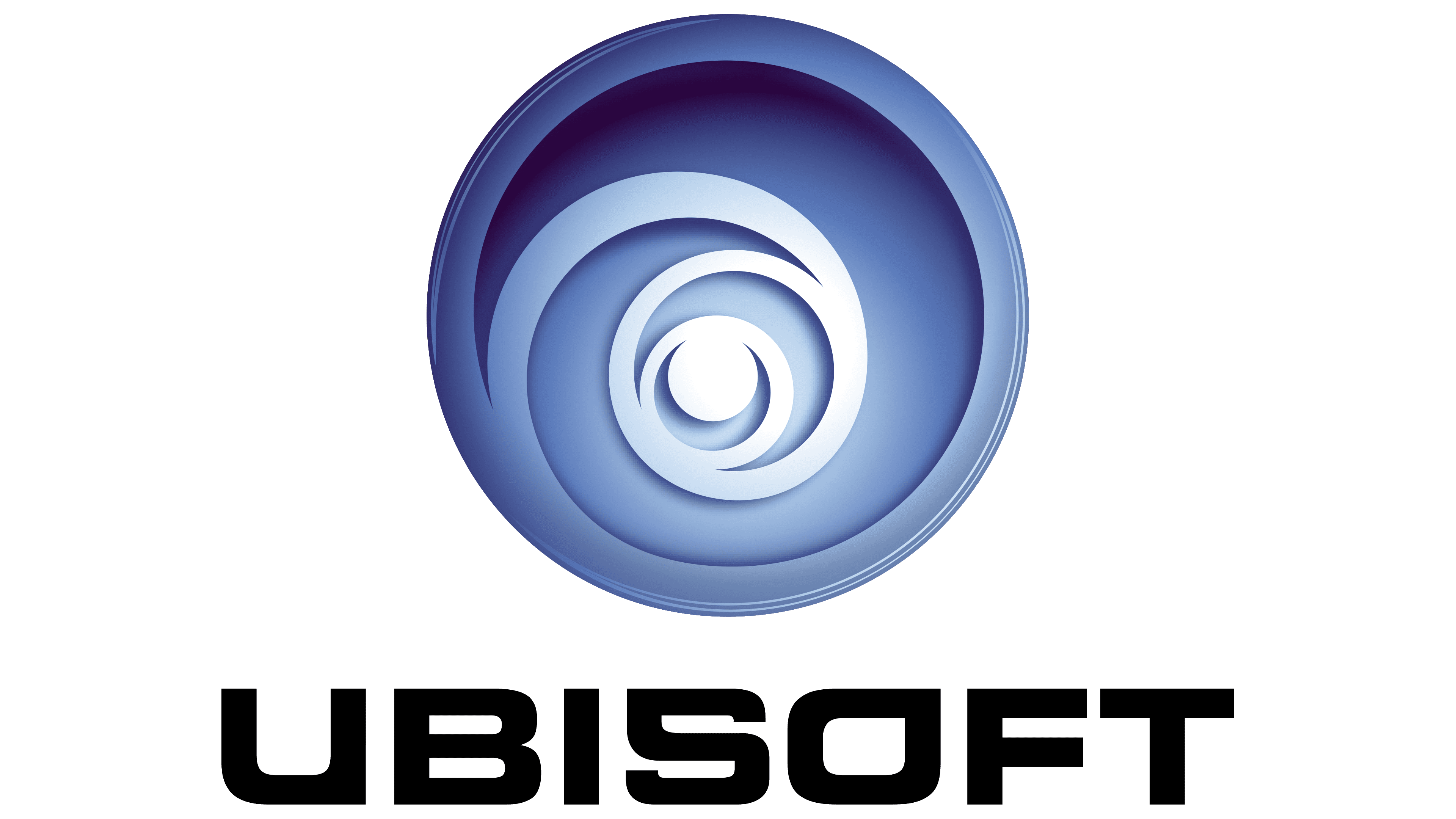
In 2003, the company became known as Ubisoft, with no space between the two parts. At the same time, the blue-violet whirlwind logo appeared, delighting gamers as it began to rotate in game intros. It was a futuristic design for its time. The emblem’s designers used a gradient that darkened the upper coils and brightened the center. The spiral pattern added depth, making the image appear three-dimensional. The company’s name was written at the bottom in a modified Microgramma Bold font, which is characterized by letters with unusually sharp corners.
2017 – today

In 2017, the purple swirl turned black and white, and the familiar gradient was replaced with a flat design. The publisher explained that the new logo aligns with the latest trends driving many global brands toward monochrome and minimalism. At the same time, the letter “O” and the swirl at its center are intentionally uneven so they look hand-drawn, without computer graphics. The company wanted to show that everything human is part of it: curiosity, enthusiasm, and “grain de folie,” that is, “a touch of madness.”
Font and Colors
The Ubisoft symbol may have been simplified to display better across different media. But its shape hasn’t changed much: a uniformly balanced vortex with a shifted center that violates the golden-ratio principle. So the designers expressed disdain for the spirals’ perfect symmetry.
The logo uses the so-called Ubisoft Sans, created by Colophon Foundry specifically for the French video game developer. It looks like a modified Gilroy Extra Bold. The black sans-serif letters look simple, except for the “O,” which resembles a round chain link and follows the shape of the hand-drawn logo’s central element.
The color scheme is also very simple. Designers turned to traditional black-and-white monochrome to create a flat image that matches the trendy minimalism. In this case, the vortex’s inscription and contours are black, and the background and gaps are white.